Faster than a waltz and designed to get the dancers really moving, the Galop moved in the 1820s from country dances to sophisticated Paris society. It was the predecessor to the next fast item to hit the dancefloor, the polka.
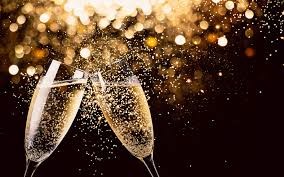
A Toast to Champagne!
In looking for music to accompany a lovely glass of champagne, we needn’t look any further than the Danish composer and conductor Hans Christian Lumbye’s Champagnegalop, Op. 14. Written for the Copenhagen pleasure garden Tivoli, it was intended to make its debut on Tivoli’s 2nd birthday, on 15 August 1845. Rain, however, forced a delay to 22 August, and it was a great hit. The question, of course, is how to make the champagne ‘pop’ sound – real bottles or a percussion instrument in substitution?
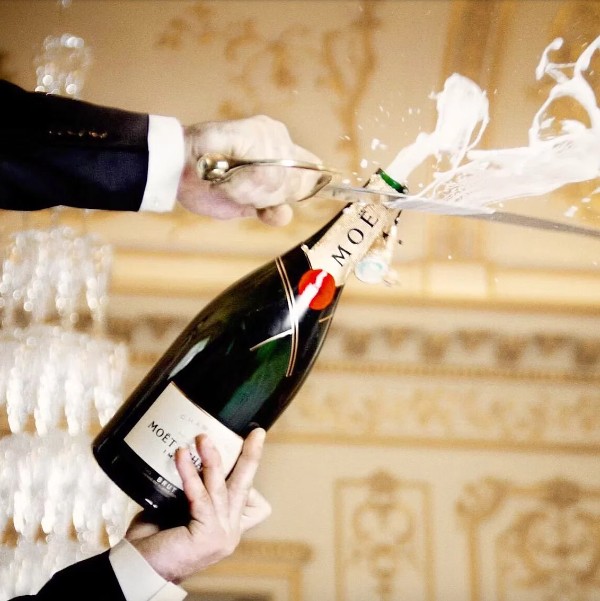
Sabering a bottle of Moët
Hans Christian Lumbye: Champagnegalop, Op. 14 (Concerto Copenhagen; Lars Ulrik Mortensen, cond.)
Johann Strauss I brought in his own Champagne Waltz two decades earlier, and, as a waltz and not a gallop, it’s a more sedate dance. That doesn’t keep it from having the occasional pop!
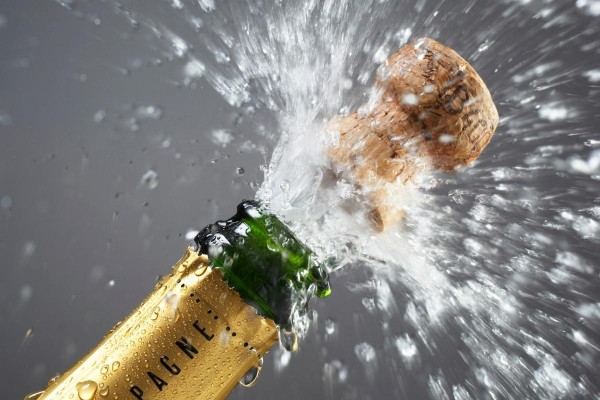
Pop!
Johann Strauss I: Champagner Walzer (Champagne Waltz), Op. 14 (Concerto Copenhagen; Lars Ulrik Mortensen, cond.)
Isaac Albéniz created his own champagne waltz in 1887, but it shows an influence more related to Chopin than dancing. It is probably best for dancing by oneself, in an empty ballroom, with one’s champagne glass as your dancing partner.
Isaac Albéniz: Cotillon: No. 1. Champagne (Santiago López Sacristán, piano)
With his own orchestra, H.C. Lumbye continued to create champagne-based music. After the success of his 1845 Champagnegalop, he was inspired to create another one when he and his orchestra were touring in St Petersburg. In his suite, Memories of St Petersburg, he included his new Petersburg Champagne Gallop.
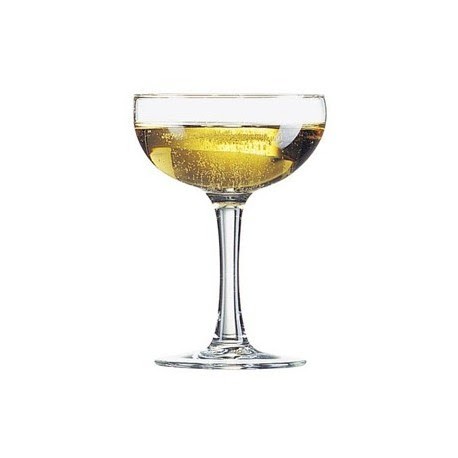
Old-fashioned style champagne glass
Hans Christian Lumbye: Petersborg Champagne Galop (Tivoli Symphony Orchestra; David Riddell, cond.)
And it’s all about the bubbles – what may not be widely known is that a super-clean and brand-new champagne glass won’t give you the bubbles you expect – there has to be a place for them to start, called a ‘nucleation point’. There should be a tiny imperfection at the bottom of the bowl so that the bubbles have somewhere to start! A single glass of champagne can have over 20,000 bubbles (don’t you love what scientists measure?), and that’s why we call it bubbly!
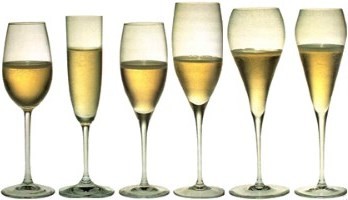
A Variety of Champagne glass styles
However much the 19th century trained everyone to dance to champagne, it was the 18th century that taught us to sing about it.
Don Giovanni kicks off his party with his Champagne Aria. He calls for the rule of Folly, everyone dancing to a different dance, and where all is madness and all is gladness. And no one says No!
Wolfgang Amadeus Mozart: Don Giovanni, K. 527 (excerpts) – Act I: Aria: Fin ch’han dal vino (Don Giovanni) (Samuel Ramey, bass; Berlin Philharmonic Orchestra; Herbert von Karajan, cond.)
One of the most brilliant of these opera wine songs is in Verdi’s La Traviata, where, early in Act I, the high-living Alfredo leads everyone in a drinking song called a brindisi. Although this means ‘a toast’ in Italian, it is thought to come from a German phrase that preceded a toast: (ich) bringe dir’s meaning ‘(I) offer it to you’
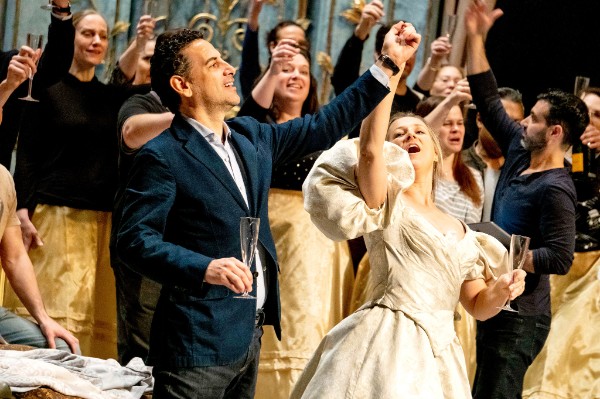
La Traviata: Brindisi scene, 2018 (Diana Damrau, Juan Diego Flórez, Metropolitan Opera)
Giuseppe Verdi: La traviata (excerpts) – Act I: Libiamo, ne’ lieti calci, “Brindisi” (Drinking Song) (Alfredo, Chorus, Violetta) (Yordy Ramiro, tenor; Monika Krause, soprano; Slovak Philharmonic Chorus; Slovak Radio Symphony Orchestra; Alexander Rahbari, cond.)
La Traviata: “Libiamo, ne’ lieti calici”
Although not citing champagne by name (we’re in the heart of Italy, after all!), Turiddu calls for bubbling wine. He describes it as ‘foaming whitely’ and praises it for driving away bad humours and bringing ecstatic happiness! Ahhhhh!
Pietro Mascagni: Cavalleria rusticana – Viva il vino spumeggiante, “Brindisi” (Turiddu, Chorus, Lola) (Plácido Domingo, tenor; Ruth Falcon, soprano; Bavarian State Opera Chorus; Bavarian State Orchestra; Nello Santi, cond.)
America didn’t have its own version of champagne until California started wine production, but, true to its sense of fun, champagne was produced starting in the 1860s. As a side note, we’re all familiar with France’s highly protective regard for the word ‘Champagne’ – if it wasn’t produced in France in the Champagne region, it’s just sparkling wine! There’s a very complicated argument based on the Madrid Agreement of 1891 about the copyright of the champagne name (unfortunately, the US was not a signatory to that) and another ruling in 2005 that if you were outside France and you’d called your product ‘champagne’ before 10 March 2006, you could continue to call it champagne. Whatever. Here’s Eubie Blake’s piece called Fizz Water – you can decide if it’s bubbly or just a soda!
Eubie Blake: Fizz Water (arr. for band) (Avatar Brass Quintet, Ensemble)
Champagne is for celebration; it is for lifting life out of the normal track and sending it skyward. Raising a glass can raise your spirits and send your feet around the dancefloor. All Praise Champagne!
For more of the best in classical music, sign up for our E-Newsletter