Under the brilliant early summer sun, Lüneburg gleams in a striking palette of blue skies, waterways, and Gothic brick architecture, providing an idyllic backdrop for the final chapters of Pygmalion’s ambitious project, Die Wege Bachs. In a profound gesture of communal art, the audience became pilgrims, embarking on a three-kilometre trek from St. Michaelis Church—where Bach once sang as a boy— to Kloster Lüne.
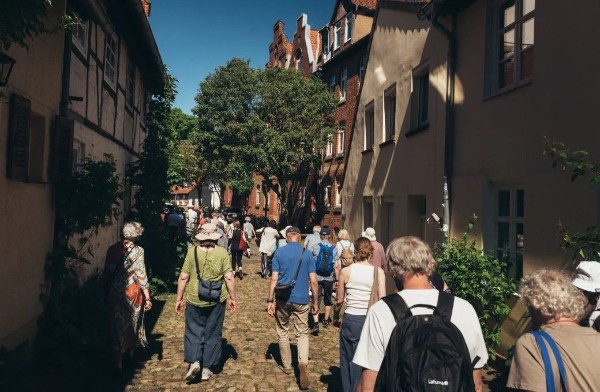
Pygmalion at Kloster Lüne (Photo: Fred Mortagne)
This walk offered a physical meditation on the legendary historical journey of a twenty-year-old Bach, who trudged hundreds of kilometres in pursuit of musical mastery. Inside the chapel, eyes are immediately drawn to a white Gothic rib-vaulted ceiling, amplifying natural light from tall windows. A gilded triptych altarpiece stands centred on a warm brick floor, while an elaborate Baroque organ loft and carved pulpit contrast elegantly with rows of pale grey pews. What followed inside this resonant sanctuary was a concert defined by an astonishing sense of vividness, theatricality, and raw emotional immersion.
A short introductory video talking about “in search of Bach” project (in French)
Pygmalion sur les Chemins de Bach – Perrine Devillers
The journey began in the sobering depths of Johann Sebastian Bach’s Cantata BWV 12, Weinen, Klagen, Sorgen, Zagen. The opening chorus was handled with tension and breath control. Pichon’s slow, meticulous buildup was precise, carving out the movement’s chromatic character with agonising beauty. In the first aria, Lucile Richardot’s rounded voice emerged through the winding, tortuous accompaniment of the Baroque oboe, utilising fine breath control to articulate a profound grief. She was followed by Romain Bockler, whose silk-textured voice flourished in a high-energy aria. While the third aria suffered from a slightly muffled tone and a minor deficit in breath support, the overall presentation of Bach’s cantata successfully plunged the audience into a deeply moving excavation of theological sorrow.
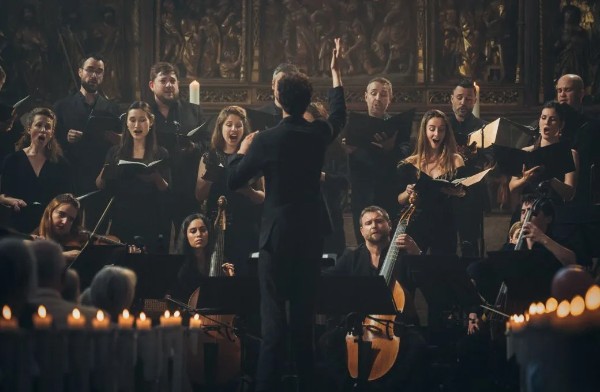
Pygmalion at Kloster Lüne (Photo: Fred Mortagne)
The following performance of Domenico Scarlatti‘s ten-voice Stabat Mater presented a complex, dazzling sonic tapestry rich in high-density figures and sudden emotional shifts. Right from the first verse, Stabat Mater dolorosa, the textures felt alive as the female voices pleaded in their high registers, juxtaposing sudden outbursts of emotion with stark, unaccompanied vocal passages. During the chromatic sections of the Cujus animam gementem, the ensemble captured a nearly archaic quality that looked back to the expressive world of late-Renaissance madrigals.
Later, the Eja Mater, fons amoris bloomed with fascinating echo effects and expansive dynamic contrasts. The music later unfolded with a serene calm, seamlessly weaving sharply contrasting character pieces into the larger structure. The absolute breathtaking pinnacle of the performance arrived with the Inflammatus et accensus. Here, the choir tackled the rapid, florid coloratura of the fugal writing with astonishing agility, with the entire work culminating in a powerful, high-density projection of the concluding Amen chorus.
If Scarlatti’s Stabat Mater looked back—its chromatic density recalling Renaissance polyphony—Handel‘s Dixit Dominus looked forward with the reckless ambition of a composer who had not yet learned what he was not supposed to do. One question is whether the papal ban on opera had any actual control over musical composition and performance in 1707. Instead, what exploded into the hall was the unbridled ambition and sheer audacity of a young, hot-blooded Handel.
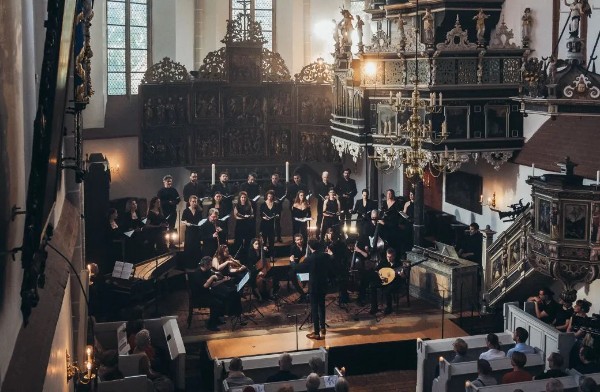
Pygmalion at Kloster Lüne (Photo: Fred Mortagne)
Pygmalion made an orchestrational choice by substituting two violas da gamba for the standard violas, giving the lower string texture an explicitly antique and resonant sheen. The instrumental writing in this early Roman work strongly recalled the style of Arcangelo Corelli—who famously served as Handel’s concertmaster during those years—and Pygmalion maintained a fierce, unwavering tension throughout. The two lead violins were utterly radiant, their lines brilliantly intertwining like threads of fire.
The vocal soloists rose to the immense challenges of the score. In the Virgam virtutis tuae, the mezzo-soprano’s rounded tones intertwined gorgeously with a searching cello line. The Tecum principium cascaded in layers of delicate sonic ripples, offering a much-needed emotional buffer before the aggressive, concertato fury of the Juravit Dominus. Throughout these movements, the orchestra’s strings seemed to impart a luminous glaze onto the singers’ voices, while the rock-solid combination of the basso continuo and chest organ propelled the entire performance forward with unyielding momentum.
The choral onslaught in the Judicabit in nationibus and Conquassabit capita left the ears tingling, characterised by immense vocal ranges stretching from top to bottom and delivered with a fiercely crisp, punchy articulation. Yet, after this fever pitch, Pygmalion offered a moment of breathless intimacy in the De torrente in via bibet. Set against a sparse, whispering string accompaniment, two female voices soared, enveloped softly by the gentle warmth of the surrounding choir. The final Gloria Patri et Filio broke loose at a radical, breakneck tempo, unleashing an unparalleled explosion of raw Baroque energy.
Stepping out into the golden hour, audience members and musicians gathered together under the gorgeous sunset at Kloster Lüne to enjoy a light snack and vibrant conversation. Walking together, listening together, and breaking bread together—it was, in every sense, the perfect day.
For more of the best in classical music, sign up for our E-Newsletter