In the 1830s, Gaetano Donizetti was at the height of his powers. His operas had conquered stages across Italy, and the composer now set his sights on the ultimate prize: conquering Paris.
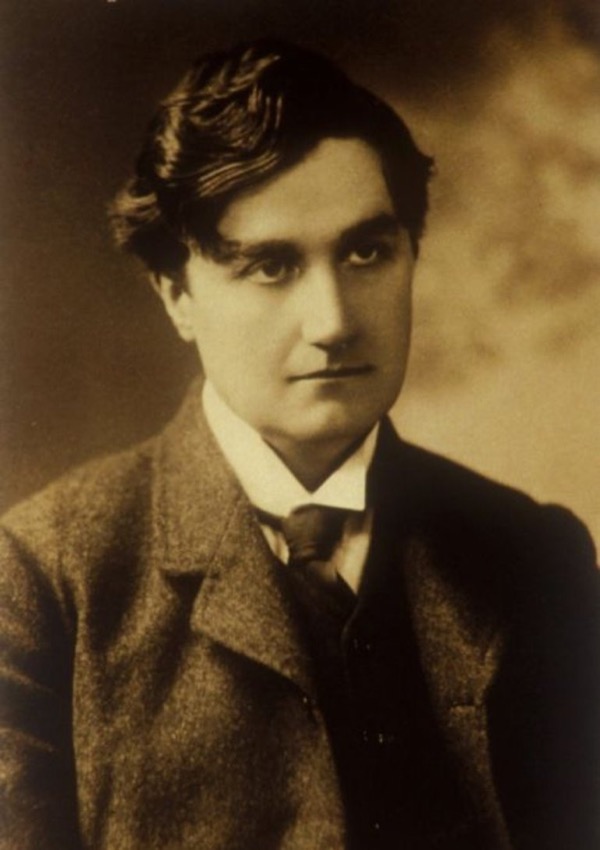
Another Italian, Vincenzo Bellini, had moved to France in 1833, and after observing the musical scene in Paris, he expressed strong opinions about French music and the Parisian musical environment.
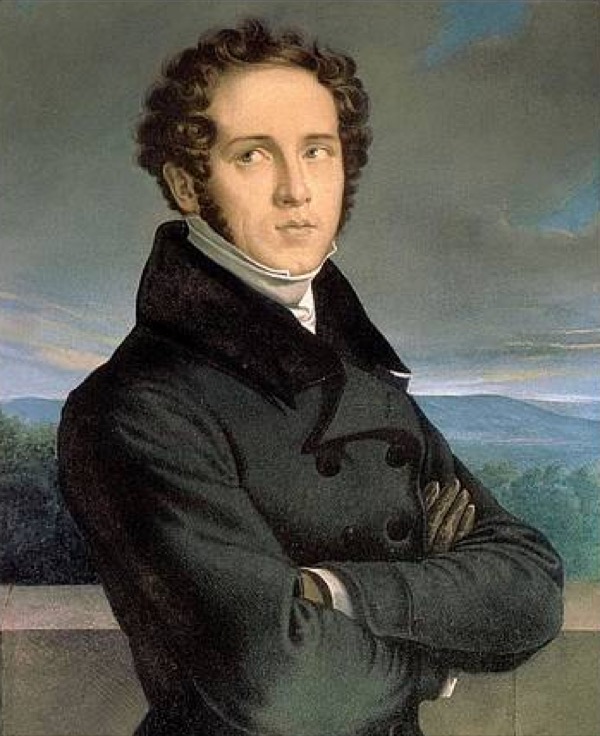
Vincenzo Bellini
Both operated under the enormous shadow of Rossini, who issued dual commissions as acting director of the Théâtre Italien for the 1834–35 season, presenting works by Bellini and Donizetti with essentially the same superstar cast. Donizetti was much in awe of Bellini’s triumph, but Bellini was anxious about the apparent competition.
To commemorate Bellini’s death on 23 September 1835, let’s look at the Parisian encounter between these great masters of Italian opera.
Vincenzo Bellini: I Puritani, “Qui la voce sua soave”
Bellini’s Final Masterpiece
On 24 January 1835, the Théâtre Italien in Paris premiered Vincenzo Bellini’s final opera, I Puritani (The Puritans). Presented just months before Bellini’s untimely death at age 33, the opera tells a love story set during the violent conflict between the Royalists and the Puritans in the English Civil War in the mid-17th century.
That memorable premiere featured the superstar singers of the day, Giulia Grisi, Giovanni Battista Rubini, Antonio Tamburini, and Luigi Lablache, later known as the “Puritani Quartet.” I Puritani became the rage of Paris and soon played on stages worldwide.
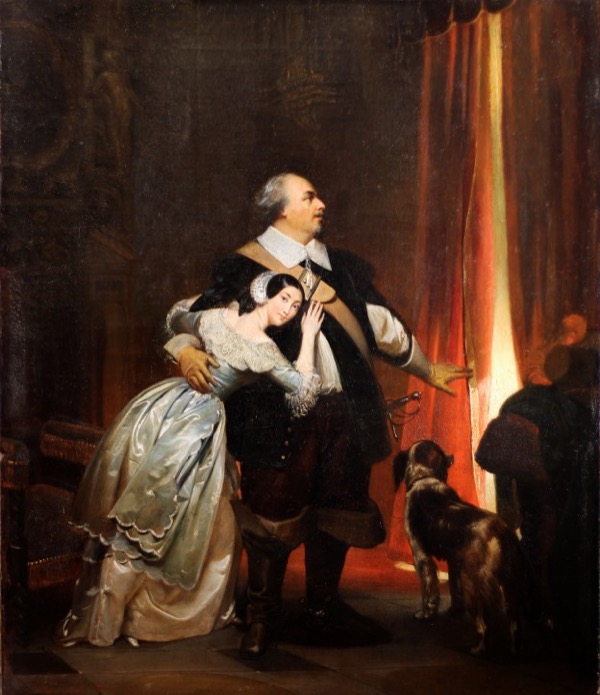
Giulia Grisi and Luigi Lablache in Bellini’s I Puritani
Musically, I Puritani reflects the ideals of Italian Romanticism, including love triangles, misunderstandings, and frustrated passions that lead to madness, set against a historical backdrop.
With his inimitable bel canto style, he captivates listeners with its sheer beauty and rich melodic invention. At the summit of his creative powers, Bellini provides a remarkable portrayal of human emotion, including an extraordinary depiction of insanity.
Vincenzo Bellini: I Puritani, “A te, o cara”
Donizetti Takes His Turn
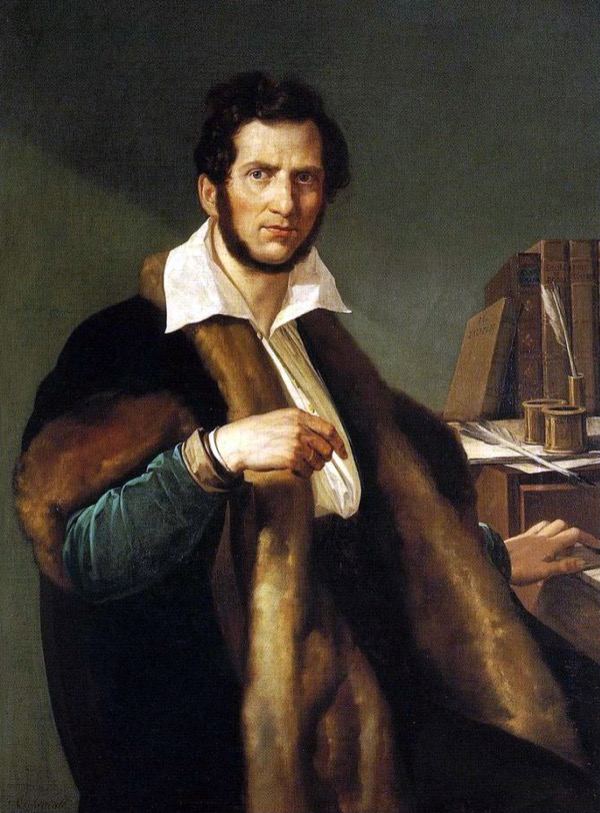
Francesco Coghetti, Ritratto di Gaetano Donizetti
Gaetano Donizetti attended the premiere of I Puritani and genuinely admired the work. As he writes to the librettist Jacopo Ferretti, “Bellini’s opera has had an immense, unbelievable success here. The public was completely ecstatic. It is a beautiful work, and he deserves it all.”
Donizetti had been busily working on his first opera to have its premiere in Paris. Marino Faliero is an opera based on the life of the Venetian Doge. It was a much darker story, tracing the historical account of Marino Faliero, whose involvement in a conspiracy against the Venetian government led to his execution in 1355.
Donizetti did not arrive in Paris with a conventional Italian opera; instead, he presented a serious, politically charged Romantic drama. Donizetti could rely on the same superstar cast as in I Puritani, and his opera strongly resembles the two Verdi operas I due Foscari and Simon Boccanegra. Would Parisian audiences be ready?
Gaetano Donizetti: Marino Faliero, Act I: Di mia patria o bel soggiorno (Ivan Magrì, tenor; Bergamo Musica Festival Orchestra; Bruno Cinquegrani, cond.)
In the Shadow of I Puritani
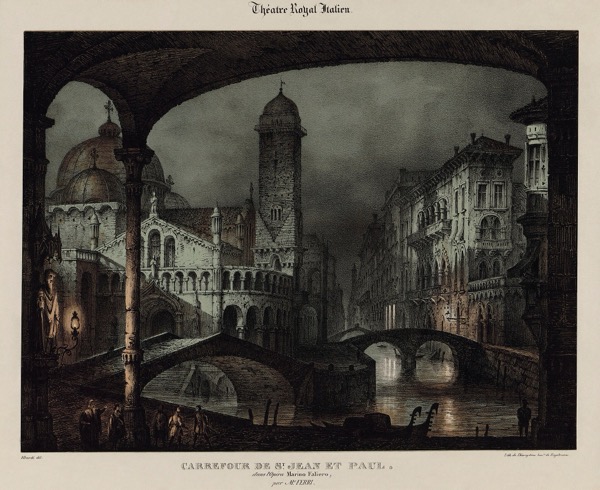
Luigi Verardi after Domenico Ferri, scene from Donizetti’s Marino Faliero
As he writes to Ferretti, “As for my own poor Marino Faliero, which will follow it shortly, I can only bow my head and hope. God grant that it will at least please the Parisian public half as much, or that they receive it with some indulgence. I am working hard, but the shadow of such a triumph is vast…”
The premiere of Marino Faliero took place on 12 March 1835, arriving late in the Paris season. The reception was mixed, and certainly nowhere near the triumph of I Puritani, but several accounts suggest that Donizetti was pleased. He also understood that the two works were different genres, and that both had succeeded without displeasing the public.
Bellini, however, was troubled by Donizetti’s arrival. When he learned in April 1834 that Donizetti would be composing for the Théâtre-Italien that same season, he wrote a long, rambling letter to his friend Francesco Florimo and others.
Gaetano Donizetti: Marino Faliero, Act II: Recitativo, Aria e Cabaletta: Notte d’orrore! (Ivan Magrì, tenor; Bergamo Musica Festival Orchestra; Bruno Cinquegrani, cond.)
The Shadow of Rossini
Bellini suspected that Rossini had orchestrated the entire scheme. As he writes, “I had a fever for three days, as I became aware of the plot actually being prepared against me. Rossini decided to have Donizetti commissioned also, because in that way, set up against me, he would suffocate me, exterminate me, with the support of Rossini’s colossal influence.”
Bellini did not confront Rossini, but sought his advice and eventually presented the relationship to him as one of affection and protection. We find no evidence that Rossini actually intended to undermine Bellini. The conspiracy was clearly Bellini’s perception, but he still wrote after the Marino Faliero premiere that the opera had been a semi-fiasco.
The supposed rivalry between Donizetti and Bellini had predictably originated with the Parisian press, but the story ended tragically. Bellini’s health deteriorated rapidly, and he died just eight months after the triumph of I Puritani at the age of only 33.
Vincenzo Bellini: I Puritani, “Suoni la tromba”
Three Days Later
Rossini immediately took charge of all arrangements, including plans for Bellini’s funeral and entombment, as well as caring for his estate. He formed a committee of Parisian musicians to secure support for a subscription to build a monument to the dead composer, as well as to support a funeral mass to be celebrated on 2 October in the chapel of the Hôtel des Invalides.
The funeral proved a grand occasion, featuring the immortal Lablache alongside the young Russian tenor Nicolai Ivanoff and the great Giovanni Rubini. Cherubini, Carafa, Paer, and Rossini served as pallbearers, and François-Antoine Habeneck led the music.
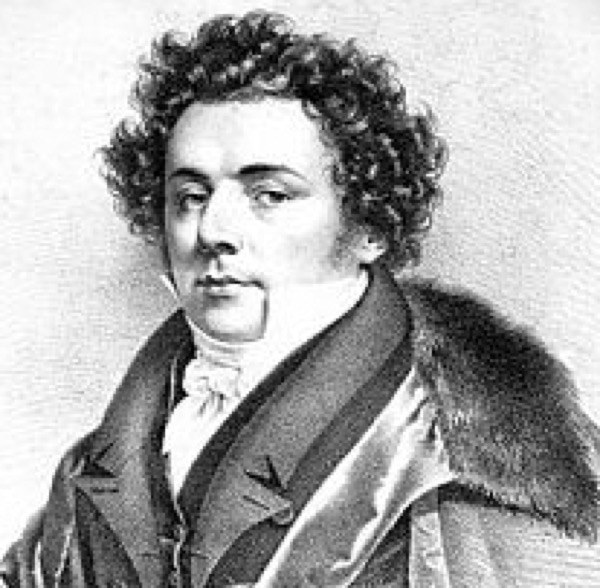
Luigi Lablache
The death of his younger colleague genuinely shook Donizetti. Within weeks, he began to work on a Messa di Requiem in Bellini’s memory, a work he never completed. Yet, the surviving music far exceeds purely ceremonial gestures.
He also agreed to write a Lamento per la morte di Bellini. When his publisher Giovanni Ricordi reproached him, Donizetti apparently replied, “I have a great deal to do, but an expression of friendship for my Bellini takes precedence over everything.”
Just three days after Bellini’s death, Donizetti oversaw the staging of Lucia di Lammermoor in Naples. It would become his most famous opera, one of the high points of the bel canto tradition, and it would reach a stature similar to that achieved by Bellini’s Norma. After Bellini’s death, Donizetti became the sole reigning genius of Italian opera.
For more of the best in classical music, sign up for our E-Newsletter