In 1580, luthier John Rose created a new instrument that he named after the allegorical musicians Orpheus and Arion. Together, they personify the power of music, and in his new instrument, the orpharion, Rose created a rival for the lute.
Orpheus was famed for taming even the wildest animals (here, killer rabbits are shown) with his artistry.
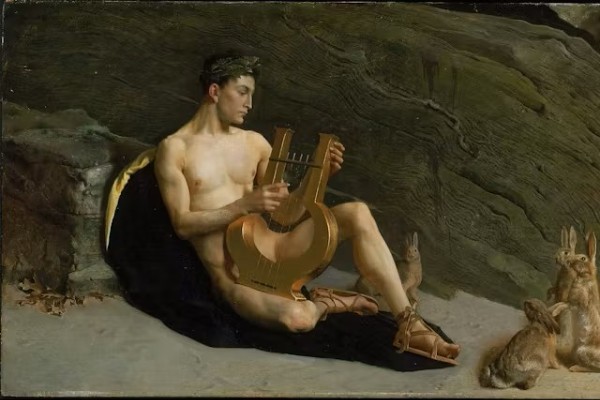
George de Forest Brush: Orpheus, 1890 (Boston: Museum of Fine Arts)
Arion, on the other hand, was called by Herodotus as ‘second to none’ among the lyre-players of his time. He lives in mythology. When returning to Corinth from a music competition in Sicily, the sailors on his ship gave him the option: give them his prizes or be thrown into the sea. If thrown in the sea, his body would be lost and would be un-mourned. Arion asked to play one last piece and then jumped into the sea. His music had brought dolphins to his rescue, sent, it is said, by Apollo, and they returned him to dry land. When the sailors returned home to tell Periander, the Tyrant of Corinth, that Arion was lost, he confronted them with the living musician, and all the sailors were killed for their actions and lies.
Arion and his dolphin were placed among the stars by Apollo. We now recognise him as extrasolar planet 18 Delphini b, part of the constellation of Delphinus.

François Boucher: Arion on the Dolphin, 1748 (Princeton University Art Museum)
In this picture of an orpharion from Athanasius Kircher’s 1650 work Musurgia Universalis, we can see a couple of defining elements of the instrument.
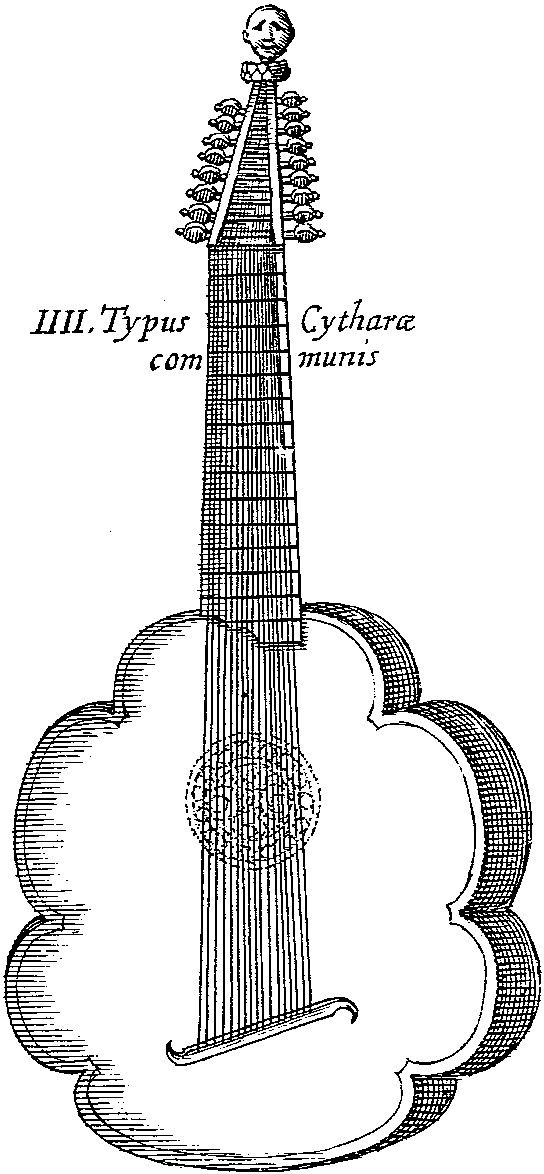
Athanasius Kircher: Mvsvrgia Vniversalis: Instrumenta polychorda: Cythara communis (Orpharion), 1650
Its body is not in a standard waisted shape like a violin or a pear shape like a lute, but rather in a cloud shape. The back of the instrument is flat (a violin has a curve, and the lute has much more than that!). And, uniquely, the strings are attached to the bridge at an angle.
The angled bridge and nut permitted the bass strings to be longer than the treble strings and so permitted a better and more satisfactory bass tone.
At the top of the neck, the nut is angled as well. What you can’t see is that the frets on the fingerboard are nearly flush and that the fingerboard is scalloped so that only a light touch is needed to sound. A lute required a stronger touch and a sharper attack.
When we look at a real example, we can see that the scalloped edges of the body look less cloudlike than in Kircher’s drawing! The angle of the bridge is also more acute than in the drawing. The scalloping on the fingerboard is also visible.
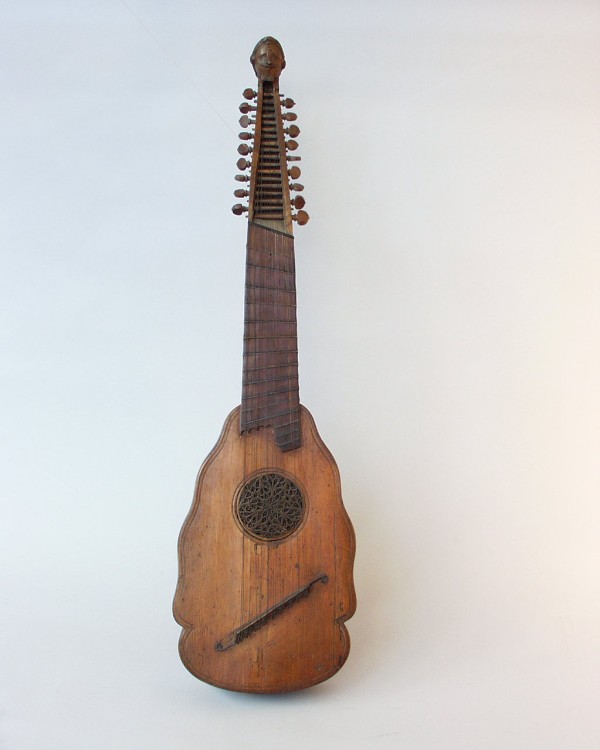
Francis Palmer: Orpharion, 1617 (Copenhagen: Musikmuseet, Musikhistorisk Museum & Carl Claudius’ Samling, Inv. No. CL 139)
What did it sound like? Let’s first listen to a lutenist playing Dowland’s A Dream, written as part of his ‘dream’ series around 1590-1600. The ‘dream’ works do not have the same thorough-going melancholy of his ‘Lacrimae’ series.
John Dowland: A Dream, P. 75 (Nigel North, lute)
On the orpharion, the sharp edge and crispness of the lute fall away, and a more resonant sound emerges. Dowland’s dream-like texture becomes more clear.
John Dowland: A Dream, P. 75 (Bor Zuljan, orpharion)
The strings were not the expected gut strings of the Baroque period, but would have been made of metal: brass, iron, and even solid silver wires.
With this new sound and a way of playing that was easier on the fingers, the orpharion quickly became part of a musician’s repertoire. For those at home, a good MF music for the opharion was published in 1596.
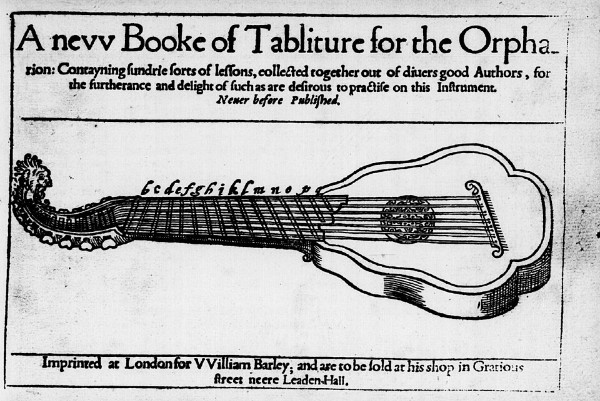
William Barley: A New Booke of Tabliture for the Orpharion, London: William Barley, 1596
And lest you think that John Rose’s invention of 1580 has vanished from music entirely, we’ll let you consider the modern ‘fan fret’ electric guitar. This example from guitar-maker Ibanez continues the 16th-century tradition into the 21st century.
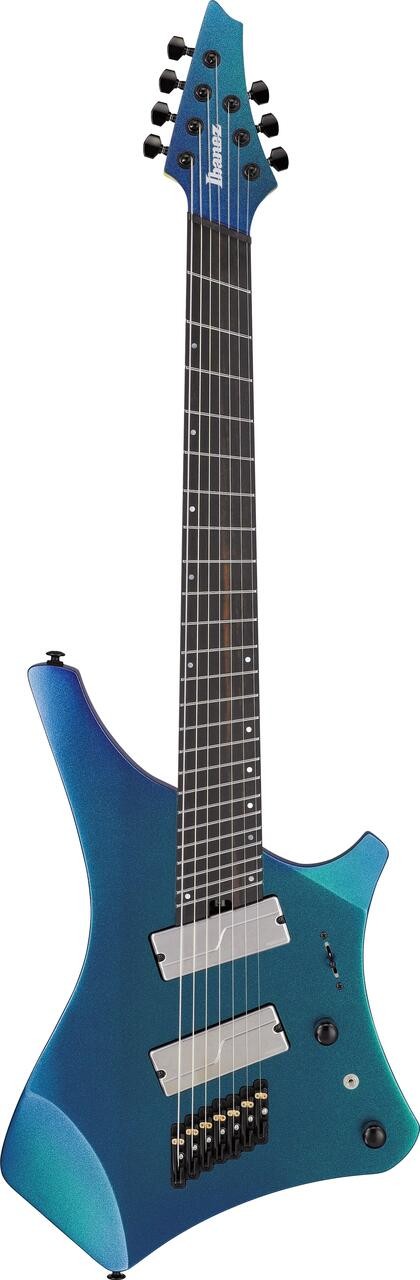
Ibanez Alpha A527-NSH 7-String Multi-Scale Electric Guitar
Orpharionist Bor Zuljan worked with luthier César Arias to create the electric orpharion. Their initial work in 2022 resulted in the steel-strung electric orpharion in 2025. The new instrument carries the orpharion’s original softened lute sound, but the electronics make it more resonant with a longer delay. It’s not quite a guitar, but it’s not a lute either.
Thelonious Monk: Round Midnight (arr. for voice and electric orpharion) (Clara Brunet, vocals; Bor Zuljan, electric orpharion)
It’s unusual that an instrument that has fallen out of common usage has ended up being so influential so many centuries later. Looking at modern electric instruments with an idea of their antecedents gives us a glimpse at the depth of history, even in an instrument that we take for granted.
For more of the best in classical music, sign up for our E-Newsletter