There have been many turning point years in the history of classical music.
However, for our money, the 365-day period between the start of June 1912 and the end of May 1913 was the most important single year in classical music history.
In that one year, a series of premieres across Europe ushered in a series of revolutionary works that would shape the trajectory of twentieth-century music.
Today, we’re looking at the major works premiered in that year and the combined impact they all had on the classical music world.
8 June 1912: Ravel’s ballet Daphnis et Chloé premieres
The year kicked off with one of Maurice Ravel’s most important works, Daphnis et Chloé.
The work was commissioned by impresario Sergei Diaghilev for the Ballet Russes. It premiered on 8 June 1912 at the Théâtre du Châtelet in Paris.
The score – telling the story of an ancient Greek pastoral romance, as re-interpreted by Ravel – is sensuous and richly, brilliantly orchestrated.
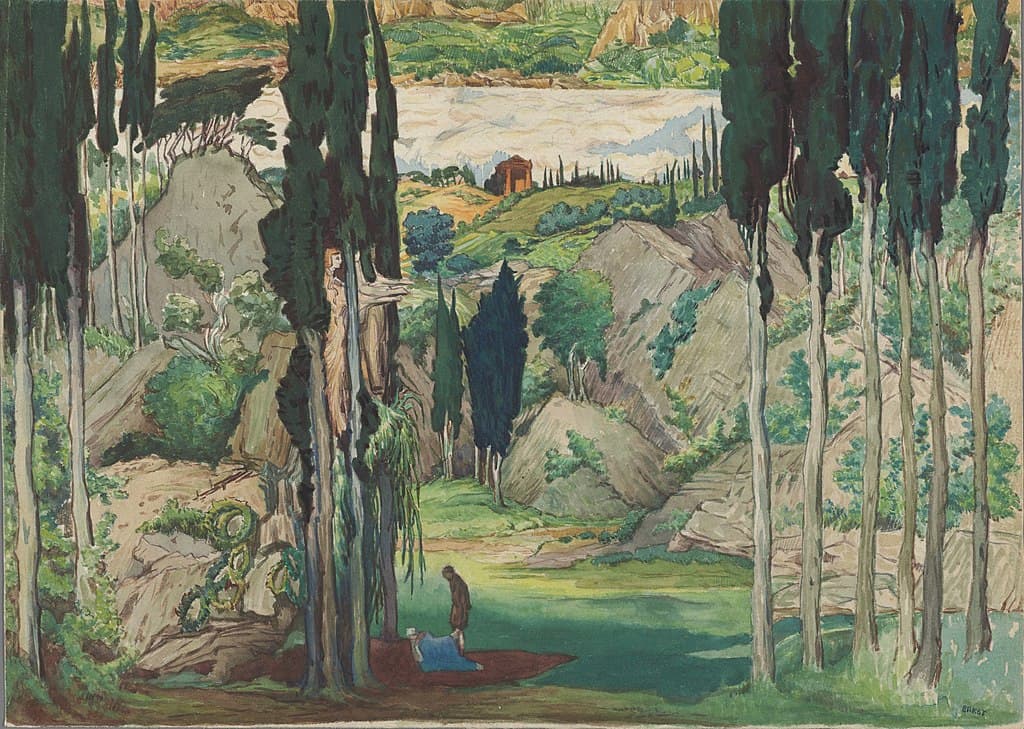
Léon Bakst’s set design for Act 1 of “Daphnis et Chloe”, 1912
Despite Ravel’s satisfaction with the score, the initial reception of the ballet was lukewarm. Diaghilev didn’t like how the work turned out. He canceled performances.
Reviews found the choreography and pacing problematic. The work never had a full dress rehearsal, and the performance suffered as a result.
However, Ravel triumphed in the end. He rearranged the music into two orchestral suites that have since become fixtures in the concert hall.
Daphnis et Chloé may have failed as a ballet, but it certainly succeeded as a concert work. It also set a new standard for effective and imaginative orchestration.
26 June 1912: Mahler’s Symphony No. 9 premieres
Gustav Mahler died on 18 May 1911 at the age of fifty of a heart infection.
The final completed work he left behind was his Ninth Symphony. It was premiered posthumously at the Vienna Festival by the Vienna Philharmonic in late June 1912.
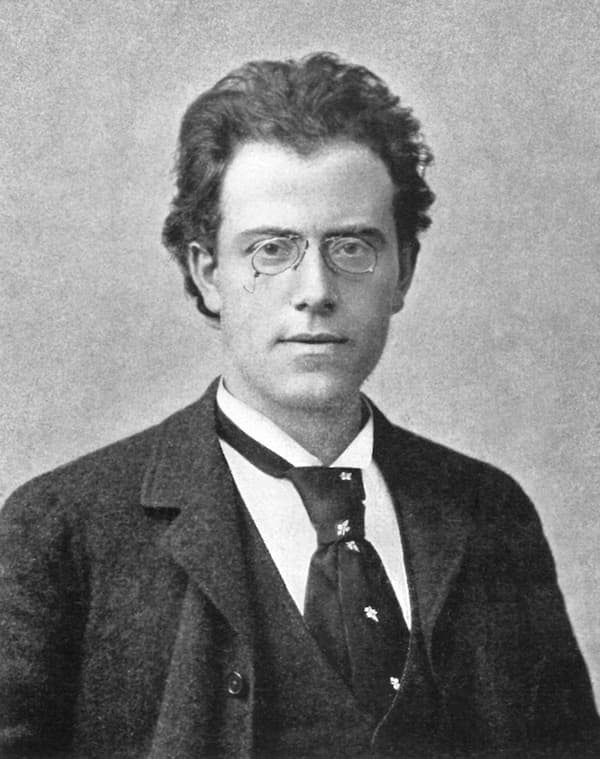
Gustav Mahler, 1892
The adagio finale, interpreted by Bruno Walter as “a peaceful farewell”, left a deep impression on contemporary composers.
For instance, Alban Berg called the first movement “the greatest Mahler ever composed.”
The premiere of Mahler’s Ninth not only closed the book on Mahler’s own output but also influenced and cleared the way for the next generation of composers…including the Second Viennese School that ascended after Mahler’s death.
Read the full story about Mahler’s Ninth.
16 October 1912: Schoenberg’s song cycle Pierrot Lunaire premieres
Several months after the premiere of Mahler 9 came the premiere of Arnold Schoenberg’s song cycle Pierrot Lunaire.
This genre-defying piece is a melodrama song cycle for voice and five instruments, setting 21 expressionist poems to atonal music.
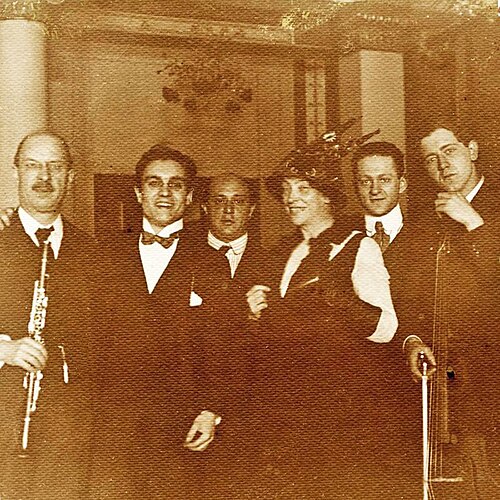
The ensemble that premiered Pierrot lunaire
Pierrot Lunaire is famous for its use of Sprechstimme (spoken-singing), an eerie vocal technique that hovers somewhere between speech and song.
According to contemporary accounts, some listeners were enraged, disturbed by the Sprechstimme and the atonal, dreamlike atmosphere created by the music.
One eyewitness recalled hissing, booing and even a prominent musician yelling about Schoenberg, “Shoot him! Shoot him!”
Simultaneously, younger artists present were enthralled and gave ovations between the cycle’s various sections.
By abandoning traditional tonality and exploring new expressive techniques, Pierrot Lunaire had a far-reaching impact.
It influenced later composers’ approach to vocal music and chamber ensemble writing, and it also signaled to the world of modern music that the frontiers of harmony had officially moved beyond the late-Romantic language…like it or not!
23 February 1913: Schoenberg’s cantata/oratorio Gurre-Lieder premieres
Four months after Schoenberg’s Pierrot Lunaire premiered, another work of Schoenberg’s was premiered: Gurre-Lieder.
Gurre-Lieder is an epic cantata (often classified as an oratorio or song-symphony) for multiple vocal soloists, chorus, and large orchestra…that had been composed a decade earlier!
The audience was expecting something like Pierrot Lunaire, and was prepared to loathe it. But instead, they got a ten-year-old, ninety-minute late Romantic extravaganza.
The audience loved it, and Schoenberg was annoyed that they loved it. When he came out to take a bow, he bowed to the orchestra instead of the audience. He later said, “I stood alone against a world of enemies.”
The work’s reception demonstrated the split forming between audiences and composers.
31 March 1913: The Vienna Skandalkonzert
Alban Berg: Altenberg Lieder (5 Orchester Lieder), Op. 4
A little over a month later, the audience, which had been offended by Schoenberg’s coolness toward their adoration of him, took revenge at a concert of contemporary music by the Second Viennese School.
It took place at the Great Hall of the Musikverein in Vienna.
Composers represented included Webern, Zemlinsky, Schoenberg, and Berg. It was going to include Mahler, but the show ended early due to concertgoers’ rebellion.
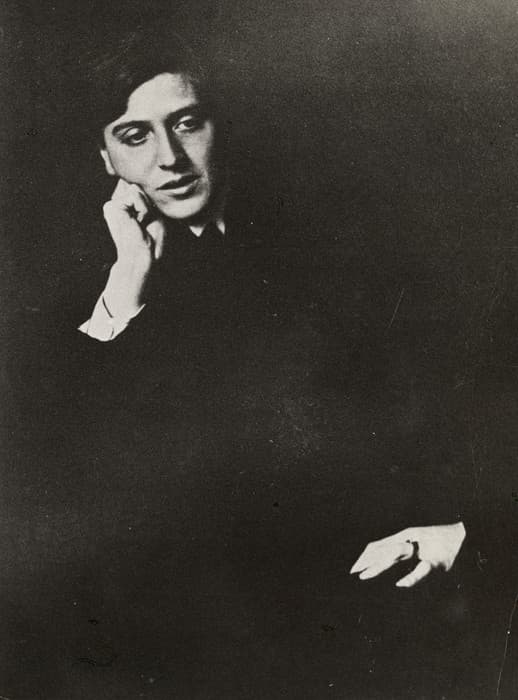
Alban Berg, 1920s
During Berg’s work, two of his Five Orchestral Songs on Picture-Postcard Texts by Peter Altenberg, the audience began calling for the composer and lyricist to be institutionalised. It was a sharp criticism, as Altenberg was already committed at the time.
15 May 1913: Debussy’s ballet Jeux premieres
By this time, Claude Debussy was the elder statesman of French modernism. He jumped in that formative season with a work of his own: Jeux, or “Games.”
It was a ballet choreographed by Vaslav Nijinsky that featured a storyline of a modern man and two women meeting on a tennis court at twilight.
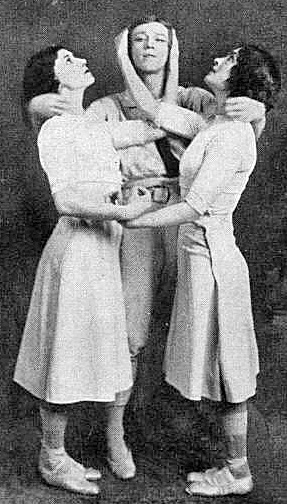
Tamara Karsavina, Vaslav Nijinsky and Ludmilla Schollar in Jeux
It would be his last completed orchestral work, bringing to a close a legendary run that had included Prélude à l’après-midi d’un faune, Nocturnes, La Mer, and Images.
In this work, he wrote music that was more abstract and enigmatic than his earlier works. Audiences weren’t outraged, or overjoyed; they were just…puzzled.
Discover the backstory behind Debussy’s ballet Jeux.
Although future musicians like Pierre Boulez would cite this work as influential, it just didn’t make much of an impression at the time.
One reason why was because of what happened in Paris two weeks later…
29 May 1913: Stravinsky’s ballet The Rite of Spring premieres
The most notorious premiere in classical music history was probably Stravinsky’s ballet The Rite of Spring.
It premiered on May 29, 1913 at the newly opened Théâtre des Champs-Élysées in Paris, performed by Sergei Diaghilev’s Ballets Russes and conducted by Pierre Monteux.
From the first moments, with its straining high-pitched bassoon solo, the audience sensed that this work was something new.
On top of the music, the violent and erotically charged choreography by Vaslav Nijinsky shocked concertgoers, and a disturbance broke out.
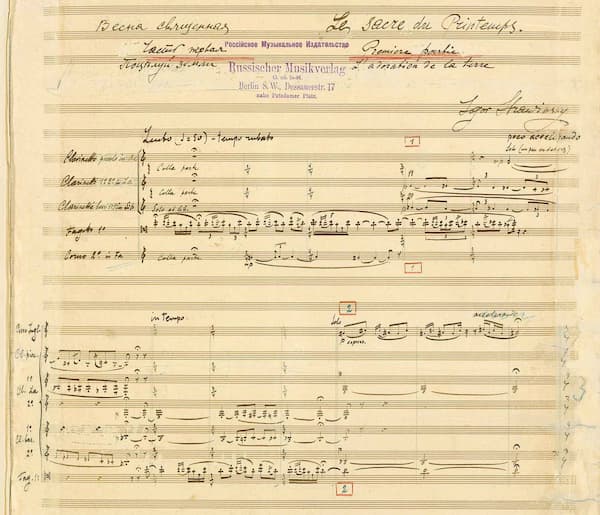
Stravinsky’s The Rite of Spring manuscript
(This disturbance entered classical music history as a riot, but it wasn’t quite that, and it was likely the content of the dancing as much as the music that caused the hubbub.)
Despite – or perhaps because of – the shocking premiere, The Rite of Spring earned a reputation as a new landmark in modern music.
Today, it’s widely considered one of the most influential pieces of classical music, not just of the twentieth century, but of all time.
Conclusion
So what were the takeaways from the classical music premieres that happened during the 1912/1913 season?
Here are just a few.
- It exemplified the transition out of the Romantic Era and into modernism. Mahler’s final symphonic premiere marked the end of the era of massive Romantic symphonies. Debussy’s career was also in its twilight. Meanwhile, Stravinsky and members of the Second Viennese School had careers on the upswing.
- Orchestration was changed forever. Of course, the first new orchestration influence was Igor Stravinsky’s The Rite of Spring, which employed the instruments of the orchestra in new and truly shocking ways. But Ravel’s Daphnis et Chloé is a triumph of orchestration, too. And even unusually written atonal chamber works like Pierrot Lunaire, with its revolutionary instrumentation, suggested new paths for orchestral composers to begin to follow.
- The old forms were really starting to break down. Schoenberg’s works weren’t following traditional musical structures. This was a prelude to an era of experimentation within genres, with long-observed rules being thrown by the wayside in search of something fresh.
- Rhythm was becoming increasingly important…and complicated. Listen to The Rite of Spring and Pierrot Lunaire. Try to clap along. Enough said.
- It marked the beginning of an age when many composers became more interested in writing for themselves and other composers and intellectuals, rather than the general public as a whole. The attitude – exemplified by Schoenberg as he bowed to the orchestral players instead of the audience during the premiere of Gurre-Lieder – would metastasise over the following decades. Agree with it or not, the rise of atonality and deliberately challenging works would impact how listeners interacted with classical music for generations to come, up until the present day.
In art, it’s rare for so many revolutions to occur in the space of twelve months. However, in 1912–1913, those revolutions happened…and classical music lovers are still living with the fallout today.
For more of the best in classical music, sign up for our E-Newsletter