A set of short anonymous poems in Boston’s Musical Herald did a poetical job of setting out the history in limericks, along with unique rhyming spellings.
We started in the 18th century with Gluck and then Haydn. Next, we’ll advance to the 19th century with Brahms and Liszt.
A German composer named Brahms
Caused in music the greatest of quahms
His themes so complex
Some people would vex
From symphonies down to the psahms.
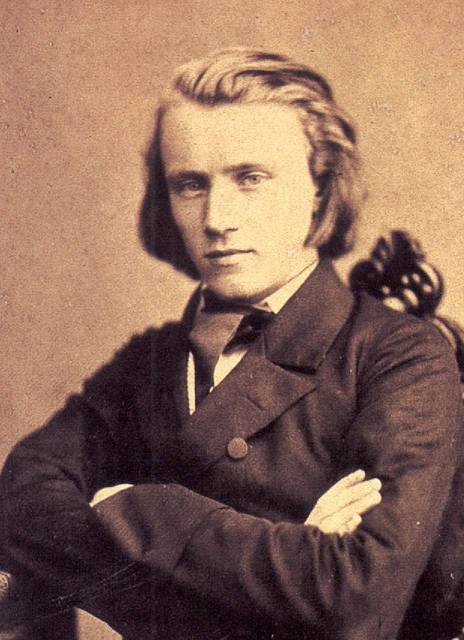
Johannes Brahms, ca 1855
Johannes Brahms (1833–1897) wrote across many genres, including folk song and German song, chamber music, a Requiem, 4 concertos, and 4 symphonies. He was also a virtuoso pianist and conductor. He was an important figure in the field of absolute music, i.e., music for the sake of music, rather than fitting a program or a story. His ‘opponent’ in music was Richard Wagner, for whom the story was the most important aspect.
The gestation of Brahms’ first symphony is a well-known story, with over a decade of work in its production. Wagner made fun of work, as being not Brahms’ No. 1 but rather a dressed-up version of Beethoven No. 10, ignoring the fact that Beethoven only wrote 9 symphonies.
In the limerick’s complaint about the complexity of Brahms’ themes, we have to recall that in the line of composers such as Palestrina to Bach, counterpoint was the most important kind of melodic conversation. One writer noted Brahms as being consumed by the ideas of ‘thematic development, counterpoint, and form’ and that they ‘were the dominant technical terms in which Brahms … thought about music’.
Johannes Brahms: Symphony No. 4 in E Minor, Op. 98 – I. Allegro non troppo (London Philharmonic Orchestra; Marin Alsop, cond.)
The limerick about Liszt focuses on one particular music genre:
There was a composer named Liszt
Who from writing could never desizt;
He made Polonaises
Quite worthy of praises,
And now that he’s gone, he is miszt.
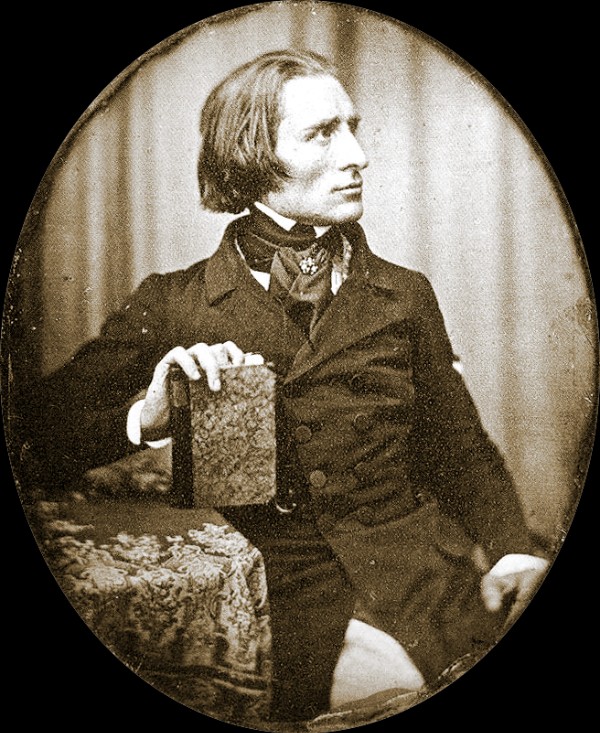
Franz Liszt, 1843 (photo by Herman Biow)
Franz Liszt (1811–1886) was born in Hungary, but made his name in Germany, primarily as an example of the New German School, which also included Wagner and Berlioz, but not Brahms, since the idea of program music was anathema to him. Liszt’s Symphonic poems were ideal embodiments of the New German School ideals.
However, the limerick focuses on Liszt’s polonaises, the first of which he wrote in 1850. Many of his polonaises were based on others’ works, such as his Introduction et Polonaise de l’opéra I puritani, S. 391, his Polonaise brillante, S. 367, which was based on the Polacca brillante, Op.72 by Carl Maria von Weber, and a polonaise based on the polonaise in Tchaikovsky’s opera Eugene Onegin (Polonaise aus der Oper Jewgeny Onegin, S. 429).
Franz Liszt: Tchaikovsky – Eugen Onegin: Polonaise, S429/R262 (Maria Stembolskaya, piano)
As part of Liszt’s career as a virtuosic pianist, he had such a formidable technique that he would take a favourite part of someone else’s opera, or someone else’s piano work, and create his own virtuosic version of it that was almost always guaranteed to be unplayable by other pianists of his day.
Liszt became the focus of an intense love by his fans and followers. Heinrich Heine dubbed the fans’ frenzy as ‘Lisztomania’, and it started in early 1841. The thirty-year-old pianist was greeted at his first recital in Berlin in 1841 with a response that verged on the hysterical. Much like a modern rock star, he was the focus of his fans. They fought over the smallest scraps, memorialising everything from his handkerchiefs and gloves to his discarded cigars.
His audiences became increasingly emotional, often fainting at the very sight of him (the same thing happened to the audiences of The Beatles and Elvis Presley). The beauty of Liszt, his skills as a pianist, and the extremes to which he took his music all contributed towards driving his audiences mad. Tales were told of audiences clapping so hard that their delicate kid gloves would split. Liszt also pandered to that audience, being the first to turn the piano so that he sat sideways to the audience so they could admire his profile while he worked his magic on the keys.
Although Paris in the 1850s was the centre of piano virtuosos, no one ever quite came up to Liszt’s level in terms of technical ability, showmanship, and utter chutzpa for putting across a musical extravaganza that dropped his audience in the aisles.
For more of the best in classical music, sign up for our E-Newsletter