One of the unusual movements in Saint-Saëns’ Carnival of the Animals is his 11th movement: “Pianists.” We opened with the march of the lions, we had an elephant, and upcoming is the most famous movement, The Swan, but in the middle are those wild pianists.
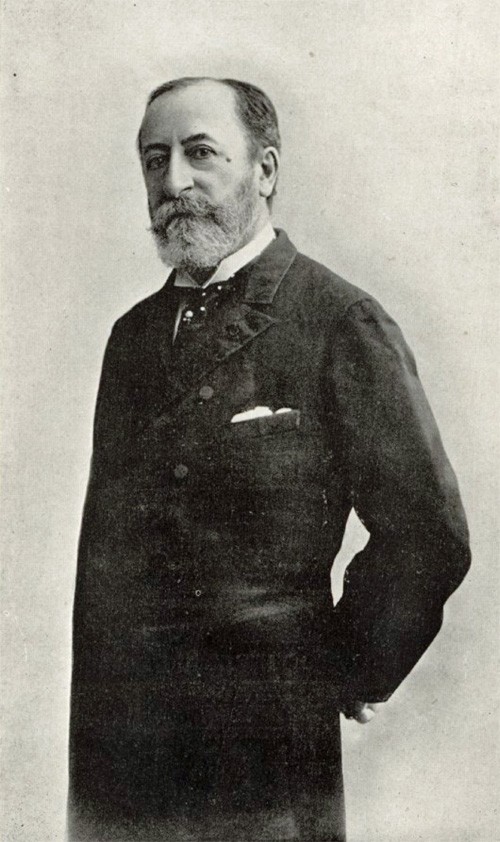
Charles Reutlinger: Saint-Saëns, ca 1880 (Paris: Bibliothèque nationale)
They are shown in music doing their typical pianist things, i.e., finger exercises and scales. With the orchestra as emphasis, the duo pianists make their way up the scale, often laboriously. In the piano world, the finger exercises are familiar and are very much like the typical Hanon and Czerny exercises that every pianist, no matter how young or how old, goes through.
Remember that these are the private actions that the wild pianists never perform in public, and when they’re on the stage. Think of this being over-voiced with a typical hushed David Attenborough–style commentary!
Camille Saint-Saëns: Djurens karneval (Carnival of the Animals) – XI. Pianister (Pianists) (Marián Lapšanský, piano; Peter Toperczer, piano; Slovak Radio Symphony Orchestra; Ondrej Lenárd, cond.)
Some performers use it as they would a practice session, with each iteration of the scale becoming easier and easier and improving each time.
Camille Saint-Saëns: Carnival of the Animals – XI. Pianists (Marylène Dosse, piano; Annie Petit, piano; Württemberg Chamber Orchestra; Jörg Faerber, cond.)
On an organ, the whole point seems to get lost, particularly when there’s only one person on the keyboard, although when the performer is building to the end of the movement, it’s rather impressive.
Camille Saint-Saëns: Carnival of the Animals (arr. E. Melnikova for organ) – XI. Pianists (Eric Plutz, organ)
How about an accordion? That seems to work better, particularly since it’s an accordion duo.
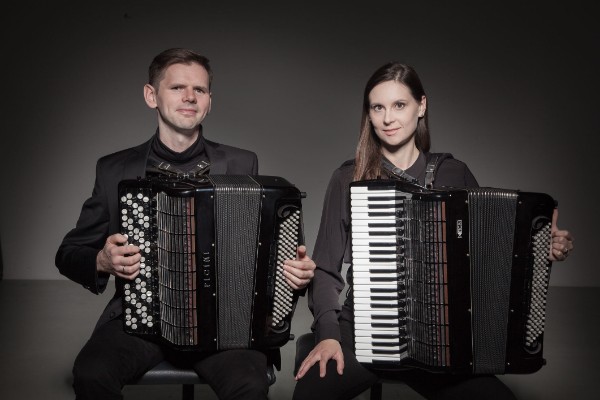
duoAccosphere (Alena Budziňáková and Grzegorz Palus)
Camille Saint-Saëns: Carnival of the Animals (arr. A. Budziňáková-Palus and G. Palus for 2 accordions and orchestra) – XI. Pianists (duoAccosphere, Ensemble; Polish Art Philharmonic; Michael Maciaszczyk, cond.)
Others use it to go further than Saint-Saëns wrote!
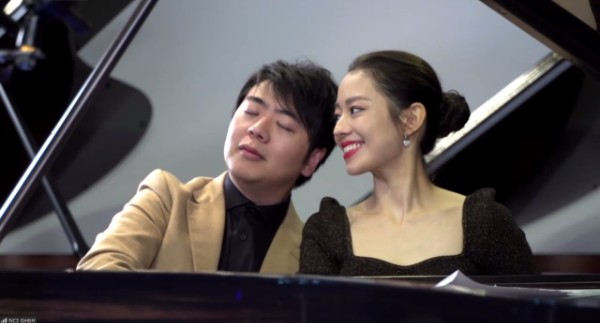
Lang Lang and his wife, Gina Alice
Camille Saint-Saëns: Carnival of the Animals – XI. Pianists (Lang Lang, piano; Gina Alice, piano; Leipzig Gewandhaus Orchestra; Andris Nelsons, cond.)
These days, the Carnival of the Animals has largely been demoted to the miscellaneous genre of ‘music for children’, which both marginalises it and gets it off the main concert programs.
Saint-Saëns wrote the work in 1886 and never intended it for publication, writing to his publisher that ‘it will figure among my posthumous works’. Saint-Saëns was fond of making pastiches of others’ work for their humorous value. He considered the Carnival as a ‘grand zoological fantasy’ and put together an unusual ensemble of two pianos, two violins, viola, cello, double bass, flute, clarinet, glass armonica, and xylophone. He wrote it for a private concert by his friend, the cellist Charles Lebouc, and he specifically composed solos for Lebouc and his friends, writing to his publisher that ‘there will be solos for the beneficiary [Lebouc], for [the flautist, Paul] Taffanel, [the clarinettist, Charles] Turban and [the double-bass player] Debailly (the Elephant Waltz). All of them were going to be involved in the private concert, and Saint-Saëns took advantage of their appearances to write something specifically for them.
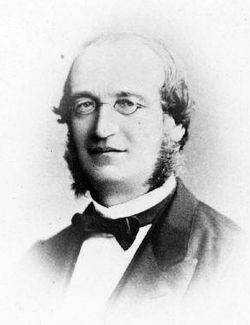
Charles Lebouc
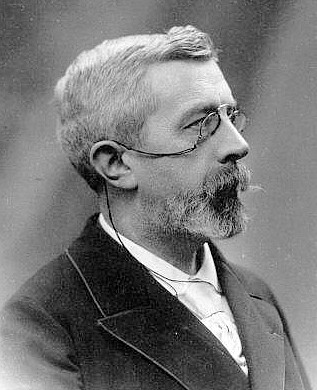
Paul Taffanel (Paris: Bibliothèque nationale)
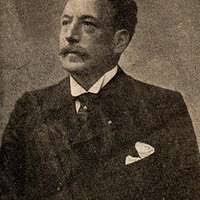
Eugène Pirou: Charles Turban
(Paris: Bibliothèque nationale)
In the Carnival, Saint-Saëns quotes music from a number of sources, including parodies of Rameau’s harpsichord piece La Poule in ‘Poules et Coqs’ (No. 2), melodies by Offenbach in ‘Tortues’ (No. 4), lifting the waltz from the ‘Ballet de Sylphes’ of Berlioz’s La Damnation de Faust for the most un-sylph–like performer. It’s played by the double bass at an Allegretto pomposo tempo in ‘L’Éléphant’ (No. 5). He quotes his own Danse macabre and Rosina’s aria from Rossini’s Il barbiere di Siviglia in ‘Fossiles’ (No. 12), as well as sprinkling in popular songs such as ‘J’ai du bon tabac’, ‘Ah! vous dirai-je maman’ or ‘Partant pour la Syrie’ that the audience would know throughout.
The premiere was on 9 March 1886, and the newspaper reviews were ecstatic, with one newspaper labelling it ‘an amusing symphonic buffoonery’. A few days later, another performance was held at Émile Lemoine’s chamber music society and then another at the house of the singer Pauline Viardot, with Liszt in the audience. Liszt, who was friends with Saint-Saëns, had requested the work. A limited number of semi-private performances followed, and one semi-public, held at the Société des instruments à vent in April 1892, which ‘took place with the musicians wearing masks of the heads of the various animals they represented’.
Despite these private performances, Saint-Saëns really didn’t want the piece to circulate. The only movement that made it into print in Saint-Saëns’ lifetime was The Swan, which Durand published in 1887. The Carnival in its entirety wasn’t published until 1922, a year after Saint-Saëns’ death. As he had feared would happen, the work was immediately popular, and that popularity has only grown over the years.
One of my favourite performances has been the one with Martha Argerich and Antonio Pappano as the pianists. They read the footnote that the music’s editor placed on the music:’ The performers should imitate a beginner’s playing style and its awkwardness’. And so they do.
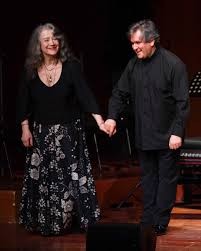
Martha Argerich and Antonio Pappano
Camille Saint-Saëns: Carnival of the Animals – XI. Pianists (Martha Argerich, piano; Antonio Pappano, piano; Rome Santa Cecilia Academy, Ensemble)
It’s hard to play deliberately wrong, and Argerich and Pappano carry it off beautifully.
As you will have noticed, this work isn’t really complete unto itself. It actually serves as the introduction to the Fossils movement, where Saint-Saëns parodies himself and a bit of Rossini.
Camille Saint-Saëns: Carnival of the Animals – XII. Fossils (Martha Argerich, piano; Antonio Pappano, piano; Rome Santa Cecilia Academy, Ensemble)
As mentioned above, the relegation of this work to children’s music is unfair to both the audience and the work. Saint-Saëns created the most unusual zoo in the world with everything from lions and elephants to fossils and pianists. and it deserves to be on more standard concert stages.
To quote the French newspaper Le Figaro on the work’s premiere in 1922, ‘We cannot describe the cries of admiring joy let loose by an enthusiastic public. In the immense oeuvre of Camille Saint-Saëns, The Carnival of the Animals is certainly one of his magnificent masterpieces. From the first note to the last it is an uninterrupted outpouring of a spirit of the highest and noblest comedy. In every bar, at every point, there are unexpected and irresistible finds. Themes, whimsical ideas, instrumentation compete with buffoonery, grace and science. … When he likes to joke, the master never forgets that he is the master’.
For more of the best in classical music, sign up for our E-Newsletter