Dame Janet Baker was born on 21 August 1933 in Hatfield, Yorkshire, England. One of the most distinguished mezzo-sopranos of the 20th century, her radiant expressiveness and total absorption in her singing provided the foundation for subsequent generations of female interpreters.
Baker captivated audiences with her rich, expressive voice and mastery of a diverse repertoire, ranging from Baroque and Classical works to modern compositions. Her interpretations, full of emotional intensity and theatrical imagination, were deeply personal.
Baker shared a celebrated artistic partnership with Benjamin Britten, whose music suited her dramatic insight and vocal subtlety. To celebrate her birthday, let’s take a brief look at Phaedra, a work Britten composed specifically for Baker.
Janet Baker sings Britten: Phaedra (Excerpt)
New Voice for Ancient Passion
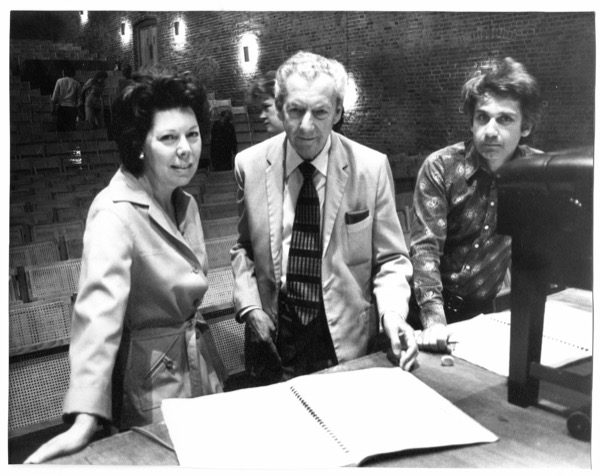
Janet Baker, Benjamin Britten and Steuart Bedford
Phaedra was Benjamin Britten’s last major vocal work, composed during the summer of 1975. As early as 1970, Britten had written the part of “Kate Julian” in the opera Owen Wingrave specifically with Janet Baker in mind. Britten had also conducted and recorded The Rape of Lucretia with Baker in the title role.
Britten had been aware of Racine’s classical tragedy Phèdre for some time, but he eventually took on the subject in 1975. One inspiration was a new edition of Robert Lowell’s verse translation, while the other was Janet Baker’s performance of Berlioz’s Nuits d’été at the 1975 Aldeburgh Festival.
The result of these inspirations was a dramatic cantata for mezzo-soprano and small orchestra, specifically written for Baker’s voice. Britten modelled the work on the Italian Baroque cantatas of Handel, presenting a series of arias for mezzo-soprano accompanied by an ensemble of strings and percussion.
The recitatives are accompanied by a continuo of harpsichord and cello, in part reflecting the influence of Purcell. The result is an extraordinarily taut and economical work based on a scenario that could easily have sustained a full-length opera.
Benjamin Britten: Phaedra, Op. 93: In May, in brilliant Athens (Janet Baker, mezzo-soprano; English Chamber Orchestra; Steuart Bedford, cond.)
Forbidden Love
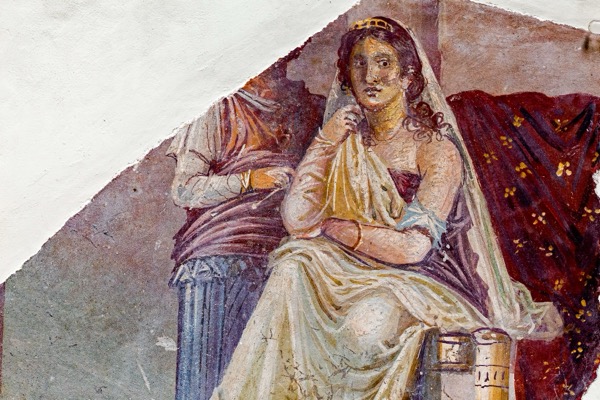
Wall painting of Phaedra and her nurse, Pompeii (British Museum, London)
On the day of her marriage to Theseus, Phaedra sees her husband’s son Hippolytus, with whom she immediately becomes infatuated. When Theseus is reported to have fallen in battle, Phaedra declares her love to Hippolytus, but is rejected.
When Theseus returns home unharmed, Phaedra claims that Hippolytus tried to seduce her, whereupon an outraged Theseus causes the death of his son. Phaedra is devastated with remorse, confesses her guilt, and decides to end her life by poisoning herself.
The subject of forbidden love was one of Britten’s favourite themes, and it resulted in one of the most passionate and emotionally involved of his later scores. Baker reflected on Britten writing Phaedra specifically for her in an interview with The Guardian in 2012.
Benjamin Britten: Phaedra, Op. 93: Oh Gods of wrath (Janet Baker, mezzo-soprano; English Chamber Orchestra; Steuart Bedford, cond.)
“I never asked him, but his gift to me before he died was Phaedra. And that was wonderful. I’m sure it was his way of saying we have worked a lifetime together, so thank you.” (Wroe, The Guardian, 2012)
A Gift of a Lifetime
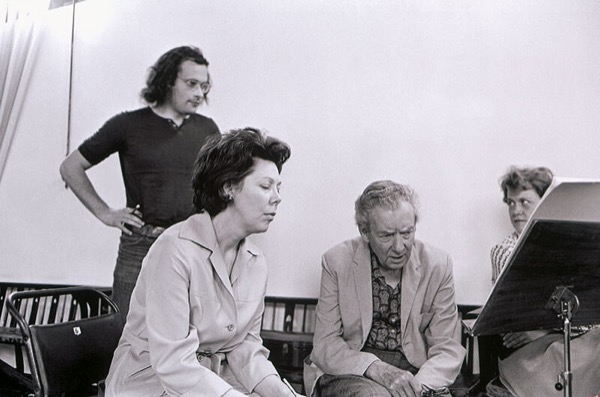
Benjamin Britten and Janet Baker, 1976
In the same interview, Baker also elaborated on her extraordinary relationship with Britten.
“Equally there is a respect and awe that never really leaves when you work with someone like Ben. And if you overstepped the mark, you were finished with him. He had to create some distance or the poor man would have been swallowed by the world.”
“People wanted to own Britten, so maybe that was something that I could appreciate, and we had a friendship until the day he died.” To be sure, in his score Britten was guided by her particular vocal and dramatic qualities. Much of the music is set in Baker’s strong middle range, pushing her into the upper register at moments of passion and rage.
Britten uses small orchestral forces to leave Baker’s voice unusually exposed. This allows her clarity of diction and subtle vocal colouring to produce the psychological intensity for which she was celebrated. He also exploits Baker’s ability to move between speech-like declamation and sustained lyricism.
What is probably most striking in the musical score is its reliance on Baker’s theatrical intelligence. She has to carry the entire dramatic burden, moving through fury, despair, and resignation within a remarkably compressed span. Essentially, the relationship between Britten and Baker was so special because they instinctively understood what the other could achieve.
For more of the best in classical music, sign up for our E-Newsletter
Benjamin Britten: Phaedra, Op. 93: My time’s too short, your highness (Janet Baker, mezzo-soprano; English Chamber Orchestra; Steuart Bedford, cond.)