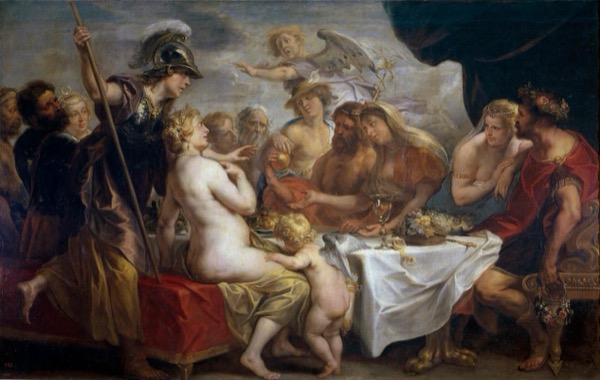
Golden Apple of Discord by Jacob Jordaens
The Work
What a Production! Over seven hours of music, twenty singers, dozens of roles, and a bewildering succession of scenes: Antonio Cesti’s 1660s festa teatrale, Il pomo d’oro, was unambiguously the most fitting birthday present imaginable for the 50th anniversary of the Innsbruck Festival of Early Music in 2026. Even when set alongside the most lavish theatrical beasts of the Baroque period—the spectacles of Francesco Cavalli or the opulent court extravaganzas of Jean-Baptiste Lully—Cesti’s creation looms over them like an utterly unrivalled dinosaur, staggering in its sheer scale and architectural audacity.
Il pomo d’oro – Bringing a Baroque Masterpiece Back to Life | Part 1
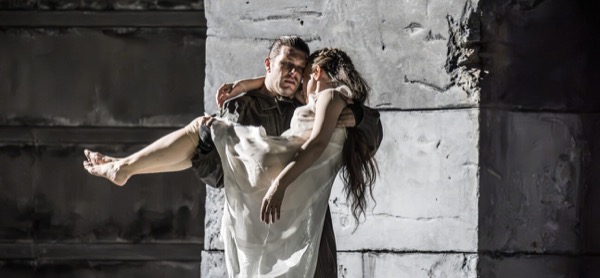
On paper, this monumental work—commissioned by Habsburg Emperor Leopold I to celebrate his wedding to Infanta Margarita Teresa of Spain—is steeped in a thematic complexity that feels strikingly relevant today. In our current world, an increasingly 19th-century-style “jungle society” has re-emerged where geopolitics once again revolves around raw appetite, who can shout the loudest, and who wields the biggest fist. Against this backdrop, Cesti’s 17th-century tale of restless human and divine lust feels surprisingly on the nose. Yet while Fabio Ceresa’s first-ever production since its 1668 premiere delivers a glittering sequence of visual transformations, its true brilliant stroke reveals itself late at night when one reflects in a quiet hotel room. This is a thoughtful staging in which every penny is spent with surgical precision. The visual imagery is instantly accessible, treating complex Western classical tropes with a witty touch that avoids empty conceptualism. Conducted by Ottavio Dantone, a vibrant cast of singers, many of whom were born in the 1990s and even the 2000s, fills the stage with irresistible youthful energy.
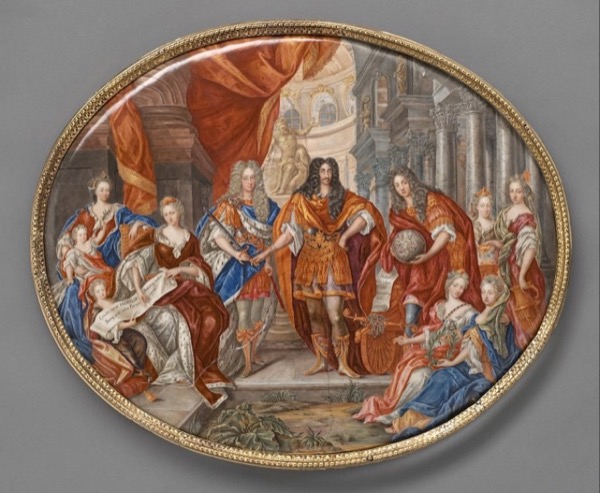
Charles Boit: Leopold I surrounded by his family, 1703, enamel painting on gold plaque
Composed by Antonio Cesti to a libretto by Francesco Sbarra, Il pomo d’oro has a prologue and five acts containing 66 scenes, requiring nearly 40 complex stage transformations featuring flying dragons, thunderbolts, and naval battles. Thematically, the opera expands upon the classical myth of the Judgment of Paris, enriching it with romantic entanglements, divine intervention, and political allegory. Rather than awarding the golden apple to Venus, Pallas, or Juno, Jupiter intervenes in the finale to bestow the prize upon Empress Margarita, hailing her as the supreme embodiment of beauty, wisdom, and virtue—a theatrical compliment designed to glorify the Habsburg dynasty.
For centuries, the opera’s performance history was shrouded in misconception. Early accounts falsely claimed that the opera premiered in 1666 and ran continuously three times a week throughout the year. However, musicologist Carl B. Schmidt proved that scheduled stagings in 1666 and 1667 repeatedly failed to materialise due to construction delays at the Theatre auf der Cortina, financial exhaustion, a severe fire in Vienna, and the premature death of newborn Crown Prince Ferdinand Wenzel. The actual premiere was finally staged across two days in 1668, to mark Empress Margarita’s birthday.
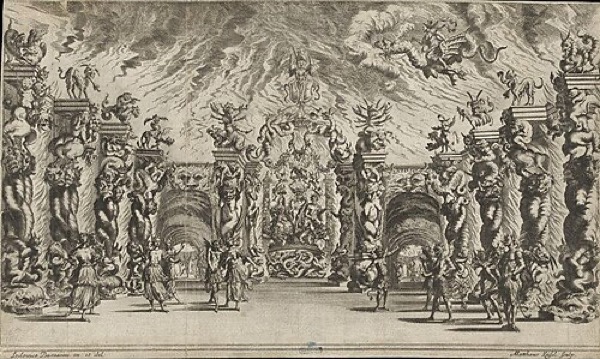
Burnacini’s stage set for the underworld scene
Narrative & Staging
Given its origins as Habsburg court propaganda, the opera’s narrative historically prioritised political flattery and dynastic legitimacy over dramaturgical logic—the main thread threading through countless subplots spanning Olympus, the underworld, and the mortal realm. Ceresa’s directional control respects Francesco Sbarra’s original libretto without imposing forced modernising tweaks, yet he fully unlocks its rich vein of humour. When the comic god Momus (Momo) mocks Mars as little more than a glutton, or when unmissable satirical nods—such as Donald Trump’s recent World Cup red card episode—are made, the staging feels delightfully fresh off the stove. The overarching dramaturgical framework remains solid. The prologue is reimagined as a Pan-European beauty pageant, where glamorously dressed contestants personify the individual Habsburg territories. When Jupiter ultimately decrees in the finale that the golden apple belongs to Miss Europa, this arrangement cleverly ties the original dynastic propaganda into a contemporary concept that satisfies the festive occasion.
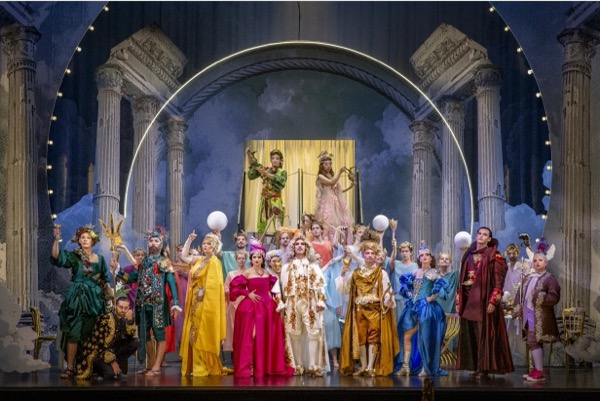
All the gods © Birgit Gufler
Spanning two long evenings, the pace naturally could not feel like a standard three-hour Baroque opera, yet it rarely drags. High-energy divine conflicts seamlessly give way to Greek battle and intimate domestic scenes. Save for a brief thirty-minute stretch at the start of Act III where the narrative thread feels slightly disorienting after the overnight break, the show maintains its momentum. In general, the dramaturgical experience resembles standing before a massive Pieter Bruegel painting: a vast landscape dense with vivid detail, governed by a grand overarching narrative, where every isolated corner remains flesh-and-blood human and rewarding to examine.
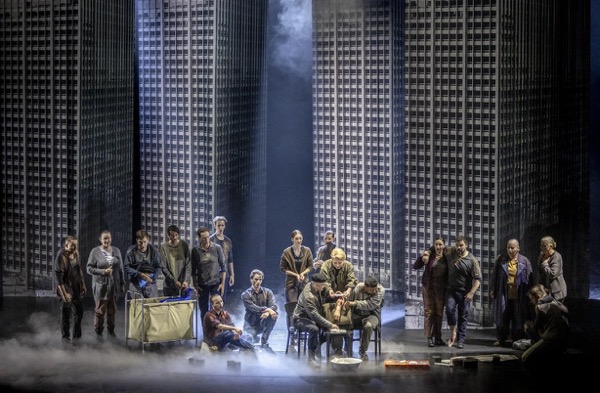
Filippo Mineccia (Adrasto), Margherita Maria Sala (Alceste), José Coca Loza (Sacerdote) choir © Birgit Gufler
Nikolaus Webern’s stage design mirrors this Bruegelian spirit, remaining lively, inventive, and visually witty throughout. The production relies on sharp, intuitive spatial contrasts that keep the audience engaged over seven full hours. We move seamlessly from a rugged, menacing Underworld—where jagged, craggy rock formations carved out of a bruised purple cavern frame desolate stone peaks—to a radiant, classical Mount Olympus framed by towering marble columns, bathed in light, and encircled by a glowing halo that crowns the shimmering array of gods and goddesses below. Paris and Ennone’s home is rendered as a sleek, contemporary luxury apartment complete with a marble bathtub. Meanwhile, the Greek city-states are depicted as a melancholic, monochromatic skyscraper jungle, providing a dark backdrop for divine incitement that feels slightly predictable. This contrasts vividly with Paris’s sea voyage, framed inside a modular ship cabin rocking amid low stage fog while Nettuno commands the turbulent blue waters with his glittering trident.
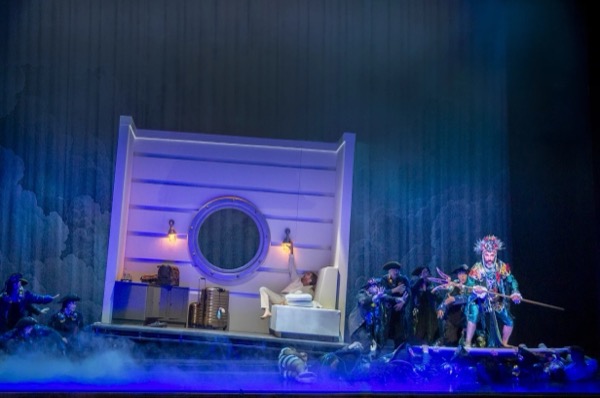
Mauro Borgioni (Paride), Federico D. E. Sacchi (Nettuno), choir © Birgit Gufler
Il pomo d’oro – Bringing a Baroque Masterpiece Back to Life | Part 2
The Cast
The casting shows meticulous care. Most singers double in multiple roles across the mythic and allegorical planes, and there is no obvious weak point in the entire line-up.
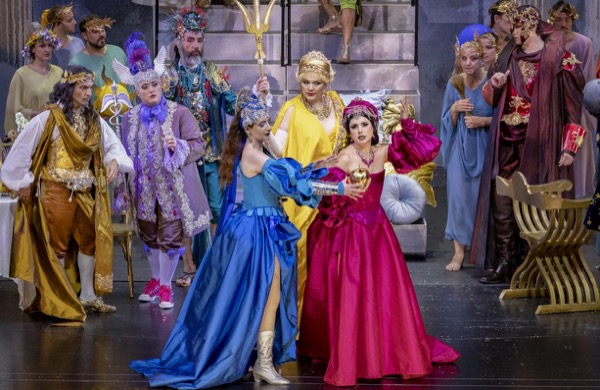
Shira Patchornik (Pallade), Jone Martínez (Venere), Sophie Rennert (Giunone) © Birgit Gufler
The three quarrelling primary goddesses are genuinely stunning. Unabashed in their hunger for the golden apple, they scheme through their respective proxies and drop their divine dignity the moment frustration strikes, acting remarkably like ordinary mortals. Draped in imperial yellow, Sophie Rennert’s Juno (Giunone) embodies Jupiter’s proud, entitled wife. Her obsession peaks when she tries to bully Momus with a thunderous rainstorm, only for the witty, unbothered Momus to brush it off effortlessly. Dressed in bright blue, Shira Patchornik’s Pallas (Pallade) delivers a metallic, razor-sharp vocal tone that endows the warrior goddess with an edge of pride and hysterical desperation. Resplendent in seductive red, Jone Martínez’s Venus (Venere) captures the essence of raw attraction. Unlike her rivals, who rely on money and weapons to bribe Paris, she effortlessly manipulates male desire by offering him Helen, navigating her second-act sensual arias with a remarkably flexible, fluid vocal line. Balancing these three demanding women is no easy task for Jupiter (Giove) in Giacomo Nanni’s work. While his presence felt slightly understated during the opening banquet scene on night one, he firmly commanded the stage by the second night’s finale, using his solid, persuasive baritone to settle the dispute.
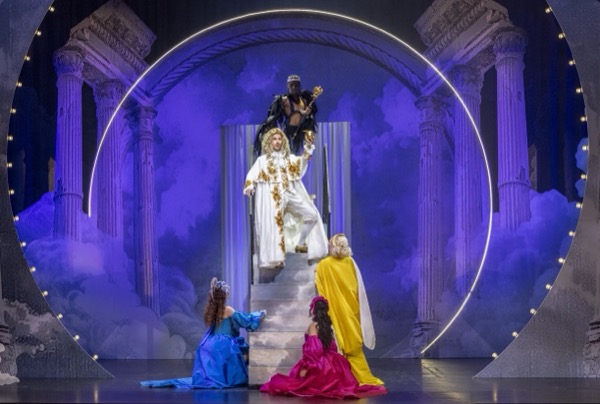
Giacomo Nanni (Giove), Shira Patchornik (Pallade), Jone Martinez (Venere), Sophie Rennert (Giunone), dancer © Birgit Gufler
Among the supporting cast, Rocco Cavalluzzi’s Momus is an absolute highlight. Without this vibrant, humorous jester, Cesti’s complex plot could easily collapse under its own weight. Far from mere comic relief, Momus ties the entire narrative together, offering cool, sharp commentary that feels refreshingly contemporary. Having pegged Paris as an unreliable fraud early on, Momus warns Ennone. However, her stubborn devotion is not so easily broken, and Rémy Brès-Feuillet’s Aurindo only manages to win her affection at the end of the opera despite his persistent secret crush. In the domestic scenes, Alberto Allegrezza’s Filaura commands complete attention with uninhibited, rustic humour. His robust tenor voice gives the drag role hilarious comedic weight; alongside Momus, Filaura shows true loyalty by intervening to stop Ennone’s suicide attempt. Meanwhile, Mauro Borgioni’s Paris (Paride) comes across as hypocritically pious—utterly defenceless against Venus’s seductive bribes while shamelessly betraying Ennone. From a modern spectator’s standpoint, Ennone’s prolonged process of finally giving up on Paris feels a bit drawn-out.
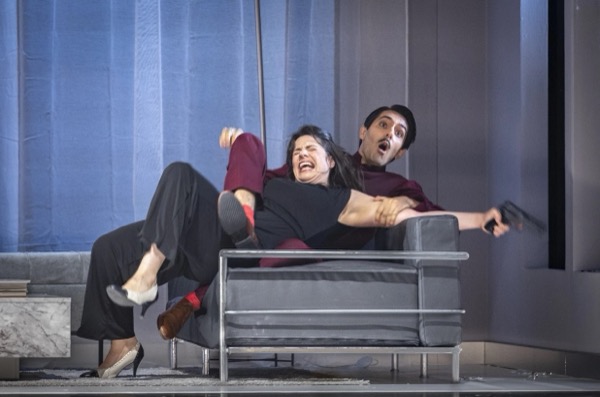
Rémy Brès-Feuillet (Aurindo), Mathilde Ortscheidt (Ennone) © Birgit Gufler
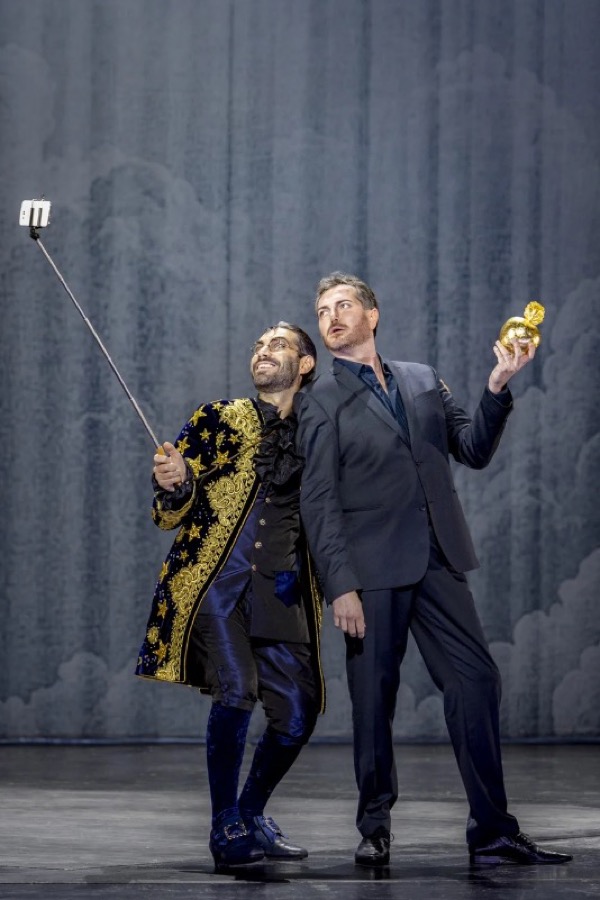
Rocco Cavalluzzi (Momo), Mauro Borgioni (Paride) © Birgit Gufler
In contrast, Federico D. E. Sacchi (Cecrope) and Margherita Maria Sala (Alceste) offered a rare portrayal of genuine devotion. Their quiet mutual support amid the cold skyscraper staging provides a rare moment of intimacy in an otherwise restless opera. Sacchi also doubles as Nettuno, capturing the realistic frustration of a sea god who understands his practical limits yet must obey a more supreme goddess’ top-down political orders. The broader cast maintains this exceptional standard: Jiayu Jin’s Amore was nimble and delicate, Neima Fischer’s Proserpina effectively conveyed the frustration of her underworld marriage, José Coca Loza delivered a grounding Caronte that feels even more convincing than his Plutone, and Žiga Čopi’s young Marte portrayed a proud war god whose confidence shone even when his vocal projection occasionally came across as slightly light.
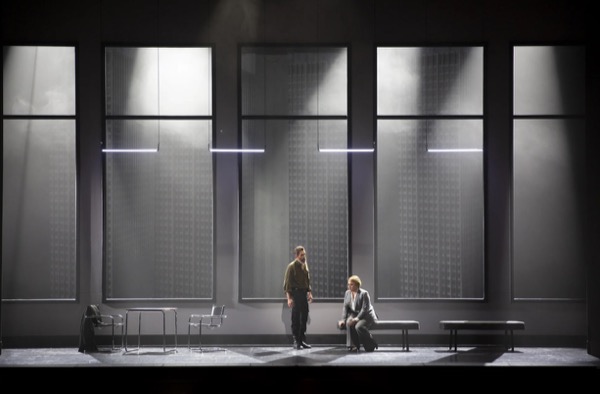
Federico D. E. Sacchi (Cecrope), Margherita Maria Sala (Alceste) © Birgit Gufler
Il pomo d’oro – Pietro Antonio Cesti: Interviewing Dantone
Final Thoughts
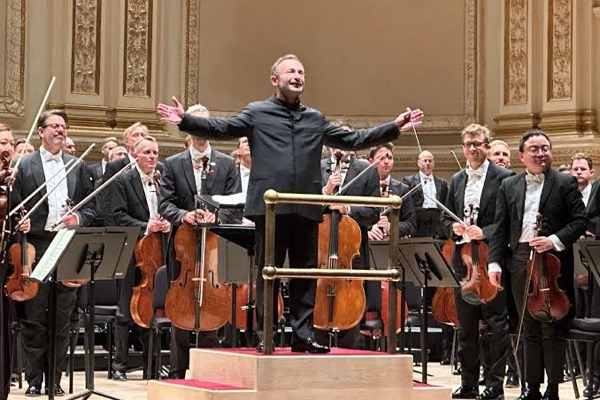
Special praise must be reserved for Ottavio Dantone and Accademia Bizantina, who clearly relished this Herculean labour. Although the Viennese manuscript of Il pomo d’oro long survived in an incomplete state lacking Acts III and V, surviving fragments preserved in Modena’s Biblioteca Estense—including arias composed by Emperor Leopold I himself—provided the vital key. Dantone drew upon these Modena fragments and his sympathetic understanding of Cesti’s idiom to complete the lost musical passages. Trimming the overall score with care to keep each evening to roughly three and a half hours, he successfully resurrected Cesti’s “unperformable” imperial masterpiece in its full, five-act entirety at the Tiroler Landestheater for the first time since 1668. In the pit, Accademia Bizantina performed with rare focus and freshness. Their execution of Cesti’s imitative counterpoint was exceptionally clear, anchored by a solid, grounded foundation in the lower strings that supported the opera’s intricate melodic textures like a great oak tree. Over this rich musical tapestry, the NovoCanto Chor and the dancers flourished beautifully, bringing Dantone’s historic reconstruction to vibrant life.
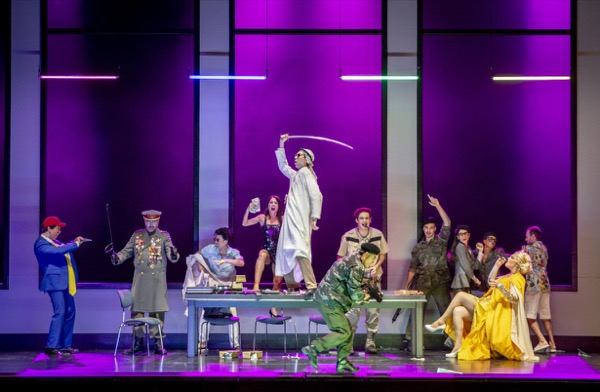
Giacomo Nanni (Eolo), Mauro Borgioni (Euro), Jiayu Jin (Zeffiro), Danilo Pastore (Volturno), Žiga Čopi (Austro), Sophie Rennert (Giunone), choir and dancers © Birgit Gufler
With this ambitious production, Innsbruck reaffirms its premier position on the European early opera map, staying true to its celebrated tradition of bringing rare yet historically vital works to life through scholarly informed stage performances. While we cannot realistically expect another staging of this gigantic work anytime soon, an upcoming CD recording will thankfully allow this monumental effort to reach a wider audience. Listeners and performers alike can feel proud to have experienced/participated in a true once-in-a-lifetime event. Additionally, this production does more than satisfy the senses—it sparks genuine curiosity: how did the 17th-century Habsburg court, as an absolute monarchy, interpret this unabashed, mocking depiction of gods behaving like flawed, petty mortals?
For more of the best in classical music, sign up for our E-Newsletter
Antonio Cesti: Il pomo d’oro: Sinfonia – Prologue: Amore et Imeneo (Francesca Aspromonte, soprano; Il Pomo d’Oro)