By now, you probably know that Franz Schubert is one of my favourite composers. I hope you forgive me for saying that the richness and subtlety of his melodic and harmonic language are unequalled in the world of classical music.
We have long been told that his music was not popular during his lifetime, but nothing could be further from the truth. Between 1821 and his untimely death in 1828, he published almost double the rate of Beethoven’s output over the same period. In particular, his songs, piano dances and other short works enjoyed great popularity.
Eternal Musical Legacy
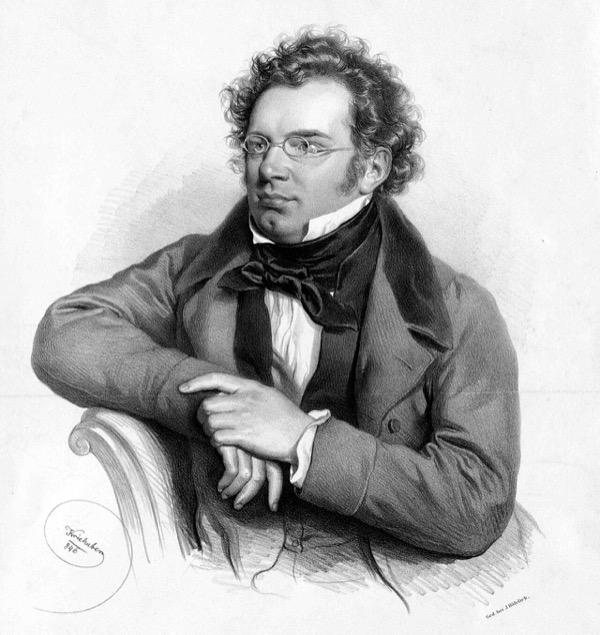
Franz Schubert
Schubert was in his late twenties when he fell seriously ill, and the experience profoundly affected his outlook on life. He wrote to his friend Leopold Kupelwieser in March 1824, “I feel myself to be the most unhappy and wretched creature in the world. Imagine a man whose health will never be right again…”
Franz Schubert died on 19 November 1828, aged just 31. To commemorate the anniversary of his death, let’s celebrate the wonderful afterlife of his music on the silver screen, as his melodies have found their way into a variety of films.
Schubert: Ave Maria (Fantasia)
From Darkness to Light
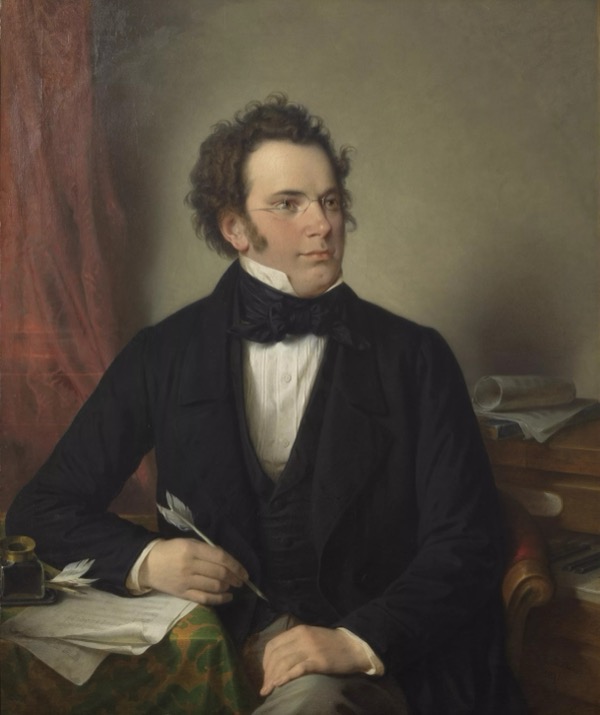
Franz Schubert by Wilhelm August Rieder (1875)
In 1825, Franz Schubert prepared a musical setting of Sir Walter Scott’s epic poem “The Lady of the Lake.” In the story, a vengeful king persecutes the heroine, Ellen Douglas, who, in turn, hides in a mountain cave and asks the Virgin Mary for help.
Schubert composed a setting for voice and piano, entitled “Ellen’s Third Song.” Designated as No. 6, it eventually became part of a seven-song cycle, published as Op. 52 in 1826. Since Scott’s original poem makes frequent references to the Latin prayer “Ave Maria,” an unknown enthusiast discarded the original words and fitted the full text of the Roman Catholic prayer to Schubert’s melody.
In Walt Disney’s Fantasia of 1940, this familiar music takes on a different dimension. It is used during the closing sequence of the film in Leopold Stokowski’s orchestral arrangement. It follows Mussorgsky’s Night on Bald Mountain and the demonic celebration of the dark spirit presiding there.
As dawn approaches, a solemn procession of monks carrying candles moves through the misty landscape. Schubert’s music accompanies this wonderful transformation from darkness to light, providing an almost otherworldly serenity.
Schubert: Ave Maria (The Batman)
Disturbing New Meaning
A single melody can have multiple meanings, and while Schubert’s Ave Maria represented the triumph of light over darkness, in Matt Reeves’ The Batman of 2022, the very same melody is associated with murder, vengeance, and a deeply troubled childhood.
It might be surprising, but in this film, this serene music is closely connected with the film’s principal villain, the Riddler. The music is immediately heard in the opening scenes, and we discover that the Riddler, as a young orphan, was singing this song in a children’s choir.
The melody is part of his childhood memories, including abandonment. The composer Michael Giacchino subtly distorts the Schubert melody, and it takes on an unsettling atmosphere. It begins to sound obsessive and ominous.
It is one of the really scary parts of the film when the Riddler sings the “Ave Maria” during his imprisonment in a State Hospital. The transformation is stunning. What had been a prayer for protection is now the expression of the resentment and rage of a disturbed mind.
Schubert: The Trout (Sherlock Holmes: A Game of Shadows)
A Musical Catch
One of Schubert’s most famous and best-loved compositions is nicknamed after a fish. That is only partially true, as the famous “Trout Quintet” is nicknamed after a song that features a fish. Schubert’s song “Die Forelle” (The Trout) was enormously popular and was published several times during his lifetime.
The “Trout Quintet” was composed on commission, and Schubert effortlessly weaves one of his most delightful and magical melodies into an impressive blend of musical narration. You might remember the fourth movement, with its set of six delightful variations on the “Trout” theme, prominently featuring the famous water motif.
The “Trout” found an unexpected cinematic home in the 2011 film Sherlock Holmes: A Game of Shadows. It is not used as background music, but becomes an essential part of the psychological duel between Sherlock Holmes and his arch-enemy, Professor Moriarty.
Just as the fisherman eventually catches the fish by clouding the waters, so does Moriarty capture and torture Holmes. With Holmes tied and helpless, “The Trout” is played over the loudspeaker, with Moriarty singing along. After all, he has finally caught his elusive opponent.
Schubert: Piano Trio in E-flat (Barry Lyndon)
A Love Story Without Words
When Stanley Kubrick was looking for music to accompany his film Barry Lyndon of 1975, he selected Schubert’s Piano Trio in E-flat Major, D. 929. He explained that he chose the trio because it struck the right balance between tragedy and romance, without being excessively Romantic.
Initially, he wanted to use only eighteenth-century music, but he could not find a suitable tragic love theme from the period. This epic historical drama tells the early exploits and later unravelling of an 18th-century Irish rogue and gold digger who marries a rich widow to climb the social ladder.
Barry first encounters Lady Lyndon at the casino, and when she withdraws to the balcony, he follows her. They exchange glances before kissing, all to Schubert’s music. All that tenderness and longing are expressed without speaking a word.
To many film lovers, Stanley Kubrick was a genius because he understood that a melody by Schubert could convey the beauty of falling in love and the sadness of knowing happiness may be fleeting. Schubert completed the trio just one year before his death, and it surely expressed his deepest human emotions.
Schubert: Piano Sonata No. 21, D. 960 (Little Women)
Beauty and Turmoil
The second movement of Schubert’s Piano Sonata in B-flat Major, D. 960, was written just two months before Schubert’s death. I think we all agree that this is one of the most hauntingly beautiful creations in the piano repertoire.
We find a gently rocking melody over a pulsating accompaniment, yet beneath that serenity lies a complicated emotional world. Ominous trills interrupt the calm, and the music becomes more troubled. The original calm does return, but it is never quite the same.
And it is these qualities that prompted Greta Gerwig to use this music in her 2019 film Little Women. The story is based on Louisa May Alcott’s famous novel, and here the music is used for its extraordinary intimacy and emotional depth.
Beyond the Music
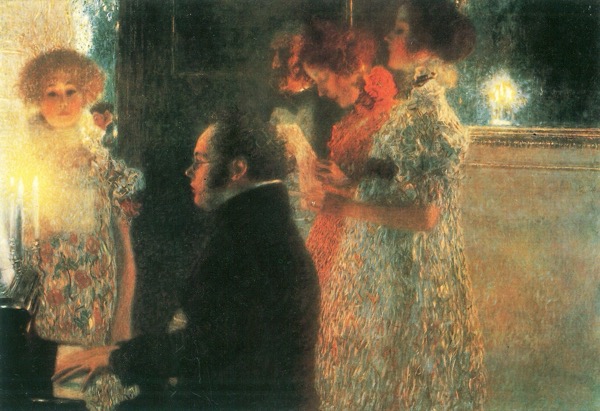
Schubert at the Piano by Gustav Klimt (1899)
Let’s conclude our excursion into the lands of the silver screen with a dramatised biographical portrait of the composer himself. The Temptation of Franz Schubert offers a look beyond the familiar image of the musical genius and introduces us to the complicated human being behind the masterpieces.
The film takes us into the troubled corners of Schubert’s private life, and through memories and encounters we discover a man of extraordinary musical imagination and emotional turmoil. Predictably, the film incorporates excerpts from several compositions.
Nearly 200 years after Schubert’s death, his music still speaks to us through a variety of different settings, finding new life on the silver screen. Truly great music transcends the boundaries of time, don’t you agree?
For more of the best in classical music, sign up for our E-Newsletter