American composer Morton Gould (1913–1996) wore many musical hats, being a composer, conductor, arranger, and pianist. As a pianist, he started his career playing piano for silent movies and was the staff pianist for the newly opened Radio City Music Hall when he was only 19. In 1935, he conducted and arranged orchestral programs for WOR radio in New York, reaching a national audience through the Mutual Broadcasting System. He conducted the orchestras for television shows, composed film music, and was the first musical director hired by an advertising agency. He composed for Broadway, for television series, and for ballet.
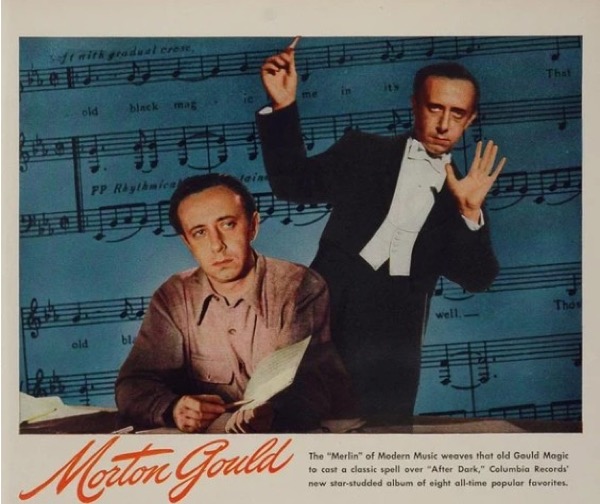
Morton Gould in a 1945 ad for Columbia Records
As a composer, his music was known for its seamless combination of different musical genres in classical forms. One example of this was the work he wrote to celebrate his marriage to his second wife, Shirley Bank. They married in 1944, and in 1945, he wrote Harvest.
He intended the work to celebrate their life together, and it carries a strong American feel. It can be compared to the works of both Roy Harris and Aaron Copland, and it is more like an abstract tone poem, rather than being directly programmatic.
The work opens with a melancholic and reflective sound and changes in the second half to a more active sound that seems very western in flavour. This is the part that sounds more like Copland, yet with a deeper reflection than Copland’s music contains.
Morton Gould: Harvest (New Russia Orchestra; David Amos, cond.)
Most of Morton Gould’s work is known for its more popular touch, and this experiment in 1940s music as a tone poem carries us into new realms for Gould. The piece was written for the unusual (but very American?) combination of strings, harp, and vibraphone; the austere harp sound contrasts strongly with the jazzier vibraphone sound. Listen for the clipped cadences in the second half that sound like we’re in the midst of hoedown music. The vibraphone melody combined with pizzicato strings is very unusual, and as we listen deeper and deeper, we can hear so much more in this music. It’s a rhapsody to American freedom, particularly to the freedom of American musical composition.
As a work for his new bride, Harvest is an interesting overview of not only American music and the activities of the fall but also a reflection on the broader musical world of the 1940s.
For more of the best in classical music, sign up for our E-Newsletter