During this interview, I swap seats with another artist and ask the questions I wish I were asked. Today, I meet with Gabriel Prokofiev and Inna Faliks, following the premiere of Gabriel’s Concerto for Minimoog Synthesizer and Orchestra.
Gabriel, Inna, before we get into the music, could you each introduce yourselves? What has shaped your musical journeys so far, and what are the ideas or interests currently driving your work?
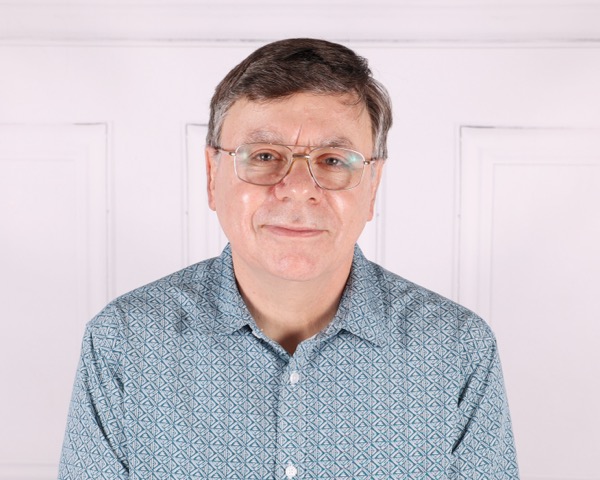
GP: Hello, I am Gabriel Prokofiev. I am a composer of classical and electronic music. I grew up in the 1980s and 1990s, and I was actually a big fan of synth-pop as a kid, and then electronic dance music as a teenager. When I was about thirteen, I got my first synthesiser. At the same time, I was studying classical piano and playing the French horn, and throughout my teens I played in many orchestras and choirs. I started writing pop songs with my friend Nathan when I was ten years old and just fell in love with the magical feeling of creating and composing. A few years later, I wrote a few classical compositions, and that opened my passion for classical music.
At the University of Birmingham, I studied electroacoustic music – the classical approach to electronics – and that really opened my mind to the vast possibilities of electronic music, as well as developing my classical approach to composition and the idea of longer-form works. However, when I was doing a master’s in composition at York, I became disillusioned with the contemporary classical world. It felt so inward-looking and disconnected from wider cultural life, so I formed an electro-funk-punk band, Spektrum. We toured Europe and released two albums.
After a couple of years, however, I realised that my passion for classical composition just could not be ignored, and I wrote my first string quartet. I wanted to share it with my own peer group, people who were not going to classical concerts, and that was when I set up Nonclassical, a record label and club night presenting classical music in a non-traditional way. Nonclassical is still going strong twenty years later. My career as a classical composer became full-time in 2011, when I left the band. But the electronic sounds and beats I produced in the 2000s became an important part of my musical language, giving my classical work a unique style and a connection to contemporary culture.
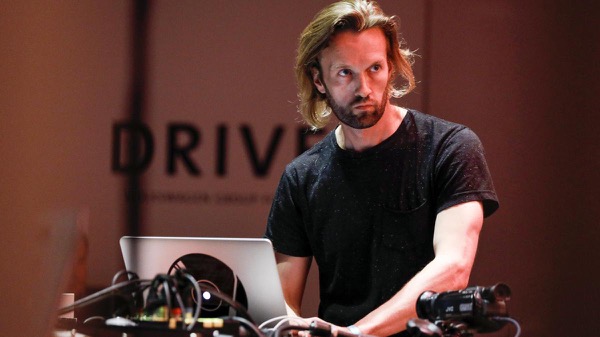
Gabriel Prokofiev
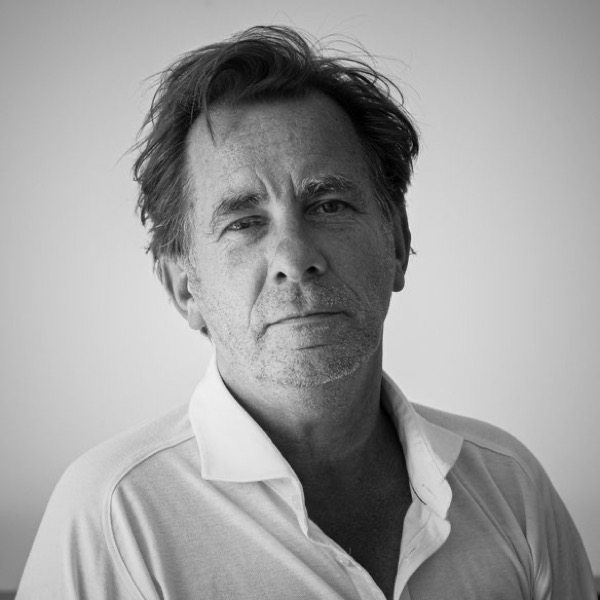
IF: I am a concert pianist, recording artist, author, storyteller and professor of piano at UCLA. When I was a child, I immigrated from Odesa, Ukraine, to the United States as part of the last wave of Jewish refugees in the late 1980s. I think that my very creative childhood, the musical city I am from and its immense classical music heritage (Gilels, Richter, Milstein, etc., were all from Odesa) inform my sound and my personality.
I composed as a kid, read and wrote poetry and plays, and my many interdisciplinary projects today stem from this creative upbringing. After Odesa, I grew up in Chicago, then Baltimore, New York and now Los Angeles, where I am Head of Piano at the UCLA Herb Alpert School of Music. I bring all these threads together in my memoir, Weight in the Fingertips: A Musical Odyssey from Soviet Ukraine to the World Stage.
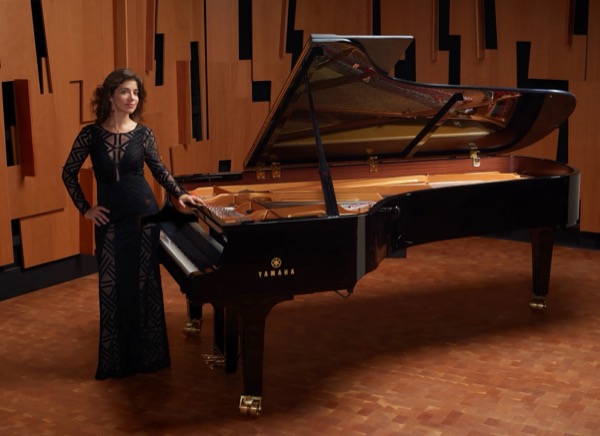
Inna Faliks
How did the two of you first meet? What brought you together musically, and what was it about each other’s work that sparked the desire to collaborate?
GP: We met at a big conference in Cremona. I fell in love with Inna’s remarkable piano playing. She has the technique and musicality that greatly inspire me, and she comes from that Slavic piano tradition that I am really drawn to, so I knew I wanted to work with her. Plus, Inna is very open to exploring new directions in classical music and was open to the idea of playing a synthesiser concerto.
I was looking for a top-level concert pianist to perform the concerto, as I wanted someone with real virtuoso chops and experience playing alongside orchestras. Interestingly, we also share roots in Ukraine (my grandfather was born in Donetsk, and my great-great-grandparents lived in Odesa).
IF: I found Gabriel to be so humble and refreshingly down-to-earth; he was just himself. I knew him to be a composer who crosses genres in a very interesting way, but also so naturally, so inevitably. I am very interested in crossing genres and disciplines, bringing together different audiences and people, and uniting them through something beautiful, exciting, passionate, and sincere, so his work immediately spoke to me.
When I performed in London – my one-woman show, Polonaise-Fantasie: The Story of a Pianist, where I play and tell stories from my life in a sort of recital-monologue – he came, and we got to know each other better. Then he asked me about the Minimoog Concerto, and a number of things aligned to make this possible.
At first, I wondered: can I do this? I am a classical concert pianist. My playing is all about colour, storytelling through sound, emotion, big technique, musical textures, and the richness of acoustic sound. How can I make it work on a monophonic electronic instrument that is three octaves long? And then I got into the music and realised it was going to be an exciting and wonderful thing, and that it would work.
Let’s turn to the Concerto for Minimoog Synthesizer and Orchestra. How did the idea come about, and what were you hoping to explore by bringing the Minimoog into a concerto setting?
GP: I have always been into synthesisers. When I was a teenager, I owned a Yamaha DX100 and also learnt to programme the Roland Juno-60 and SH-101. Then, in my twenties, I started to collect synths, and I love exploring the sonic possibilities of each synth. So composing a synthesiser concerto was a dream project for me, something I was “born to do”, I think. I started thinking about the idea at least ten years ago, but other projects took over until I finally decided it had to be my number one priority. I then started reaching out to orchestras with the proposal.
It was a very natural decision for me to choose the Minimoog as the solo instrument. There are several reasons. Firstly, it was the very first compact, mass-produced performance synthesiser, and the first instrument to make synthesisers widely available to more musicians. In fact, it revolutionised electronic music. Secondly, its design and sound-generating structure set a standard that has influenced most synths since. It is really the godfather of synths. Thirdly, it has become a “classic” instrument, as it continues to be built in its original design to this very day, whereas many other classic synths are not reissued as faithfully to their original design. Fourthly, it is monophonic, so it can act like a solo violin or solo saxophone and be a clear melodic solo instrument. Fifthly, it sounds fantastic! The Minimoog has such a powerful and soulful sound. Its bass is so rich and its high frequencies so strong, and its sonic potential is huge. Even though it was invented over 50 years ago, it can still sound completely contemporary. Finally, it is called the Minimoog “Model D”, just like the world-standard concerto instrument for piano concertos: the Steinway “Model D”. For me, that coincidence showed that it was destined to be a concerto soloist!
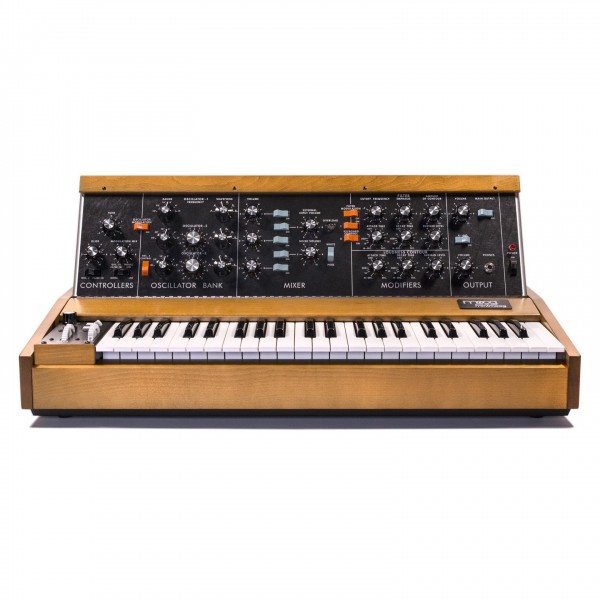
Minimoog Model D synthesiser
Because of the huge sonic possibilities of the instrument, I really wanted this concerto to showcase a wide range of sounds that the Minimoog can produce and also connect to the different styles of electronic music in which those types of sounds have evolved. So there are sounds reminiscent of acid house and rave music; heavy drum sounds that remind us of hip-hop and electro; dark bass sounds that connect to grime music; then more lyrical sounds that remind us of the theremin.
Each of these sounds draws the concerto towards those styles of music, and so sometimes the orchestra becomes a huge rave track or a pulsing grime track, while at other times it provides a more traditional concerto accompaniment.
IF: I think that, for me, the idea is that in working on this concerto and getting to know it – and, of course, in learning the Minimoog – I get to still be completely myself as a performer. The part is a virtuoso keyboard part, and the orchestral writing is incredibly rich and well written, making it a great partner to the soloist. In that respect, the Minimoog takes a traditional soloist’s place, and it has never had music written for it that makes it sound like it does here.
G Prokofiev: Synthesizer Concerto -EXCERPTS- Inna Faliks (minimoog) & Orquestra Sinfónica do Porto
I think it is really a game changer for the instrument – and also for me. I never knew I could fall in love with this instrument as I have. Also, I feel that it bridges completely different audiences because it brings together so many types of music – funk, rock, classically elegant orchestral writing, lush orchestration, EDM and a myriad of sounds I did not know I would ever get to make.
Gabriel, you have been experimenting with the concerto form for some time, first with the turntable and now with the synthesizer. What draws you to placing these instruments in dialogue with an orchestra? How does each one challenge or expand your understanding of the traditional concerto?
GP: Back in 2006, I composed a Concerto for Turntables and Orchestra. This became a really important piece in my career, as it explicitly illustrated my passion for bringing contemporary instruments into the classical orchestra. A few years later, I composed a concerto for bass drum, another unlikely orchestral soloist. And probably around that time, the idea of composing a synthesiser concerto started to float around in my thoughts.
Each of these instruments brings a new and contemporary energy to the classical orchestra. The turntables evolved out of hip-hop culture in the late 1970s, and so some elements of hip-hop can be heard in my turntables concerto, as well as new directions for the instrument. Composing a concerto for synthesiser allowed me to bring in some wonderfully dirty sounds, reminiscent of the sounds I heard when going to raves in the 1990s. These sounds are such an important part of contemporary culture but are never heard in an orchestral context, so it was a real thrill to bring these magical electronic sounds into the orchestra.
BBC Proms 2011: Gabriel Prokofiev – Concerto for Turntables and Orchestra
As a lover of the concerto form, I still stay quite true to the classical structure, with four movements, including a slow movement and a driving finale. But these new instruments bring a very contemporary energy into the tradition, connecting it to modern culture.
Inna, before working with Gabriel, you had little experience with the world of synthesizers. How did you navigate this unfamiliar territory, and what did the process reveal to you about your own musical approach and possibilities as a performer?
IF: I got Gabriel’s Minimoog in the mail, along with the score. I just dove in. At first, it seemed impossible. I am not the most tech person to begin with. I had never had to deal with oscillators, this type of keyboard or a monophonic texture. The piece is challenging musically, so even if I did not have to worry about how to mix the sound, it would still be a challenge.
Because no sound is pre-programmed, every bit is like something a bartender mixes on the spot to make a unique libation. A touch of Control Frequency, a bit of Loud Attack, changing the Sustain by a tiny bit, moving the Mod Wheel ever so slightly – every little thing makes a difference. The possibilities are huge (and the possibilities of disaster – like no sound coming out – are also a nightmare I have never had before! As pianists, no matter what, we press down and sound comes out! Not so with the Minimoog).
At first, I learned all the motions. I had to almost automatically remember what to turn and when. Some big patch changes are always scary, even a year later. Then certain things became more intuitive. If I heard that the mix of sound was not right, I began to know what I needed to do to change the sound, whereas before I would have been stumped. I am more confident now in my intuition at the instrument, I think, though after a year and a few months, I am, of course, still learning.
In the end, it is about this intuition to make colour and tell a story, regardless of the instrument. Little by little, I realised that my feeling for colour, for drama, my love of funky rhythms, of exciting build-ups, of playfulness, of relentless musical energy – can help me. In the end, I just have to play the piece with the same confidence and virtuosity that I would on the piano.
It was amazing discovering the instrument with Gabriel’s help, and through his eyes. He has known it all his life, so when something does not work, I just ask him, and he usually fixes it in a second. On the other hand, he is an amazing sounding board for musical ideas. I feel like he truly listens and tries to understand the player in the most sensitive way. That is kind of a dream when you work with a composer. He is meticulous in what he wants, but also really sensitive to what I feel.
Looking beyond this project, what are you both currently working towards? What new ideas, collaborations or musical territories are you most keen to explore, and where would you like to take your work next?
GP: I found composing for Minimoog and orchestra so inspiring that I would love to do more with this combination. Maybe a dance suite for synth and orchestra could be a future project…
Right now, I am working on some pieces for cello and piano – going right back to the basics! Then, in May, I will have my music choreographed for a new ballet in Warsaw with the Polish National Ballet. I am also planning to compose a Theremin Concerto for theremin maestro Thorwald Jørgensen. We are just starting to approach orchestras for the commission, so look out for that in two to three years!
IF: I am making quite a few recordings of different projects – most recently, Stranger Things: Piano Works from a Young Refugee’s Backpack. This has music by Wagner, Brahms and Schoenberg, as well as two of my own compositions that I wrote as a kid. I am getting back to composition more now. This is exciting for me. I also just finished writing my first novel – a murder mystery in the classical music world.
I hope to do more with the Minimoog and with Gabriel. Maybe a piano concerto? I am also excited that my poetry-music series, Music/Words LA, will feature Gabriel’s music in Los Angeles soon. I hope that we get to perform together more, perhaps on some electronics-piano projects.
This season, I have a solo recital at Carnegie Hall (Weill Hall) on March 11, and I also get to play Clarice Assad’s Lilith Piano Concerto, written for me, with the brand-new Harmonium of Texas. Grateful for this life in music!
Thanks very much, Gabriel and Inna. And a last one for the road — one book, one album, one film: tell us about your latest cultural findings?
GP: Book: The Bee Sting by Paul Murray is one of my favourite recent reads. I loved it so much that I then read his three other books straight afterwards. Album: Balladeste’s Imprints – their new album, which came out a few days ago. I was at the launch event, and they have such a unique and appealing musical language. I love Preetha’s Indian classical violin playing. Film: I saw the new film Behemoth! a couple of weeks ago. It is about the life of a cellist (Pedro Pascal), directed by Tony Gilroy. I was really impressed by its sensitivity, and it was so enjoyable to see the lives of orchestral musicians explored on the big screen.
IF: Books: The Odyssey by Homer, translated by Emily Wilson, and Contraposto by Dave Eggers. The first is an absolute delight that feels as fresh and wondrous as a new work. I love how certain terms repeat, like musical cells (“wine-dark sea”, etc.). I love the humanity and flaws of Odysseus, and the lessons in the situations he finds himself in. Contraposto is simply the most beautiful book I have ever read about the life of a painter. Honest, funny, pained yet hopeful – just a perfect novel in every way. Album: Gabriel Prokofiev’s Dark Lights. Film: Fellini’s Amarcord.
Drawing on their collaboration, Prokofiev and Faliks show how technology can become an extension of musical expression rather than an end in itself. Through the encounter between the Minimoog and the orchestra, they bring electronic and classical traditions into dialogue, combining virtuosity, experimentation and imagination to explore new possibilities within the concerto form.
For more of the best in classical music, sign up for our E-Newsletter