Paul Hindemith, born on 16 November 1895 in Hanau, a small town near Frankfurt, quickly became a leading figure in the German avant-garde. He composed in a variety of genres, including orchestral works, chamber works, solo piano pieces, songs, and even an opera.
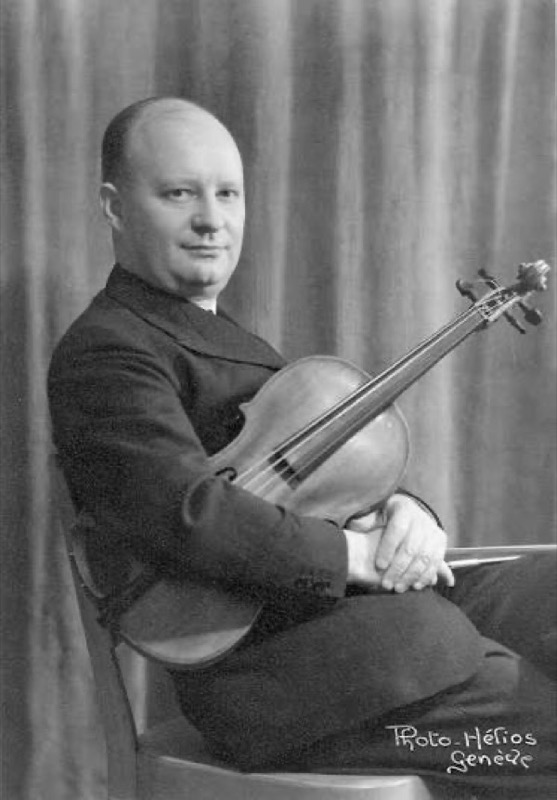
Paul Hindemith
While he was greatly admired, Hindemith was not universally acclaimed. Theodor Adorno called his music “symptomatic of a false social consciousness,” and condemned it as “being not truly useful at all.”
Hindemith, like many of his fellow composers, was forced into exile due to his political affiliation or religious beliefs. He emigrated to the United States in 1940, and to celebrate his birthday, let’s take a closer look at his Metamorphosis after Themes by Carl Maria von Weber, one of Hindemith’s most frequently performed works to this day.
Paul Hindemith: Symphonic Metamorphosis after Themes by Carl Maria von Weber: I. Allegro (BBC Scottish Symphony Orchestra; Martyn Brabbins, cond.)
Abandoned Collaboration
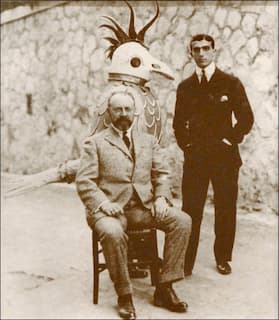
Henri Matisse and Léonide Massine preparing the ballet Le chant du rossignol (debut February 2, 1920) with the mechanical Nightingale.
The idea for the Metamorphosis came from the choreographer Léonide Massine, with whom Hindemith had collaborated with on the 1938 ballet Nobilissima visione, about the life of St Francis of Assisi.
Massine wanted an orchestral arrangement of Weber’s music, whereas Hindemith entertained the idea of a more complex variation piece. Hindemith’s concept proved too complicated for Massine’s needs, and they abandoned the plans.
Hindemith continued with the composition even after he dropped out of the ballet project, so he could fall back on a nearly finished work when he received a commission from Artur Rodzinski, the new chief conductor of the New York Philharmonic, in 1943.
Paul Hindemith: Symphonic Metamorphosis after Themes by Carl Maria von Weber: II. Scherzo (Turandot): Moderato – Lebhaft (BBC Scottish Symphony Orchestra; Martyn Brabbins, cond.)
Weber’s Forgotten Themes
The Metamorphosis premiered in New York on 20 January 1944. The music also found a theatrical home in George Balanchine’s Metamorphoses, choreographed for the New York City Ballet and performed by the company in November 1952.
The first movement of Hindemith’s Symphonic Metamorphosis after Themes by Carl Maria von Weber is based on the little-known Eight Pieces for Four Hands, Op. 60, composed around 1818, by Weber.
Nos. 4 and 7 frame the work, and he selected the exotic overture to the drama Turandot as his Scherzo. Weber’s Turandot is based on a single Oriental theme he found in Rousseau’s Dictionnaire de la Musique (1768). His incidental music was quickly forgotten until Hindemith used the “air chinois” in his Metamorphosis.
Paul Hindemith: Symphonic Metamorphosis after Themes by Carl Maria von Weber: III. Andantino (BBC Scottish Symphony Orchestra; Martyn Brabbins, cond.)
Jazz and a Touch of Parody

Paul Hindemith, 1923
Hindemith does not treat the borrowed themes as a classical theme-and-variations set but alters them from the start in his typical eclectic style. The entire work comprises four movements, essentially producing a small symphony.
The exotic second movement has always been particularly popular, as the timpani and percussion take solo parts, and the trombones launch a jazz fugue as the movement reaches its climax.
The third movement is a siciliano that features an exposed 20-measure solo for the flute. The final march unfolds at a brisk tempo, introduced by a showy fanfare. The piece has a strong sense of pageantry and parody, and Hindemith’s music is intelligible and entertaining.
Paul Hindemith: Symphonic Metamorphosis after Themes by Carl Maria von Weber: IV. Marsch (BBC Scottish Symphony Orchestra; Martyn Brabbins, cond.)
An Uncompromising Voice
One of the most prolific composers of the 20th century, Hindemith composed nearly 300 major works. Yet, he found less public acceptance than his contemporaries Stravinsky, Bartók, and Schoenberg.
Hindemith was highly critical of Schoenberg as a teacher, theorist, and composer, and he helped spark the ongoing discussion of music’s role and the artist’s place in contemporary society.
Hindemith always saw himself first as a musician. Although he was convinced that composition could not be taught, he strongly believed it was the composer’s duty to preserve the cohesion of musical life in all its parts.
For more of the best in classical music, sign up for our E-Newsletter