Domenico Scarlatti, born on 26 October 1685 in Naples, Italy, composed 555 keyboard sonatas for harpsichord or the earliest pianofortes. Only a small fraction of these sonatas were published during his lifetime, but his most famous collection, his 30 Essercizi, was rapturously received throughout Europe.
However, alongside his keyboard sonatas, he composed operas, cantatas, sinfonias, and liturgical pieces. In his sacred music, Domenico showed the harmonic richness and individuality he would later develop in his keyboard writing.
To celebrate his birthday, let’s feature Domenico Scarlatti’s liturgical music: settings of emotive sacred texts set to tuneful melodies that occasionally sparkle with operatic elements.
Domenico Scarlatti: Stabat Mater
From Naples to Rome
Domenico Scarlatti (1685–1757) was the sixth child of Alessandro Scarlatti, the most important opera composer of his generation in Italy, with roughly 100 operas to his name. Alessandro took over his son’s musical training and arranged an appointment as organist at the viceregal chapel in Naples before the boy turned sixteen.
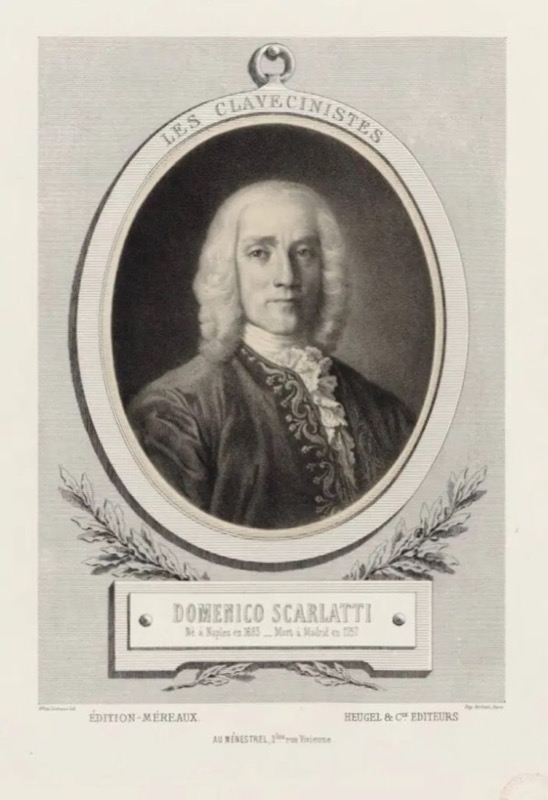
Domenico Scarlatti by Alfred Lemoine
One year later, they looked for employment in Florence, and Alessandro sent his son to Venice, where he remained for four years. In 1709, we find Domenico in Rome, in the service of the exiled Queen of Poland, Maria Casimira.
You might remember Domenico competing against George Frideric Handel in a keyboard contest, with Handel declared the better organist and Scarlatti the better harpsichordist. He enjoyed varied patronage and worked at the Basilica of Santa Maria Maggiore and later at the papal Cappella Giulia.
Domenico Scarlatti: Missa breve, “La stella”: Agnus Dei (Immortal Bach Ensemble; Morten Schuldt-Jensen, cond.)
From Court to Chapel
Domenico apparently was unhappy with his employment at Santa Maria Maggiore, but followed the call of his important patron, Cardinal Ottoboni. The Italian musicologist Eleonora Simi Bonini has found four works by Domenico Scarlatti in the archive of Santa Maria Maggiore, including a short mass setting titled “The Star.”
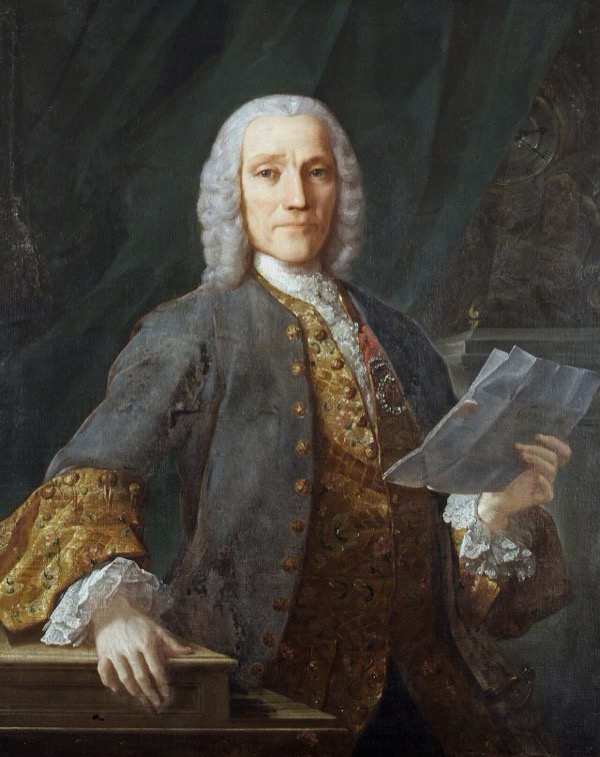
Portrait of Domenico Scarlatti
For Queen Maria Casimira, he composed cantatas, serenades, and operas. However, his employment ended when the Queen ran out of money and retired to her native France. In 1713, he was already appointed assistant to the maestro di cappella of the Cappella Giulia at St Peter’s, and he became the maestro in 1714.
He retained this position until the summer of 1719, when he was recorded as departing for England. However, we don’t know if this journey actually took place. Three pieces survive as a record of Scarlatti’s time at the Cappella, including the Stabat Mater.
Domenico Scarlatti: Te Deum (The Sixteen; Harry Christophers, cond.)
Grief and Grandeur
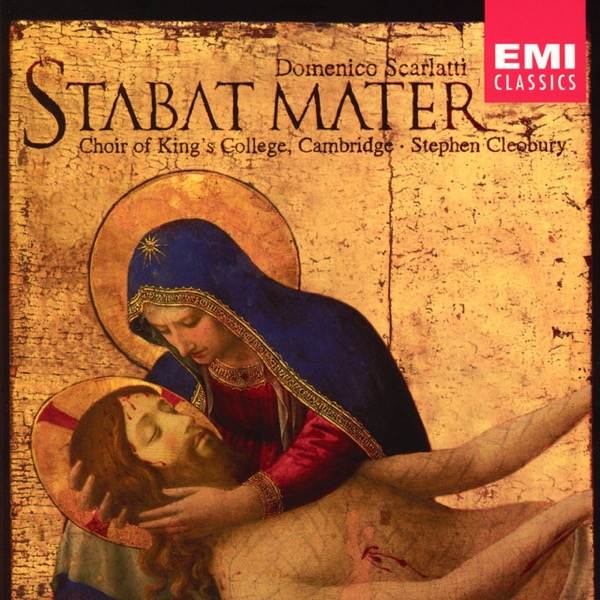
Domenico Scarlatti: Stabat Mater
The Stabat Mater is probably the best-known example of Scarlatti’s church music, even rivalling his father’s setting of the same text. As Keith Anderson writes, “Scored for ten voices, two five-part choirs, and continuo, all voices are seldom heard together but are deployed in a series of contrasting textures.”
“The work consists of a series of continuous sections, with varying groups of stanzas from the text, providing a good example of the Baroque stile misto.” From the reflective austerity of the opening through to brilliant soloistic flourishes, Scarlatti maintains the musical interest with deceptive skill.”
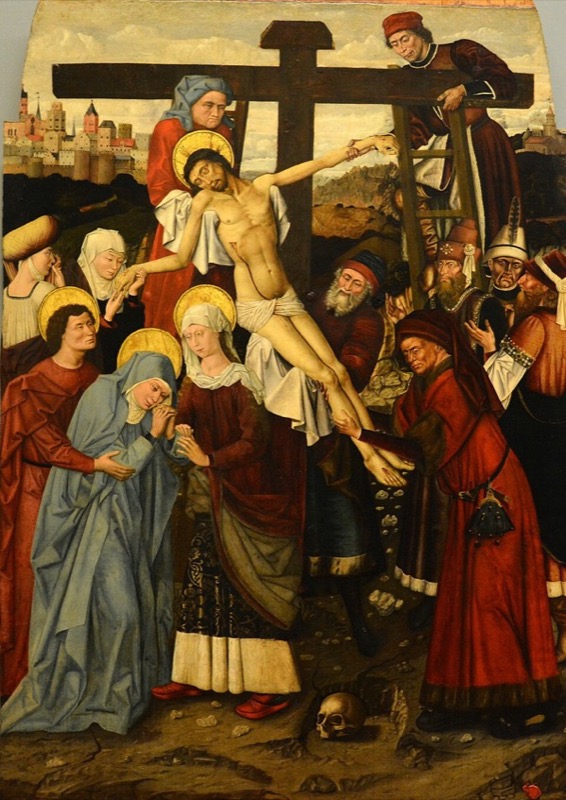
Stabat Mater
Add to this the two masterly final sections, “Fac ut animae” and “Amen,” and it is clear that
the whole work stands as a testament to the composer’s considerable and diverse talents. With plenty of true Baroque drama in some florid tenor entrances, Domenico presents a remarkable synthesis of old and new styles.
Domenico Scarlatti: Mass in G Minor, “Madrid Mass”: Kyrie (Monteverdi Chamber Choir; Eva Kollar, cond.)
The Madrid Mass
In 1719, Domenico Scarlatti went to the court of Lisbon, and by 1728 he had joined the court of the Infanta Maria Barbara, who was to be married in Madrid. In Lisbon, Scarlatti was a harpsichordist and music teacher to the Infanta, and here he crafted his famed harpsichord sonatas.
In Madrid, in a collection of choral compositions copied in 1754, we find the Scarlatti Mass in G minor, sometimes referred to as the “Madrid” Mass. Nothing is known about where and when this mass was written, but it is preserved alongside another mass by Tomás Luis de Victoria, the great Spanish composer of the late Renaissance.
Scarlatti was a thoroughly Baroque composer. Neither stylistic analysis nor the available sources allow one to say for certain that Scarlatti wrote the mass in Madrid rather than bringing it from Lisbon or even from Rome. But the style is specific even among the composer’s own works, and so it seems more probable that it is a late, isolated sacred work.
Domenico Scarlatti: Magnificat: Magnificat (King’s College Choir, Cambridge; Stephen Cleobury, cond.)
Domenico Scarlatti: Magnificat: Fecit potentiam (King’s College Choir, Cambridge; Stephen Cleobury, cond.)
Domenico Scarlatti: Magnificat: Gloria Patri (King’s College Choir, Cambridge; Stephen Cleobury, cond.)
Scarlatti’s sacred music is highly approachable, yet it is based on a solid foundation of exceptional compositional technique. Harmonic richness and melodic individuality produce tuneful melodies which mix religious deference and occasional operatic elements.
A Different Voice
It is difficult to establish an approximate chronology of Scarlatti’s church music. Only a single work, the expressive Salve Regina for soprano, strings, and continuo, composed in the composer’s last year, is dated in the sources, but it was probably for private devotions. It’s probably reasonable to assume that all other sacred pieces were written between 1708 and 1728, when he was employed as a church musician.
Malcolm Boyd writes, “It should occasion no surprise that Scarlatti’s vocal music shows little of the harmonic daring and few of the ‘happy freaks’ that characterise his mature harpsichord sonatas. The keyboard music of this period, Scarlatti’s perhaps more than most, sprang directly from the composer’s fingers in the act of improvising.”
Domenico Scarlatti: Te gloriosus (Western Washington University Concert Choir; Robert Scandrett, cond.)
The Human Voice
“Vocal composition, on the other hand, was essentially a considered art, subject to the demands of a text and governed by the rules and traditions of ‘good composition’. The apparent gulf between Scarlatti’s vocal and keyboard styles can be observed also in the music of other composers such as Byrd and Frescobaldi.”
Domenico Scarlatti’s sacred music may not contain the flashes of harmonic audacity and unexpected twists of his keyboard sonatas. Yet, it reveals a different side of his musical imagination.
His sacred music is shaped by vocal elegance, devotion, and a keen instinct for drama. The music moves between hushed contemplation and radiant operatic intensity. This is beautifully demonstrated in the Stabat Mater, music that ranges from personal grief to collective lament.
For more of the best in classical music, sign up for our E-Newsletter