Steve Reich is a monument of contemporary classical music. He needs no introduction, particularly as he celebrates his 90th birthday this year. One of the founding fathers of American minimalism — alongside Philip Glass, who coincidentally celebrates his 90th in 2027 — Reich has a body of work that expands from studio experiments to ensemble and orchestral music, and multimedia music theatre. His influence, as this performance demonstrates, crosses the borders of musical genres and forms. In such a context, it makes little sense to comment on the quality of the works presented during the performance of his music at Southbank on September 27, 2026. Reich has entered the canon of Western classical music, and what was once innovative has now become, to many of us, tradition; perhaps one of the most important traditions of the turn of the century.

Steve Reich © Jennifer Taylor
Jonny Greenwood, best known as one of the driving forces of Radiohead, happens to also be a contemporary classical composer who forged a collaborative relationship with Reich after performing and recording Electric Counterpoint. This subsequently inspired Reich to compose Radio Rewrite, based on Radiohead’s music — both works are being performed on this occasion. Last but not least, the London Sinfonietta, founded in 1968, has forged a reputation for commissioning, premiering and championing radical new and contemporary music.
Clapping Music – Steve Reich
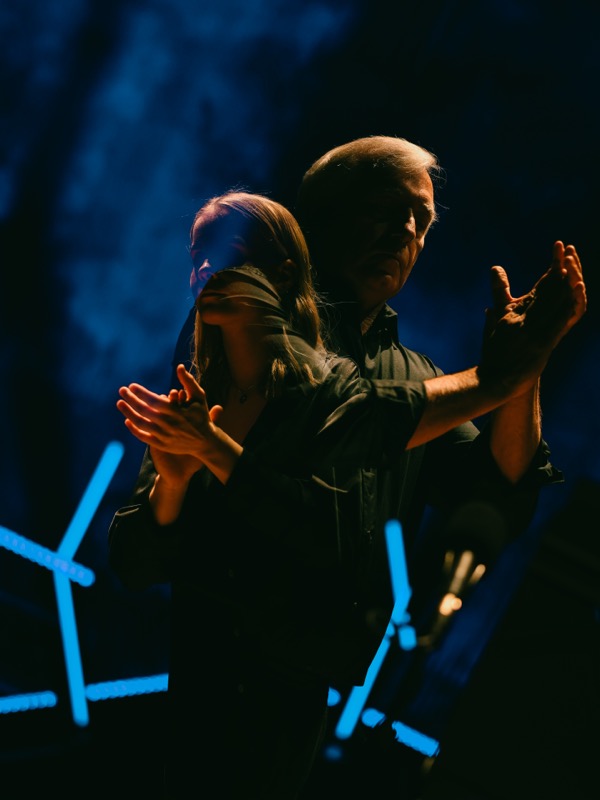
The London Sinfonietta (Photo: Seb Gardner / London Sinfonietta)
The performance starts with “Clapping Music”, perhaps the most simplistic yet representative example of Reich’s approach to music. Two performers clap an identical rhythm, while one of them slowly shifts the rhythmic pattern, creating an intricate interaction between the two until eventually both fall into place again. This is the ultimate example of Reich’s complex and mesmerising pulsating repetitive music. A wonderful choice to start a performance, and a great device to capture the audience’s attention. Pulse is then performed by the London Sinfonietta, with Greenwood joining for his first performance of the day, on electric bass. The piece is performed as it perhaps should be: a gentle, reflective and meditative blend of pulsating bass and piano, over which the strings and woodwinds weave, in the best Reich fashion, smooth and lyrical melodic lines. Radio Rewrite follows and is based on Radiohead’s “Jigsaw Falling into Place” and “Everything in Its Right Place”. Thirteen years after its premiere, the five-movement piece hides and unhides Radiohead’s harmonic and melodic language — a way for the American composer to return the favour to popular musicians who have sampled his works over the past decades.
Electric Counterpoint – Steve Reich
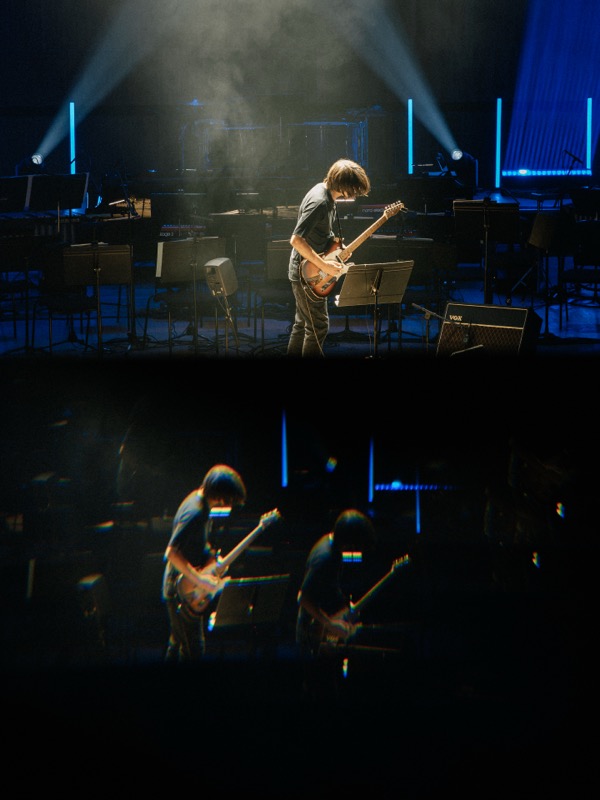
The London Sinfonietta (Photo: Seb Gardner / London Sinfonietta)
After a short interval, Greenwood returns to perform Electric Counterpoint. Greenwood, who is always a little reserved in his stage presence during performances, delivers a very convincing and original performance — after all, he has recorded it himself for Nonesuch Records, alongside the debut recording of Radio Rewrite, and has been performing it since 2011. He is, in fact, alongside Pat Metheny — the original guitarist who recorded the piece — only the second guitarist to have recorded the piece with such success, injecting his own personality into a less polished version than the original. Here, Greenwood has pre-recorded the multi-track ahead of the performance and plays the final topmost part. The last piece of the performance, City Life, uses the process that initially placed Reich on the musical map of innovators: pre-recorded loops and samples used in conjunction with a live performance. It acts as a modern urban tone poem, describing the composer’s home city — so influential to his work.
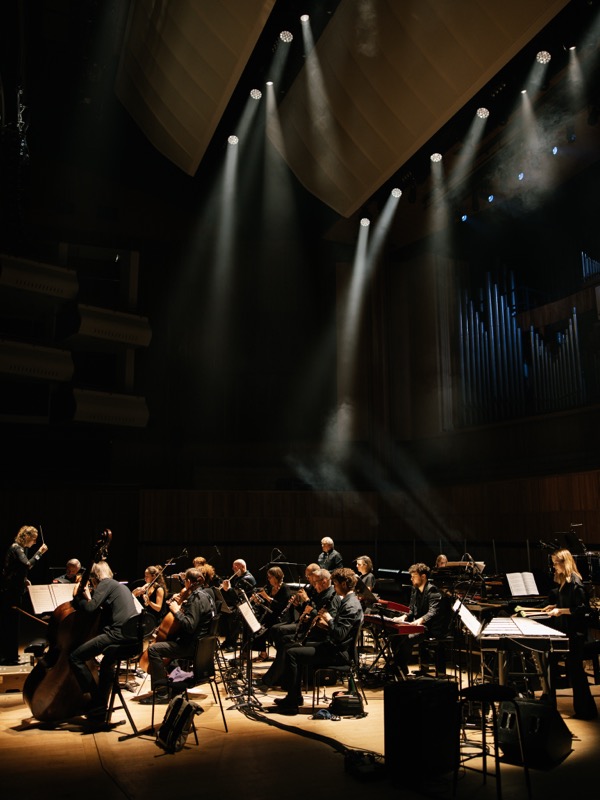
The London Sinfonietta (Photo: Seb Gardner / London Sinfonietta)
With such great music and great performances, one must also point out the curation of the afternoon’s programme, which somehow reflects a development in Reich’s music: his own initial path through percussion and “Clapping Music”, his use of tape loops and overdubbing with Electric Counterpoint, as well as samples and pre-recorded sounds of New York — often omnipresent in his music — with City Life. Last but not least, there is his collaborative crossing of forms and genres with Radio Rewrite and Pulse — a process and concept intrinsic to Reich’s music.
Reich’s music, in traditional concert halls, can sometimes appear more polished and less revolutionary than it really is. Perhaps this is because much of it was initially conceived to exist outside the traditional classical environment. Yet hearing these works brought together in such a carefully curated programme, and performed with such precision and conviction, was a fitting celebration of a composer whose influence reaches far beyond the walls of Southbank. Sadly, this time, there was no encore and no surprise appearance from the composer himself. That would have turned an already remarkable celebration into a moment for the history books…
For more of the best in classical music, sign up for our E-Newsletter