Russian composer Alexander Glazunov (1865–1936) started his piano studies at age nine and began composing at age 11. Mily Balakirev recognised his talent and contacted Nikolai Rimsky-Korsakov on his behalf. He began studying with Rimsky-Korsakov in 1879, when he was 14, and progressed quickly.
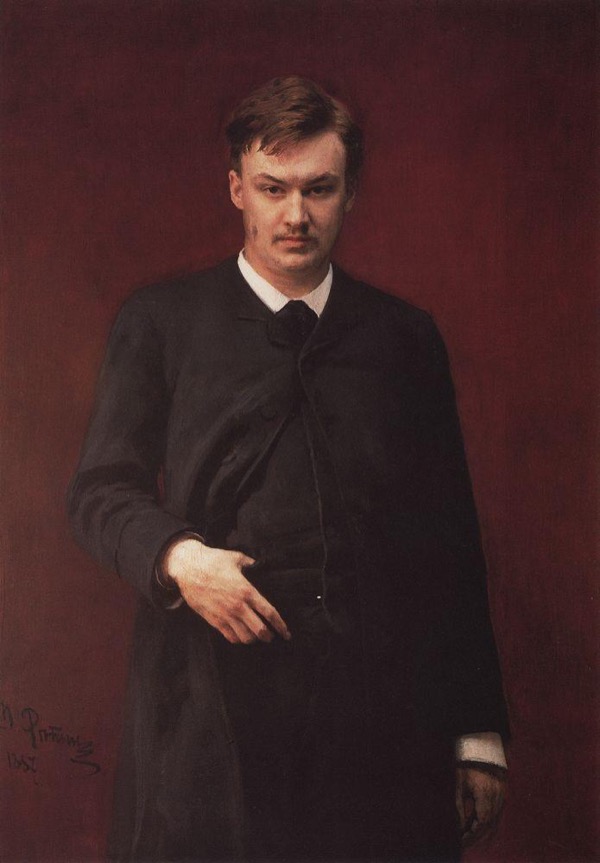
Ilya Repin: Alexander Glazunov, 1887 (St Petersburg: State Russian Museum)
His First Symphony premiered in 1882, when he’d just turned 16, and both the work and the composer were praised. The work brought him to the attention of wealthy industrialist and amateur musician Mitrofan Belyayev, and through his publishing house, supported Glazunov on a tour of Western Europe in 1884. His first symphony premiered in Weimar, where he met Liszt.
International acclaim followed, as did honorary doctorates from the universities of Oxford and Cambridge in 1907.
Before this acclaim, however, Glazunov began work on his first string quartet, Op. 1. His String Quartet No. 1 in D major, Op. 1, was written between 1881 and 1882. It premiered in St Petersburg on 25 November at a meeting of the Imperial Russian Music Society. Tchaikovsky admired its fusion of ‘nationalist sentiment’ and classical style (he had completed the last of his 3 string quartets in 1876). Glazunov’s skill, even as a teenager, earned the work the Glinka Prize in 1884.
In a bravura beginning in unison, the quartet presents a melody that will be further developed later. The following theme brings in folk-inflected ideas with rhythmic strength. Each voice assumes its own authority as it plays with the theme. The folk melody’s distinctive opening figure recurs over and over, each time redefined by the voice playing it.
Alexander Glazunov: String Quartet No. 1 in D Major, Op. 1: I. Andantino moderato (Tippett Quartet)
The lively Scherzo, which may look to Borodin’s First Symphony for inspiration, changes the mood entirely. Again, the distinctive opening figure moving through the 4 voices adds to the active sense of play.
Alexander Glazunov: String Quartet No. 1 in D Major, Op. 1: II. Scherzo: Vivace (Tippett Quartet)
The slow movement, very much in the tradition of a ‘romance without words’, opens with a wistful melody that moves over the quartet, gaining in emotion with each new iteration. The movement seems to end in a whisper.
Alexander Glazunov: String Quartet No. 1 in D Major, Op. 1: III. Andante (Tippett Quartet)
The final movement, although marked Moderato, opens with a strong statement that seems tied to folksong. In the development section, the young composer shows off his skill in modulating between keys. Themes from every movement recur, and in the end, the opening melody returns.
Alexander Glazunov: String Quartet No. 1 in D Major, Op. 1: IV. Finale: Moderato (Tippett Quartet)
Glazunov’s skilful manipulation of expectation is what Tchaikovsky noted with approval: these may be classical forms, but the young composer’s injection of Russian folk-music metaphor didn’t go unnoticed. His next quartet, completed in 1884, showed advances in formal technique and the influence of music that he would have heard during his 1884 European tour.
As a young composer, Glazunov produced a work in his First String Quartet that went beyond what he’d been taught. The blend of local and international ideas hinted at where this composer might be headed. Although he’s best known for his symphonic works, his 7 quartets are worth studying to understand what lay behind those larger works.
For more of the best in classical music, sign up for our E-Newsletter