Béla Bartók’s final year was a storm of fatal illness, profound creativity, professional triumph, and heartbreaking exile.
By the time the Hungarian composer entered the last twelve months of his life, he had terminal leukaemia and was increasingly frail.
But that illness did little to diminish his determination to compose, revise, perform, and even provide for his wife after his death.
Today we’re looking at the story of Bartók’s final twelve months: a period in which he was simultaneously preparing for death – and writing music that he had faith would outlive him.
October 1944: Finishing the Sonata for Solo Violin
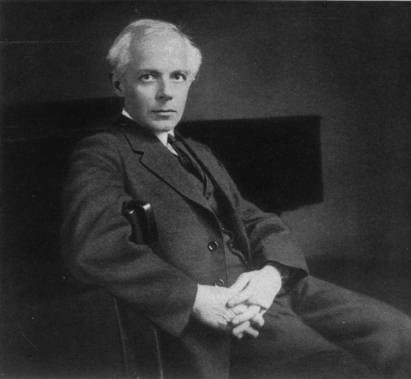
Béla Bartók, 1927
In April 1944, Béla Bartók had been diagnosed with terminal leukaemia, with symptoms including high fever, weight loss, and overwhelming fatigue.
He was in a difficult financial position at the time; he’d fled Europe in October 1940 with his wife Ditta, and the ongoing war in Europe was decimating the royalties he earned from his compositions.
Despite his ill health, he stayed creatively busy.
He was finalising the score for his Sonata for Solo Violin, which Yehudi Menuhin had commissioned.
He was also in the final stretches of preparing the Concerto for Orchestra, with rehearsals set to begin in November.
Other works were also in embryonic form: his viola concerto and his Piano Concerto No. 3, which he intended as a present for Ditta.
November 1944: Premiere of the Sonata for Solo Violin
Bartók’s Sonata for Solo Violin
On November 26th, 1944, Yehudi Menuhin premiered the Sonata for Solo Violin at Carnegie Hall.
Bartók was delighted by the performance, writing afterwards, “I was afraid it was too long; imagine…a single violin for twenty minutes. [In fact, the sonata lasts closer to thirty.] But it was quite all right, at least for me.”
Today the sonata is acknowledged as one of the most important works in the 20th-century violin repertoire.
December 1944: Premiere of the Concerto for Orchestra
Bartók’s Concerto for Orchestra
To his relief, Bartók’s doctors allowed him to travel to Boston to see the premiere performances of the widely anticipated Concerto for Orchestra, performed by the Boston Symphony Orchestra under conductor Serge Koussevitzky.
The premiere happened on December 1st and 2nd in Boston. The orchestra gave an encore performance there on December 29th and 30th.
The work was an immediate hit with critics and audiences alike.
January 1945: The Concerto for Orchestra at Carnegie Hall
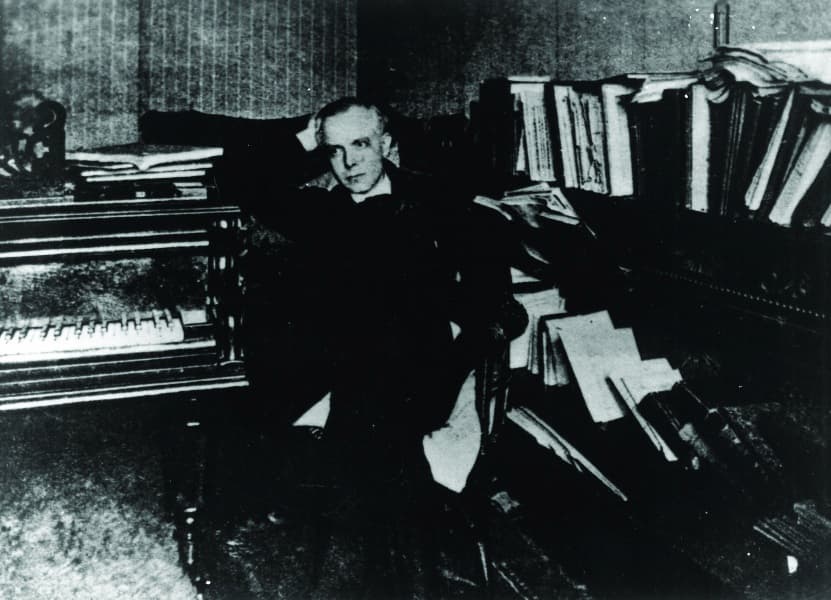
Béla Bartók
After four performances in Boston in December 1944, the Boston Symphony Orchestra premiered Bartók’s Concerto for Orchestra in New York City at Carnegie Hall.
February 1945: Revising the Concerto for Orchestra
After the premiere performances of the Concerto for Orchestra, Bartók – always a perfectionist – began anticipating future performances.
He returned to the score to make revisions, now that he’d heard it live. The most noteworthy change was an extension to the ending of the final movement, so that the work would end with more of a bang.
This professional success was incredibly bittersweet, as Bartók’s health was continuing to deteriorate.
Early in 1945, he suffered from a string of respiratory illnesses, aggravated by his leukaemia: colds, bronchitis, and even pneumonia.
He might have died then, but leaders at the American Society of Composers, Authors, and Publishers (ASCAP), the organisation paying for his health care, pushed to get him access to penicillin. During wartime, such antibiotics were rationed for military use, and he required an exemption. Fortunately, the drug therapy was successful. It wouldn’t cure his leukaemia, but it extended his life by months.
March 1945: The Premiere of the Dance Suite for Piano
Bartók’s Dance Suite for piano
Between his frantic work on his viola concerto and third piano concerto, Bartók worked on an ethnomusicological project: transcriptions of Romanian folk music. He finished the third volume of these transcriptions in March 1945.
Pianist György Sándor also premiered a solo piano version of Bartók’s Dance Suite in New York.
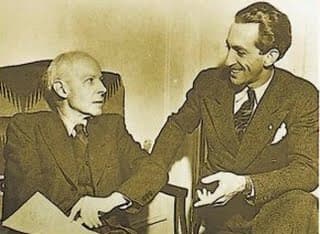
Béla Bartók and György Sándor
April 1945: Elected to the Provisional National Assembly in Hungary
In April 1945, New Yorkers’ minds began turning toward summer plans. Yehudi Menuhin invited Bartók and his wife Ditta to travel to his home state of California, and Bartók seriously weighed going.
Simultaneously, V-E Day and the downfall of Nazi Germany were fast approaching. Officials were deciding how Hungary would reconstitute its government.
Bartók himself was elected to Hungary’s Provisional National Assembly that April. It was less a serious request for him to become a politician than an acknowledgement of his importance to mid-century Hungarian arts, culture, and nationalism.
May 1945: Achieving American Citizenship
However, as spring went on, it became increasingly obvious that Bartók would never be well enough again to return to Europe.
After his departure from Europe, he’d been classified first as a visitor, then, after Hungary joined the Axis powers, an “enemy alien.”
Nearly five years after his arrival, in May 1945, he was naturalised as an American citizen: a deeply poignant moment.
June 1945: Summering in Saranac Lake
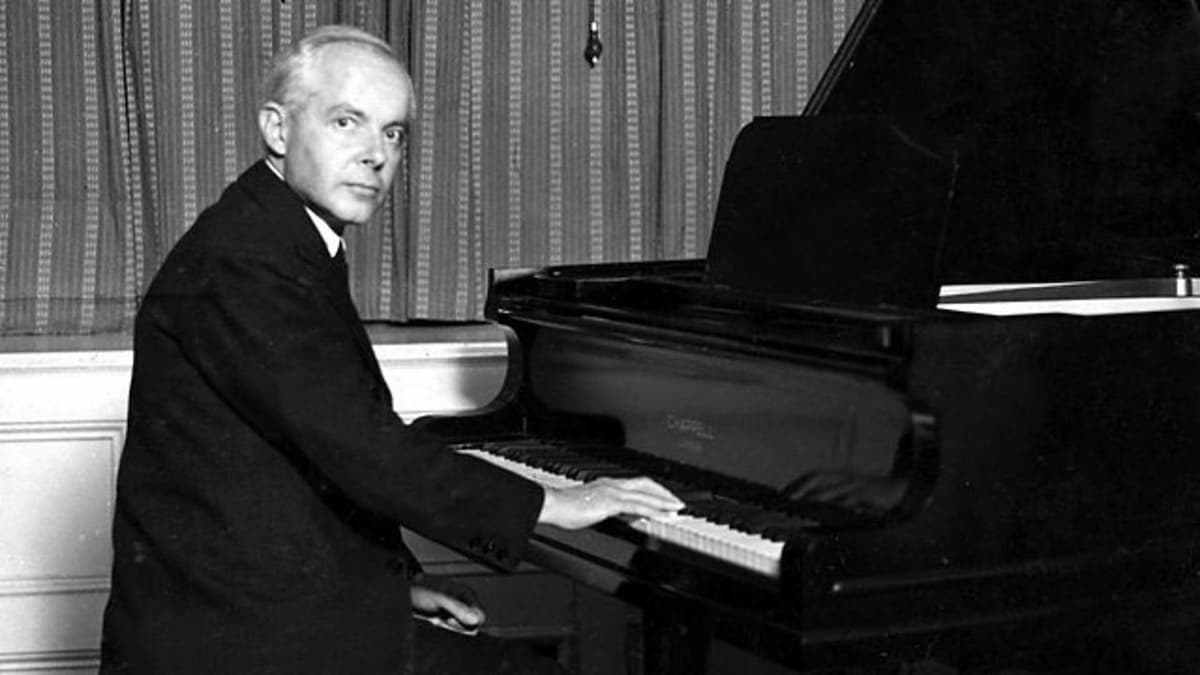
Béla Bartók
Because of the war, and because Bartók wanted to make tweaks after hearing the premiere, publication of the score to the Concerto for Orchestra was delayed. But by June, he had finished his final corrections and sent the score to the printer.
As the summer heat hit New York City, Bartók had to finalise his summer plans. He ended up too ill to take advantage of Menuhin’s California invitation, so he chose the resort town of Saranac Lake, New York, where he’d spent a couple of summers before.
He and his wife Ditta rented a four-room cabin there for $15 a month. It was furnished with two cots and a table, with no piano. Bartók brought the bare minimum: ink and manuscript paper. He felt deeply satisfied there.
“We are happy indeed to stay in this wonderful quiet place,” they wrote in the guest book.
July 1945: Inspired in the New York Woods
Bartók was invigorated by his rural surroundings. Ditta wrote that he was “feeling so well it was almost beyond belief.” He took long walks and returned to the cabin invigorated rather than drained.
He used his energy to press on with his viola concerto and the third piano concerto.
Bartók followed the European political situation from Saranac Lake. He grew discouraged by the increasing Soviet influence in Hungary. Now it seemed that not only his health, but also his political opinions, would force his indefinite exile to continue.
August 1945: Finishing the Viola Concerto
Bartók’s Viola Concerto
On August 5th, Bartók wrote a famous letter to William Primrose, the violist who had commissioned the viola concerto. In it, Bartók explained his ideas for the work’s structure. He acknowledged that it was, as written, in an “embryonic state,” but that its structure was fixed.
As he composed, he continued to lose weight. One neighbour later remembered how his wife Ditta, under enormous strain, cried on her shoulder, seeing her husband so ill.
September 1945: Final Days
Bartók’s Piano Concerto No. 3
Around Labour Day, the Bartók family took the train from Saranac Lake back to New York City.
He continued composing until close to the end. He came within seventeen measures of finishing his third piano concerto. (A former student, Tibor Serly, later finished the final bars, working from his teacher’s notes.) It must have been a relief to get so close to the finish line, as he intended for Ditta, a pianist herself, to perform this work posthumously to help support her financially.
On September 21st, Bartók’s health deteriorated to the point where he had to be admitted to the hospital. He was given blood transfusions, but despite his doctors’ best efforts to save him, he died on September 26th, 1945.
For more of the best in classical music, sign up for our E-Newsletter