Chen Gang, the Shanghai-born composer whose name is inseparable from the Butterfly Lovers violin concerto, died in Shanghai in the early hours of 18 July 2026. He was 91. The announcement was made by the Shanghai Conservatory of Music, where Chen had served as professor of composition for decades. No cause of death was given, though his health had deteriorated over the past year.
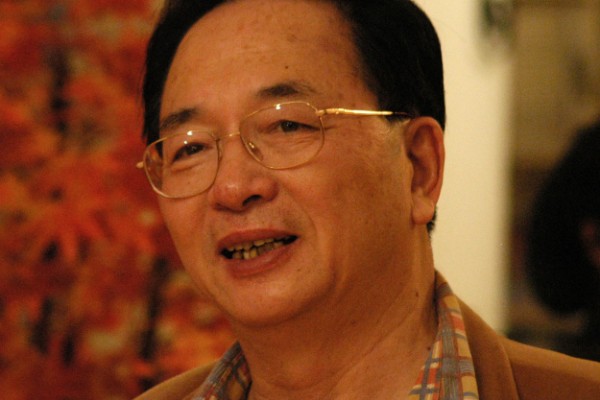
Chen Gang © Kroma Productions
I met Chen Gang several times in 2009 when China Newsweek assigned me to report on the concerto’s 50th anniversary. He impressed me as a man of considerable personal charm, known for romanticising the signature melody carried by the solo violin, a line, he maintained, that came to him while boating on Beihai Park lake in Beijing with a beloved companion. He Zhanhao, his co-composer, fiercely disputed this claim.
At the time, collective authorship was not merely fashionable but politically mandated, and most artistic outputs of the era followed its logic. The Butterfly Lovers is no exception. The concerto Chen co-wrote with He Zhanhao in 1958, which premiered the following year, remains one of the most performed and iconic orchestral works in history. That it was composed by a 24-year-old student, completed under political dictate, and born of a collaboration between two men who could scarcely have been more different — and who spent much of the subsequent half-century in open dispute — makes it one of the more improbable monuments in the repertoire.
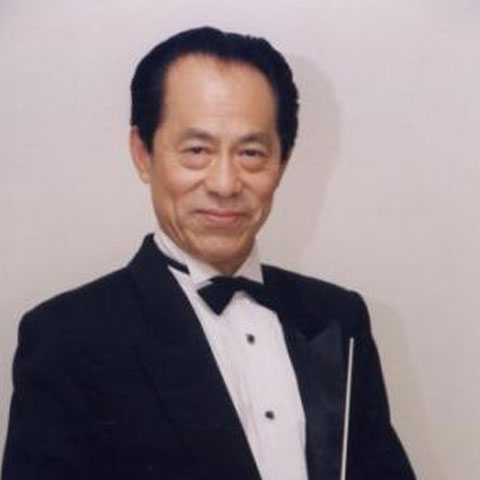
He Zhanhao © hkco.org
Like most mainstream music of that era in China, the Butterfly Lovers did not arise from pure artistic inspiration. In 1958, the Shanghai Conservatory was tasked with producing a work to mark the tenth anniversary of the People’s Republic of China. Three proposals were submitted for Party review: two were politically on message, one about steel production, one about the militia. The third, submitted by Meng Bo, then director of the Shanghai Municipal Bureau of Culture and Party secretary of the Conservatory, was about love. A connoisseur and cultured man, Meng had taken to heart a directive from Zhou Yang, then deputy director of the Central Publicity Department, that the arts should attend to their entertainment function first. He chose the ancient legend of Liang Shanbo and Zhu Yingtai — China’s Romeo and Juliet — as his subject.
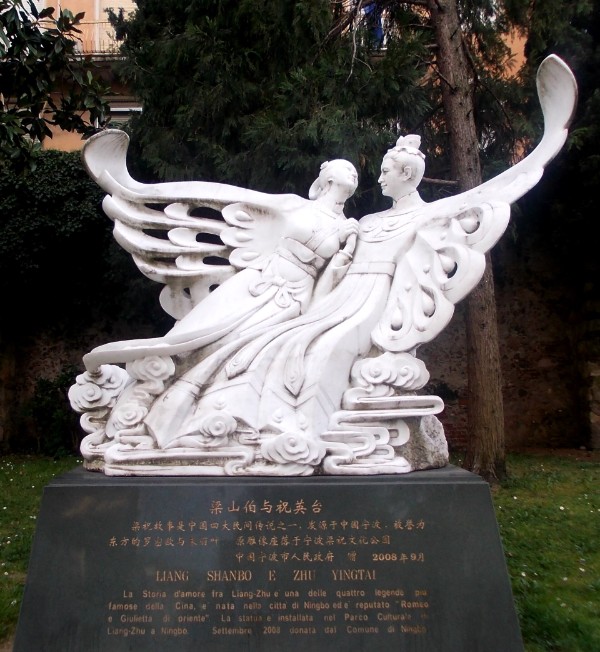
Monument to Liang Shanbo and Zhu Yingtai near the Tomba di Giulietta in Verona, Italy
The story, however, does not end in tragedy. In a characteristically Taoist resolution, the two lovers escape their tombs, which are torn open by thunder, and are reincarnated as butterflies in unity. It is a tragedy turned triumph, and it produces the return of the mesmerising theme in the third movement — one that bears, in its quality of transcendence, a distant kinship with the Adagio of Alban Berg‘s violin concerto.
He Zhanhao, a member of the Conservatory’s folk music experimental group, had already been working on melodic material drawn from Yue opera, the regional form native to Zhejiang province that gave the legend much of its musical identity. Since no member of the group had formal composition training, Meng brought in Chen Gang, top student of the composition department and son of the celebrated songwriter Chen Gexin, to provide the technical architecture. The result fused Yue opera melodic idiom with Western orchestral form, and when violinist Yu Lina gave the premiere in May 1959, the response was, by all accounts, extraordinary.
The two men who produced it could hardly have been less alike. Chen Gang was the son of a celebrated composer, educated in the Conservatory tradition and trained in Western harmony and counterpoint, with a tendency toward the romantic. He Zhanhao came from a farming family, had no formal composition training, and brought to the project an instinctive grounding in folk and regional opera idiom. The divergence in temperament and background that made the concerto what it is also made the collaboration unstable.
In the years and decades that followed, the two men fought their battle in print and on screen. He Zhanhao repeatedly argued in media interviews that his melodies came first and that the work was a collective achievement, implying Chen’s contribution was secondary. Chen countered that melody alone does not make a concerto. The dispute was, at its root, a consequence of the joint authorship model under which the work had been commissioned, designed to subordinate individual credit to collective wisdom, and one that left both men permanently unsatisfied with how history apportioned the glory.
Meng Bo, the man who set the whole thing in motion, remained characteristically precise when I spoke with him in 2009, even in his nineties. He Zhanhao was already in the group; Chen Gang was brought in because the group had no composer; the others gradually withdrew; the concerto was the work of both men, and neither could be removed from the equation. He also shared newspapers carrying lurid headlines about how the concerto had been demonised, and he himself was denounced during the Cultural Revolution.
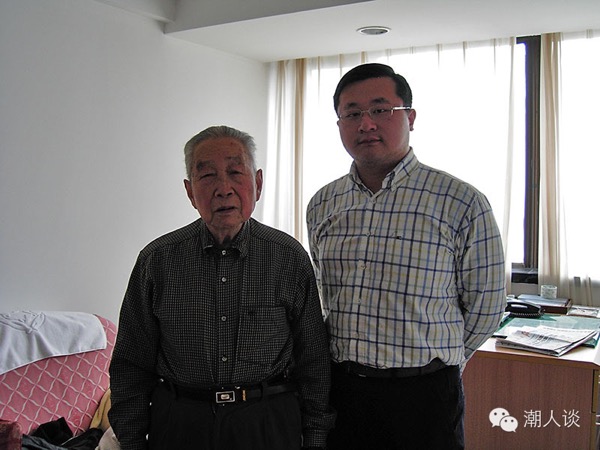
Meng Bo and Rudolph in 2009
Chen and He’s roads parted thereafter. Chen Gang’s subsequent output was substantial and distinguished on its own terms. In the 1970s he produced a group of violin miniatures, among them Sunshine Illuminates Tashkurgan and Morning on the Miao Mountains, that became staples of Chinese violin education and carry an evocative, landscape-like quality that has kept them in regular circulation. The 1980s brought the violin concerto Wang Zhaojun, which colleagues described as a companion piece to the Butterfly Lovers, and in 1985 he completed Nangma, an oboe concerto drawing on Tibetan musical material. Even in old age, he did not slow. In his eighties he composed the symphonic poem Eternal Sorrow: The Jade-Bright Song of Lady Yang, a large-scale orchestral work, and the ten-piece cycle Chinese Sound Paintings for violin and string quartet. At 90, just last October, he completed Symphonic Overture: Blossoming, dedicated to Shanghai, the city of his birth and his entire life.
Yet none of these works escaped the gravitational pull of the Butterfly Lovers. As I wrote plainly in that 2009 China Newsweek article, the violin concerto Wang Zhaojun and another concerto inspired by Dream of the Red Chamber were fleeting successes rather than lasting additions to the repertoire. He Zhanhao’s post-Butterfly Lovers output fared no better; some smaller pieces for zheng circulated, but nothing of equivalent orchestral standing emerged. The two men who together produced China’s most enduring classical work spent the rest of their careers demonstrating, perhaps inadvertently, just how rare the conditions for such a work had been, and how far-sighted Meng Bo’s original choice remains.
The concerto has been performed continuously for almost seventy years. It is arguably the most beloved piece of orchestral music in the world’s second most populous country. It has been adapted for piano, erhu, harmonica, accordion, cello, and even musical saw. Pianists from Chow Ching-lie to Chen Jie, violinists from Akiko Suwanai to Chloe Chua, have all contributed to its substantial discography. And yet it remains largely a celebration confined to Chinese communities rather than a fixture of the international repertoire.
In September 2012, I was at the Hong Kong Cultural Centre for the concert marking Jaap van Zweden’s inaugural season as music director of the Hong Kong Philharmonic, overjoyed to find the Butterfly Lovers on the programme with Ning Feng as soloist. Van Zweden went on to lead orchestras in New York, Paris, Taipei, and Seoul. Whether he has introduced the concerto to audiences beyond the Chinese diaspora remains a question that deserves a serious answer.
Part of the explanation is structural. The four violin concertos that dominate the core repertoire, by Beethoven, Brahms, Mendelssohn, and Tchaikovsky, are sustained by an entire ecosystem: publishers issuing authoritative editions, record labels distributing recordings globally, agents collecting royalties, musicologists analysing the scores, and orchestras from multiple countries championing the works.
For the Butterfly Lovers, this infrastructure was slow to materialise and has never fully developed. The most significant early push came from an unlikely source: Klaus Heymann, whose Marco Polo label released a 1978 recording with Japanese violinist Takako Nishizaki and the Nagoya Philharmonic under Kek-Tjiang Lim. Nishizaki went on to record the concerto multiple times, eventually seven, for Heymann’s labels, winning five gold records. Nishizaki is Heymann’s wife, a detail that adds a domestic dimension to what might otherwise appear a purely entrepreneurial championing of Chinese repertoire.
Heymann’s near-exclusivity strategy, which made it difficult for other violinists to record the work under his labels in the early years, meant that international exposure was channelled almost entirely through a single performer, limiting the diversity of interpretations that might have broadened the work’s reach at the dawn of the compact disc era. The most critically admired recording came only in 2007, when Gil Shaham recorded the concerto with the Singapore Symphony under Lan Shui for Canary Classics. Musicians and composers, including Chen Gang himself, praised it as the finest account on disc. But an independent label lacks the distribution reach to reshape a work’s international profile, and the recording remained underexposed outside specialist circles.
Butterfly Lovers performed by Gil Shaham
In live performance the picture is similarly uneven. Chinese soloists and orchestras touring abroad have tended, for commercial and diplomatic reasons, to programme works with which they have personal or institutional associations. Non-Chinese soloists rarely programme the Butterfly Lovers even on tour in China. The work sits in an awkward position: too distinctively Chinese to be absorbed automatically into the Western canon, and not yet sustained by the kind of global advocacy that might change that.
A deeper cultural dimension also shapes this. Western audiences and institutions have historically engaged with Chinese classical music on their own terms, treating it as exotic, occasional, or supplementary rather than as repertoire deserving the same scholarly and programmatic commitment as the European canon. This is changing slowly, but the mechanisms that would accelerate it remain underdeveloped. Major international labels commissioning new recordings, leading non-Chinese soloists building the work into their regular programmes, music publishers issuing authoritative critical editions, remain underdeveloped.
Chen Gang was aware of this all his life, and one senses it was a source of quiet frustration. He gave six decades to the project of transmitting Chinese culture through Western instruments and Western forms, convinced that the synthesis was both possible and necessary. The Butterfly Lovers proved it could be done. The difficulty of extending that achievement, as his own subsequent works included, suggests how singular the convergence of factors that produced it really was: the political moment, the institutional decision, the pairing of two radically different temperaments, and the deep well of a folk tradition that gave the melody its immediate, almost physical hold on the listener.
Chen Gang is gone. The concerto remains. Whether the classical music world beyond China will ever fully reckon with what it represents is a question that his death makes newly urgent.
For more of the best in classical music, sign up for our E-Newsletter