Mozart had many students over the course of his career – but some of his most gifted pupils were women.
He wrote music for them, praised their talent in letters to his father, and in at least one case declared a student a genius.
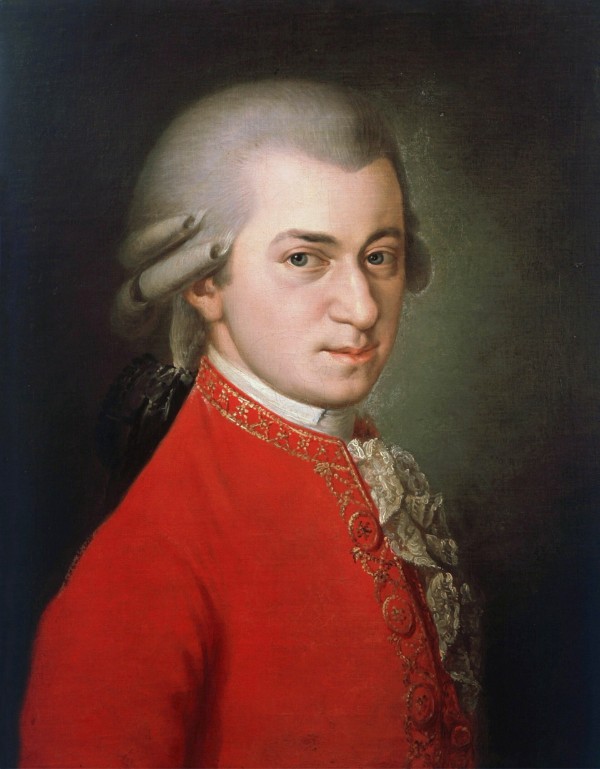
Wolfgang Amadeus Mozart
Here are three of the women who studied with Wolfgang Amadeus Mozart.
Barbara Ployer: Inspiration for Two Piano Concertos
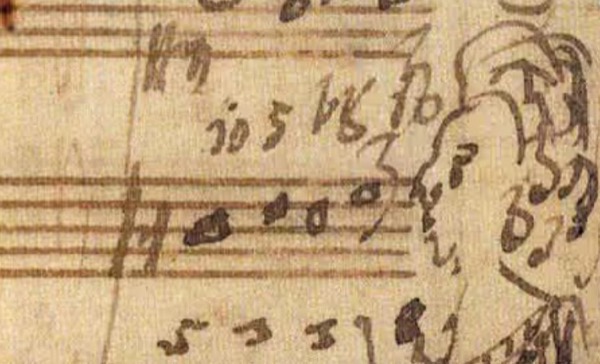
Barbara Ployer, sketch by Mozart
Barbara Ployer was born on 2 September 1765 in Sarmingstein, Austria, between Vienna and Linz. Her father was a timber merchant, tax collector, and an agent of the Salzburg court.
After her mother died in 1779, the year she turned 14, she was sent to live with her uncle in Vienna.
Two years later, another musician arrived in Vienna with connections to Salzburg: Wolfgang Amadeus Mozart. He was aiming to make a living as a freelance musician and teacher and was seeking networking opportunities.
We don’t know exactly when he and Barbara Ployer met, but Mozart first wrote to his father about her in February 1784.
That year, he wrote two piano concertos for her: Piano Concerto No. 14 (K449) and Piano Concerto No. 17 (K453). She premiered both in her home.
Mozart’s Piano Concerto No. 14
Her uncle’s financial situation began deteriorating in the late 1780s. Perhaps for that reason, around this time, she married Cornelius Bujánovics von Agg-Telek. The couple left Vienna and moved to his estate in Croatia.
Scholar Michael Lorenz reports that her later years were characterised by a “persecution mania” and that the Bujánovics were absorbed by pursuing bizarre conspiracies against a variety of parties, including “their own relatives, the state, the police and the Freemasons.”
She died in 1810. Today she is best remembered for her brush with Mozart – not for the strange turn her later life took.
Caroline Pichler: The Precocious, Literary Aristocrat
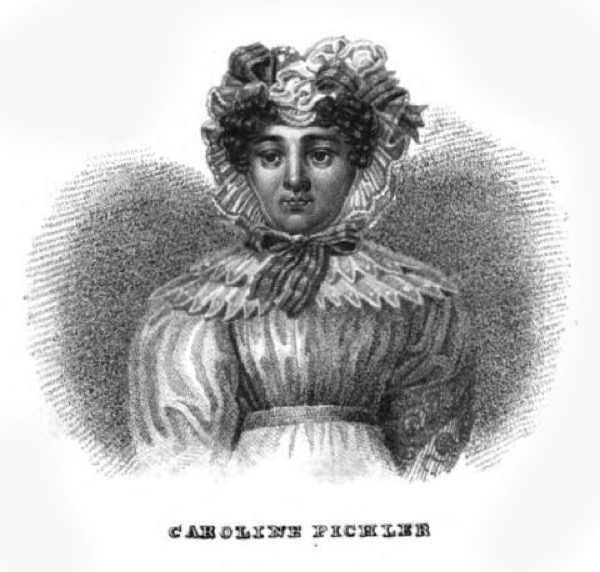
Caroline Pichler
Caroline Pichler was born on 7 September 1769 to Franz Sales von Greiner, an advisor to the Holy Roman Emperor, and his wife. As a child, she even met Empress Maria Theresa.
She was not just aristocratic; she was also precocious. She grew up learning five different languages, and published her first poem when she was twelve.
She studied music with Mozart, who often performed his work at the Greiner household.
In 1796, the year she turned 27, she married a government official named Andreas Pichler, who encouraged his wife to develop her literary talents.
Over the course of her marriage, she became a respected salon leader and author, writing essays and novels, as well as an autobiography published posthumously.
In that autobiography, she recalled one memory of Mozart:
“One day when I was sitting at the pianoforte playing the ‘Non più andrai’ from [The Marriage of] Figaro, Mozart, who was paying a visit to us, came up behind me. I must have been playing it to his satisfaction, for he hummed the melody as I played and beat the time on my shoulders. Still, then he suddenly moved a chair up, sat down, told me to carry on playing the bass, and began to improvise such wonderfully beautiful variations that everyone listened to the tones of the German Orpheus with bated breath. But then he suddenly tired of it, jumped up, and, in the mad mood which so often came over him, he began to leap over tables and chairs, miaow like a cat, and turn somersaults like an unruly boy.”
Mozart’s “Non più andrai” from The Marriage of Figaro
Rosa Cannabich: The Talented Teenager from Mannheim
Rosina Theresia Petronella Cannabich was born in Mannheim in the spring of 1764, the eldest of six children.
Music was the family business, and every Cannabich child was taught music from an early age. Her father, Christian, was the Konzertmeister, or lead violinist, of the famous Mannheim Orchestra, one of the greatest ensembles in Europe.
Between November 1777 and March 1778, when she was 13 and 14, Mozart, then in his early twenties, lived in Mannheim and gave her piano lessons.
He wrote to his father in 1777 that Christian Cannabich “has a daughter who plays the piano rather well, and to make him a friend, I work now on a sonata for his mademoiselle daughter.”
He reported later that she was “a very beautiful and well-behaved girl. For her age, she has much good sense and a demure character; she is serious and speaks little. But what she does say comes forth with grace and friendliness.”
He wrote his Piano Sonata No. 7 (K. 309) for her, and made the second movement a portrait of her character.
Mozart’s Piano Sonata No. 7
In November 1777, Mozart wrote in a letter to his father:
“Three days ago, I began to teach the sonata to Mademoiselle Rose. Today we have finished the first Allegro. The Andante will give us the most trouble; this is full of expression and must be played accurately with the gusto, forte and piano as it is written. She is very clever and learns very easily.”
He suggested that she might cover her keyboard with a handkerchief and practice that way, and even spoke of her “genius.”
In February 1778 she performed his Piano Concerto No. 6 (K. 238) in Mannheim.
Mozart’s Piano Concerto No. 6
The next month, he bragged to his father:
“She can certainly make herself heard everywhere now. As a woman of 14 years old and a dilettante, she plays quite well; and they have me to thank for that, the whole of Mannheim knows that. She now has gusto, trill, tempo, and better application, which she did not have before.”
Within weeks, unable to secure a job, Mozart left Mannheim and the Cannabichs for Paris in search of work.
It’s unclear what became of Rosa Cannabich after her brush with Mozart. Because of the similar names of her musical sisters, it has been difficult for historians to ascertain her later whereabouts.
One theory suggests that she married a man with the last name Schulz and became a pianist billed as a former pupil of Mozart, performing in St. Petersburg in 1788, 1790, and 1793.
Conclusion
Barbara Ployer, Caroline Pichler, and Rosa Cannabich represent only a fraction of the women who studied with Mozart.
Their stories – one ending in paranoia and conspiracy, one in a celebrated literary career, and one uncertainly, possibly in St. Petersburg – are as varied as the music he wrote for them.
For more of the best in classical music, sign up for our E-Newsletter