Antonio Vivaldi wrote roughly 500 concertos over the course of his career. You probably know four of them.
True, the Four Seasons are among the most beloved pieces of music ever written – and rightly so.
But Vivaldi’s genius extended far beyond those four famous works, into a vast catalogue of concertos for violin, cello, flute, bassoon, and combinations of instruments that nobody else was writing for at the time.
If you love the Four Seasons and want to know where to go next, these Vivaldi concertos are the perfect place to start.
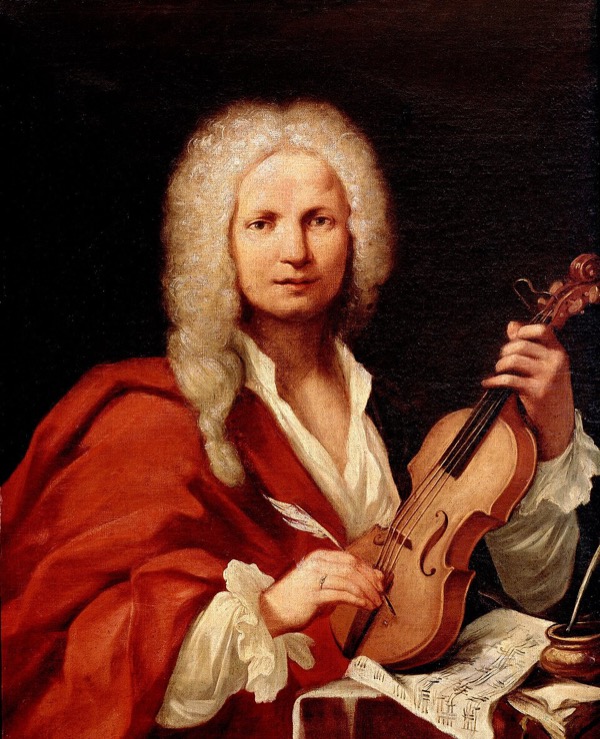
Antonio Vivaldi
Concerto for Two Violins in A minor from L’estro armonico, Op. 3, No. 8 (RV 522)
L’estro armonico (The Harmonic Inspiration) was published in 1711. It’s a set of twelve concertos for a variety of instruments and instrument combinations.
The music – written in Venice and published in Amsterdam – was international in scope, finding its way into the library of Johann Sebastian Bach in Germany, among others.
In fact, Vivaldi scholar Michael Talbot has claimed that L’estro armonico was “perhaps the most influential collection of instrumental music” of the entire century.
The eighth concerto in the set is for two violins, featuring a lively dialogue between the two soloists, punctuated by a slow movement of surprising poignance.
Johann Sebastian Bach: Organ Concerto in A Minor, BWV 593 (arr. of Vivaldi’s Violin Concerto in A Minor, RV 522) (Rudolf Scheidegger, organ)
Bach was so taken by this concerto that he arranged it for the instrument closest to his heart: the organ. In his arrangement, the organist plays both violin parts with separate hands, while pedalling the orchestral accompaniment with their feet.
It’s an endorsement of how instrumental – no pun intended – this music was in establishing the international musical language of the Baroque.
Concerto for Four Violins in B minor from L’estro armonico, Op. 3, No. 10 (RV 580)
This concerto is also from the L’estro armonico collection (it was published as the tenth). Its most striking element is its texture: it is for four solo violinists and an orchestra.
There is a reason why this instrumentation isn’t very common – it is very difficult to balance all these voices in a satisfying way! – So it sounds like very few other pieces in the repertoire.
Bach was so impressed by this piece that he made an arrangement of it for four harpsichords, introducing his own version of the texture problem to solve! It was the only piece he wrote for harpsichord that was not based on his own material: another tribute to Vivaldi’s talent and influence.
Johann Sebastian Bach: Concerto for 4 Keyboards in A Minor, BWV 1065 (arr. of Vivaldi’s Concerto for 4 Violins in B Minor, Op. 3, No. 10, RV 580) (Martin Galling, Hedwig Bilgram, Franz Lehrndorfer, Kurt-Heinz Stolze, harpsichords; Mainz Chamber Orchestra; Günter Kehr, cond.)
Concerto for Violin in F major from La stravaganza, Op. 4, No. 9 (RV 284)
This violin concerto comes from a collection Vivaldi dubbed La stravaganza, or The Eccentricity. It was published in 1716 and dedicated to a nobleman to whom Vivaldi gave violin lessons.
This collection earned its nickname due to the unusual twists and turns in its harmony and melody.
One French music critic named Pierre-Louis Ginguené, who grew up later during the more restrained Classical era, described Vivaldi’s passage work as being “brilliant, difficult and occasionally bizarre.”
He even accused La stravaganza of being “more taken up with the cares of astounding the ear than with those of enchanting it.”
Ironically, Vivaldi’s simultaneous embrace of the beautiful and bizarre – his ability to both astound and enchant modern listeners – is one of the major reasons why his music still resonates today.
Concerto for Two Cellos in G minor (RV 531)
Out of Vivaldi’s roughly 500 concertos, this is the only one written for two cellos.
It makes a case for its uniqueness in the opening statement, which – contrary to custom – features the two soloists playing the emphatic main theme, with the orchestra entering later.
This unusual use of the solo instruments extends into the second movement, which is a solo dialogue between the cello soloists, accompanied by the continuo.
The work ends with a nervous syncopated theme in the orchestra that sounds like the instruments are tripping over themselves.
The solo cellists respond with a series of hard-driving passages, featuring moments of great lyricism as the cello voices soar next to one another.
Talbot wrote of this concerto, “This is a concerto to single out among the hundreds that Vivaldi wrote.”
Concerto for Bassoon in E minor (RV 484)
The solo instrument that Vivaldi wrote the most concertos for was the violin. The instrument he wrote the next most concertos for? The bassoon! In fact, he wrote 39 bassoon concertos that we know of.
Why? Vivaldi was the director of music at the Ospedale della Pietà, an orphanage and music school. Abandoned babies or babies from poor families were left there, and the girls would be trained to become musicians.
The arrangement was novel; there were very few professional women musicians at the time. The girls’ brilliance and virtuosity attracted tourism and generated income.
A Frenchman passing through Venice commented about the Ospedale, “They sing like angels, play the violin, the recorder, the organ, the oboe, the cello, the bassoon; in fact, there is no instrument large enough to frighten them.”
We don’t know which of Vivaldi’s bassoon concertos were written for his virtuoso students, if any, but it is very plausible that if he did, this is one of them.
Concerto for Flute No. 2 in G minor, “La notte” (RV 439)
The Four Seasons are famous for being program music – i.e., portraying real life in music. But the Four Seasons were not the only instrumental program music that Vivaldi wrote.
Two examples are his second and third flute concertos.
This one is subtitled “La notte” (“the night”). It discards standard structure – there are six improvisatory movements here instead of the normal three – and moves from idea to idea like an insomniac with racing thoughts.
In fact, one of the movements – the fifth movement Largo – is even titled “Il Sonno” (“the dream”).
This is Vivaldi at his most bizarre…and it’s beautiful.
Concerto for Flute No. 3 in D major, “Il gardellino” (RV 428)
By contrast, Vivaldi’s third flute concerto is nicknamed “Il gardellino” (“the goldfinch”). We don’t know whether the nickname came before or after its composition.
Regardless, the solo part certainly resembles a bird, including birdlike traits like trills, leaps, and repeated notes.
After the chirpiness of the first movement, the slow movement is moving music scored for the solo flute and basso continuo.
This is a great piece for those who love the charming imitations of birdsong found in Vivaldi’s Spring from the Four Seasons.
Conclusion
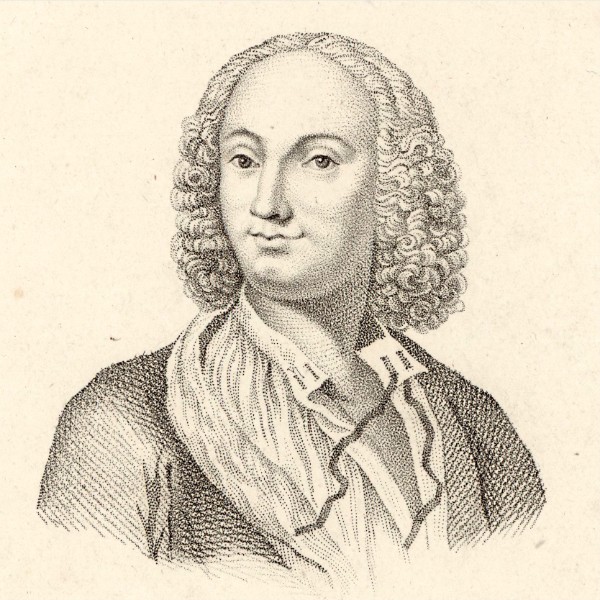
Antonio Vivaldi
Vivaldi’s catalogue is so large that even devoted listeners have barely scratched the surface.
The concertos above represent just seven of the hundreds that reward closer attention – and each one offers something distinct from the Four Seasons while unmistakably belonging to the same creative mind.
If any of these concertos sends you deeper into Vivaldi’s catalogue, that’s exactly what he would have wanted. He spent decades writing music for the sheer joy of it, faster than his copyists could keep up. There is always more Vivaldi to discover!
For more of the best in classical music, sign up for our E-Newsletter