Luigi Cherubini‘s Medea was a vehicle for Maria Callas – she brought back Cherubini’s long-forgotten score and made it her triumph.
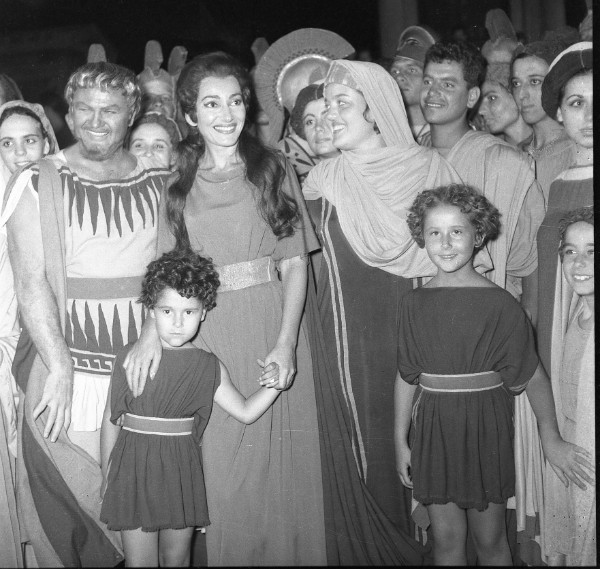
Callas as Medea at Epidaurus, with Kiki Morfoniou as Neris and Jon Vickers as Giasone, 1961 (photo by Kleisthenis) (GNO Archive)
The French-language Médée, had received its premiere in Paris at the Théâtre Feydeau on 13 March 1797. Its opening reception was indifferently received by the Parisians, and it wasn’t immediately revived. Over time, Cherubini’s work and François-Benoît Hoffmann’s libretto (based on Medea by Euripides and Médée by Pierre Corneille) were translated into German (1800) and were shortened (1806). By 1855, Franz Lachner had added recitatives to the 1806 version for its Frankfurt debut. These recitatives replaced the previous spoken dialogue and brought the work more in line with normal practice.
It wasn’t until 1865, with the work’s premiere in London in Italian (with new recitatives by Luigi Arditi), that it found its audience. In 1909, an Italian translation of the 1855 Lachner version was prepared by Carlo Zangarini for La Scala, and it was this hybrid German/Italian version that was revived in 1953 for Callas.
It was in Florence in 1953 that Callas sang the work for the first time and owned the role. She performed it through the 1950s and 1960s, with an important and notable performance being at the Dallas Opera in 1958, directed by Alexis Minotis. This production went to London in 1959, Greece at Epidaurus in 1961, and La Scala in 1961–1962.
Maria Callas’s Medea in Dallas (1958) [Rare Video] (Maria Callas as Medea; Nicola Zaccaria as Creonte, and Teresa Berganza as Neris. Conducted by Nicola Rescigno (Dallas, 1958))
Other video excerpts give a better sample of Callas’ intensity in the role. Here’s her first entrance at La Scala.
Maria Callas – MEDEA – Medea’s entrance – Milan, Dec. 1961 (La Scala, 1961)
The Dallas production was a purely Greek event. From its prima donna to its choreography, Greeks were involved. It was staged by the leading dramatic actor and theatre director Alexis Minotis; the sets and costumes were by the painter Yannis Tsarouchis. The choreography was by Maria Hors. Along with Callas in the cast, they were joined by Greek bass Nicola Zaccaria as Creonte. All the costumes for Dallas were sent from Athens and the workshops of the National Theatre of Greece.
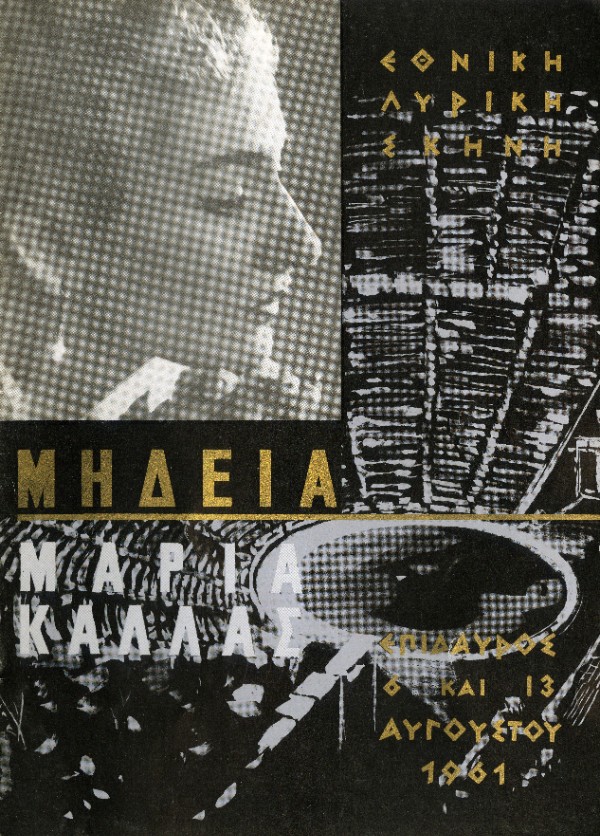
Poster for the 1961 production (GNO Archive)
As an interesting note for this 2026 production: all the costumes had been lost over the past 60 years and needed to be recreated with one exception: bass Tassis Cristoyanni as Creonte wore the original 1961 costume for his role.
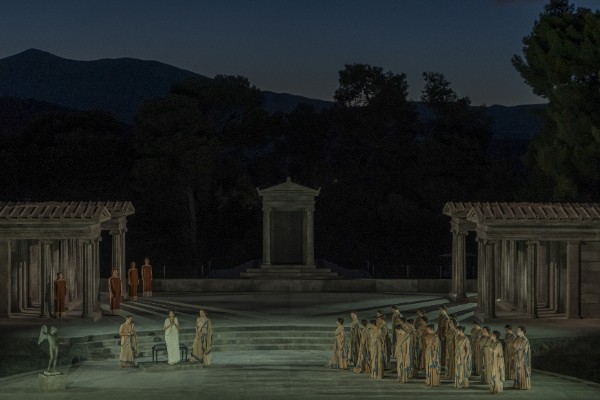
In the setting of the ancient theatre of Epidaurus, the scenery was very effective. Three collonaded buildings framed an open area with steps on one side. The area in front of the steps served as a room where Jason’s bride-to-be, Glauce, conferred with his maid-in-waiting, where Medea conspired with her servant, and so on.
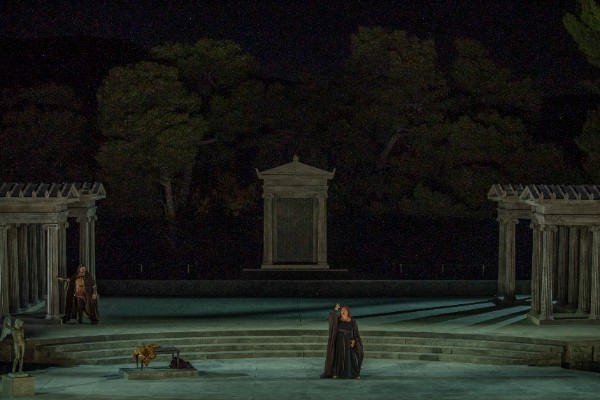
Giasone (Jean-Français Borras) and Medea (Anna Pirozzi) on the stage, 2026 (photo by S. Simopoulos) (Greek National Opera)
The secret of a Greek amphitheatre lies in its acoustics. Designed and built by Polyclitus the Younger from Argos about 330 BC, the theatre is famed for its perfect acoustics – even a whisper on stage could be heard by the 14,000 spectators. The 2026 audience numbered only 10,000 due to the ravages of time and the space required for modern electronics. And, unfortunately, the singers weren’t always audible. The worst was Creonte, who should have been audible everywhere, but whose sound often got lost. The best was Neris (Alisa Kolosova), Medea’s servant, who could always be heard clearly. The orchestra was not at its best: problems with coordination and dynamics at the beginning settled down by the end, but made for a poor start. In a very odd way, the live orchestra sounded like a 1960s recording.
Anna Pirozzi as Medea was, perhaps, 90% Callas, but formidable, nonetheless. Her rapid mood swings from begging Creonte for more time before she gets exiled to demanding Giasone fulfill his familial obligations to her and not marry Glauce were truly exciting to witness.
It all ends in blood, and as the central building is moved forward, the drama intensifies. Medea leaves the temple on her chariot, her dead children at her feet, while smoke and light billow up around her temple.
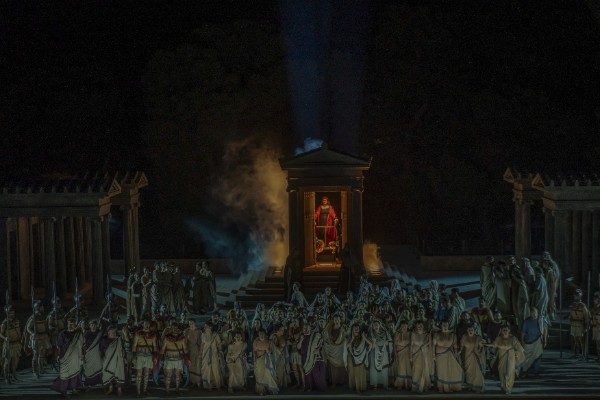
Medea’s triumphant entrance, 2026 (photo by A. Simopoulos) (Greek National Opera)
This was the Greek National Opera’s first return to Epidaurus since Callas’ famed 1961 production. It’s a difficult space for a standard opera – no backstage, no pit, no wings – and yet what they did with using the front space as a variable area – sometimes with a statue of the God of Love, sometimes with a bench, or with a marble stele to move around gave the area more flexibility than might have first been thought possible.
The two main female characters, Glauce (Danae Kontora) and Medea (Anna Pirozzi), carried their roles well. Glauce was difficult to hear at first, but dressed in white, made an effective bride-to-be for Giasone.
Glauce (Danae Kontora) in white before her wedding, 2026 (photo by A. Simopoulos) (Greek National Opera)
The sorceress Medea was dangerous from her first entrance. Her role starts with a fiery entrance, confronting the guards, and then builds to the end. She starts at a high point and then only takes it higher.
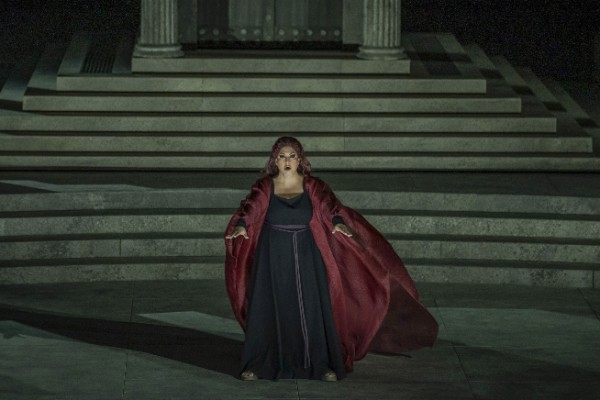
The sorceress unleashed, 2026 (photo by A. Simopoulos) (Greek National Opera)
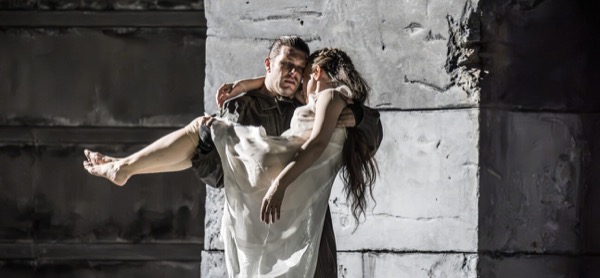
When Medea gives the poisoned gown and diadem to Glauce as her wedding present, you know there’s only tears ahead – Glauce is too happy, and you should never trust Medea to be generous.
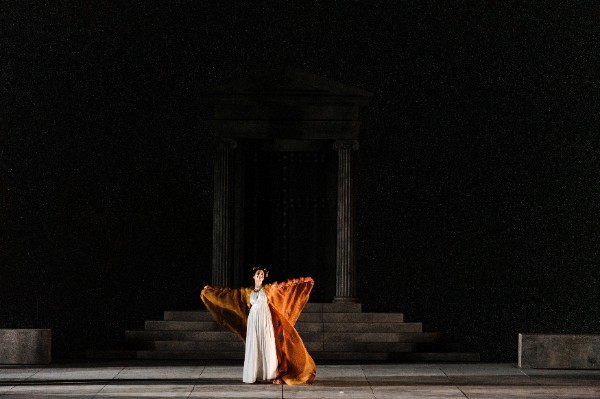
Glauce in the poisoned gown and diadem, 2026 (photo by Giannis Antonoglou) (Greek National Opera)
In the end, the building emotions and pressure lagged a bit, but the true ending with the horror of the dead children, Medea’s ‘there, I showed YOU’ attitude, and the shock of the crowd made up for any lightness before it.
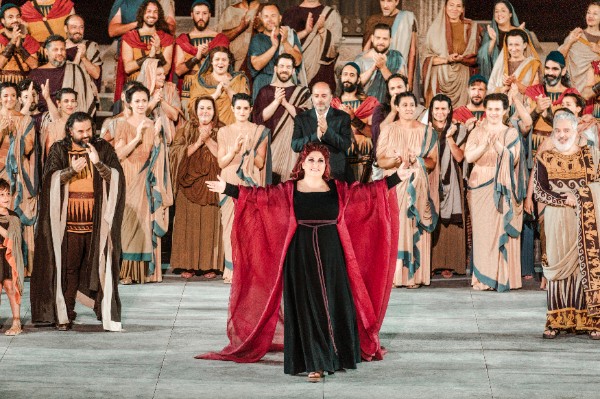
Medea takes her bows, Giasone on the left and Creonte (Tassis Cristoyanni) on the right, chorus master Agathangelos Georgakatos behind, 2026 (photo by Giannis Antonoglou) (Greek National Opera)
If GNO were to return to Epidaurus, they would benefit from more familiarity with the stage area and how the acoustics would work best with the singers’ voices.
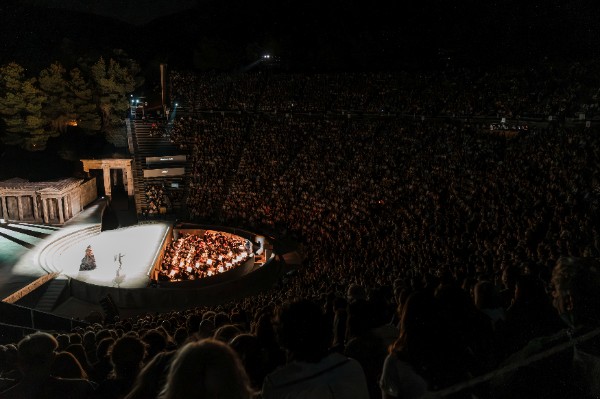
The stage and amphitheater, 2026 (photo by Giannis Antonoglou) (Greek National Opera)
The greatest pity was that this was for one night only. It would be interesting to see the whole production moved to the main opera house in Athens, put the orchestra in the pit, and then see what a modern stage could do to focus the audience.
GNO Medea at the Ancient Theatre of Epidaurus | 20/06/2026 | Η Μήδεια της ΕΛΣ στην Επίδαυρο
Luigi Cherubini: Medea
Greek National Opera
20 June 2026, Epidaurus
For more of the best in classical music, sign up for our E-Newsletter