Stephen Foster, born on July 4th (1826–1864), was an American Romantic-era composer who, almost exclusively, wrote songs and even today, when we celebrate the 200th anniversary of his birth, those songs live on.
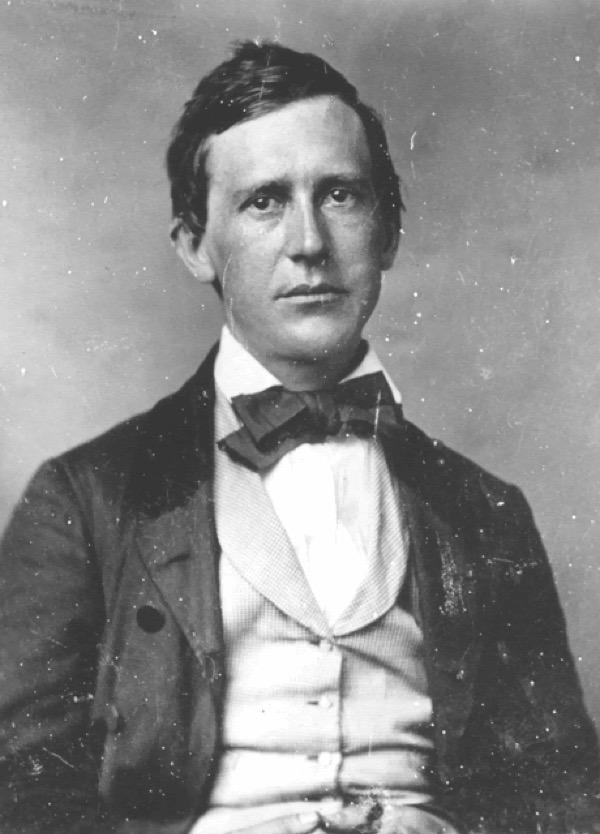
Stephen Foster, ca 1860 (Library of Congress)
Stephen Collins Foster was born in Lawrenceville, Pennsylvania, just outside the western city of Pittsburgh. His family wasn’t particularly musical, but his parents did ensure that their children, particularly their daughters, received training in voice and piano. In the years before the Civil War in the United States, social gatherings and home gatherings would feature both amateur musical performances and poetry readings.
Foster’s biography was highly controlled, edited, and censored by his brother Morrison, and his version of his brother’s life has been largely accepted. It was only with a new biography in 1998 that Foster’s life was brought closer to reality.
The world around Foster in the 1830s was a tremendous mix of influences. Pittsburgh, as a centre of steel production, brought immigrants from around the world, including the Welsh in the 1830s, Irish immigrants in the 1840s escaping the Potato Famine, and German, Italian, and Polish workers. He received an education that would have included English grammar, diction, the classics, penmanship, Latin, Greek, and mathematics, and attended (for a week) Jefferson College in Canonsburg, PA, before leaving school to return to Philadelphia.
The family said he was always interested in music, and he taught himself the flute (his favourite instrument), clarinet, violin, piano, and guitar well enough to perform in home groups. At age 9, he was said to have performed, singing and dancing, with a local theatrical group. He never studied music formally but worked in the Pittsburgh music shop of Henry Kleber (1816–1897), who was active from 1830 in all kinds of musical activity as not only a music dealer but also a songwriter, music teacher, impresario, accompanist, and conductor.
Although he had a day job as a bookkeeper in his brother Dunning’s steamship company (1846–1849), Foster was always composing music. He would give it away as presents to his female friends and to professional performers. The first song that made his name is one that is still sung today, Susanna, which had been entered into a 1847 competition. Even before the work was published, it was an instant hit.
Stephen Foster: Susanna (Oh! Susanna) (United States Army Chorus; Thomas Rotondi Jr., cond.)
It’s a nonsense song about a man travelling from Alabama to New Orleans to see his beloved, bringing his banjo. But, the humour in the song is its use of dialect and oxymorons: ‘It rained all night the day I left, The weather was dry. The sun was so hot I froze to death, and I shut my eyes to hold my breath’. Other verses are confusing amalgams of knowledge: our lover travels by telegraph, but the engine blows up, and the horse runs off. As a poem, it’s funny; as a reflection of another society, it’s tragic.
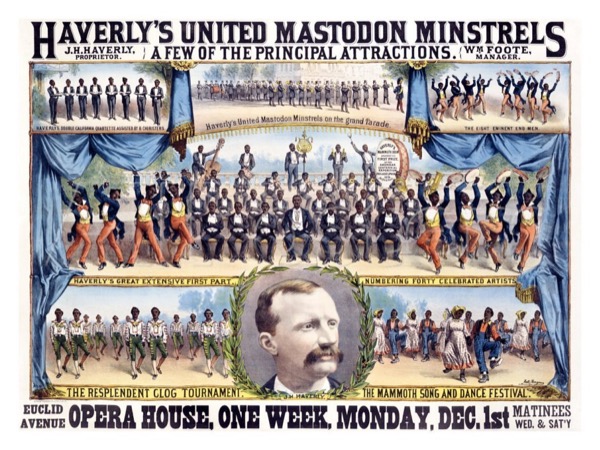
Poster for a Minstrel show, Haverly’s United Mastodon Minstrels, ca 1880
This song was very much in the minstrel genre that was popular in America starting in the early 19th century. These were theatrical performances by white actors painted in blackface. The music, the comic routines, and the stagings all played on the idea of the dim-witted black population that lived in the American South. By playing on racial stereotypes, an entire theatrical genre was born, not to die out until the early 20th century.
Foster wrote some 250 songs, and because of his familiarity with the minstrel genre, his works were immediately taken up by the minstrel performers. Many of these songs were written for a single voice, but others were for a single voice with four parts for the chorus.
Foster married Jane McDowell in 1850, and that was the real start of his productive career. In the next 4 years, he wrote Camptown Races (1850), Nelly Bly (1850), Ring de Banjo (1851), Old Folks at Home (known also as Swanee River, 1851), My Old Kentucky Home (1853), Old Dog Tray (1853), and Jeanie with the Light Brown Hair (1854), the last written for his wife Jane.
These songs are a mix of the minstrel (Camptown Races, Ring de Banjo), the sentimental (Old Folks at Home, Old Black Joe), and love songs (Jeanie with the Light Brown Hair). They all found their audience either on the stage or in the parlour, sung by the family.
Stephen Foster: Camptown Ladies (Camptown Races) (Frederick Urrey, tenor; John Van Buskirk, fortepiano)
Although the title makes it seem like a minstrel song, making fun of America’s black population, Old Black Joe is a sentimental lament sung from the point of view of the dying man, who hears his departed friends calling his name from heaven.
Stephen Foster: Old Black Joe (Poor Old Joe) (Paul Robeson, bass-baritone; Ray Noble Orchestra; Ray Noble, cond.)
Old Folks at Home was written as a minstrel song, with its use of black dialect, such as ribber (river), brudder (brother), and its ‘longing for de old plantation’, but it’s been moved over to the sentimental side of his repertoire, with the emphasis on the ‘folks’ and not the plantation.
Stephen Foster: Old Folks at Home, “Way Down Upon the Swanee River” (Paul Robeson, bass-baritone; Ray Noble Orchestra; Ray Noble, cond.)
Old Folks at Home was made the state song of Florida in 1935 (the Suwanee River empties into the Gulf of Mexico in Florida), but objections to its lyrics led the state, in 2008, working with the Stephen Foster Memorial, to revise them to make them more acceptable.
His love song to his wife, Jeanie with the Light Brown Hair, is a song where you’re not exactly certain what has happened to Jeanie – she floats ‘like a vapour, on the soft summer air’, he wails ‘for the lost one that comes not again’, and ‘I sigh for Jeanie, but her light form strayed…’. Stephen separated from Jane between 1853 and 1854, and the song was written during their estrangement.
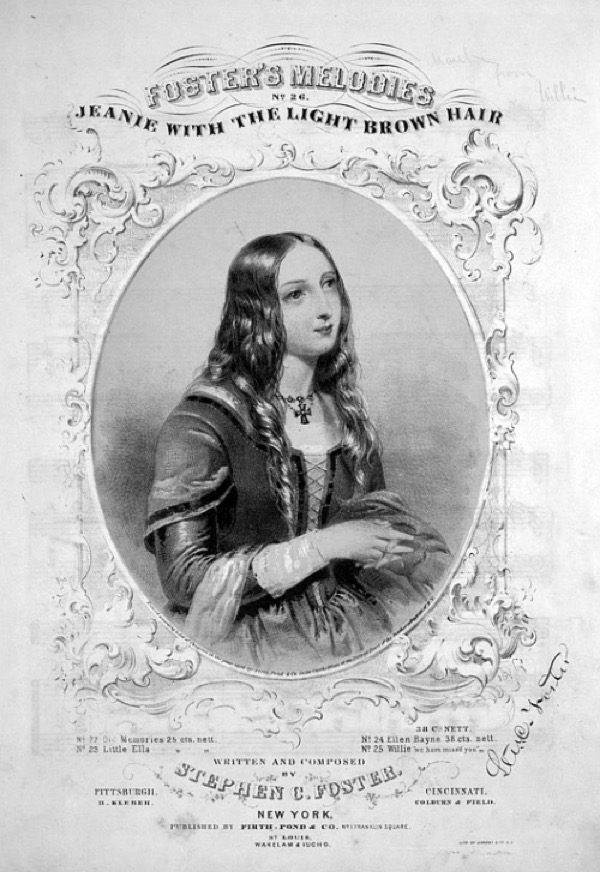
Sheet music for Jeanie with the Light Brown Hair, 1854
Stephen Foster: Jeanie with the Light Brown Hair (Thomas Hampson, baritone)
My Old Kentucky Home, written in 1852 and 1853, is a sentimental ballad that was made the state song of Kentucky in 1928.
Stephen Foster: My old Kentucky home, good night (Paul Robeson, bass-baritone; Ray Noble Orchestra; Ray Noble, cond.)
Although published as a minstrel song, this was the beginning of Foster’s turn against slavery. He wrote fewer minstrel songs after this and began writing music that incorporated black musical ideas as a style. Its nostalgic theme of loss of home resonated in many communities: the Foster family home was lost to money problems, abolitionists used the song to evoke sympathy for the plight of slaves, and the song was picked up by homesick Civil War soldiers.
Although only 23 of his 250-some songs were in minstrel dialect, they accounted for 90% of his income during his life.
As another step in his abolitionist beliefs, in response to Abraham Lincoln’s call for volunteers for the Civil War, made on 1 July 1862, Foster took a widely circulated poem by James S. Gibbons and wrote his patriotic We Are Coming Father Abraham, 300,000 More.
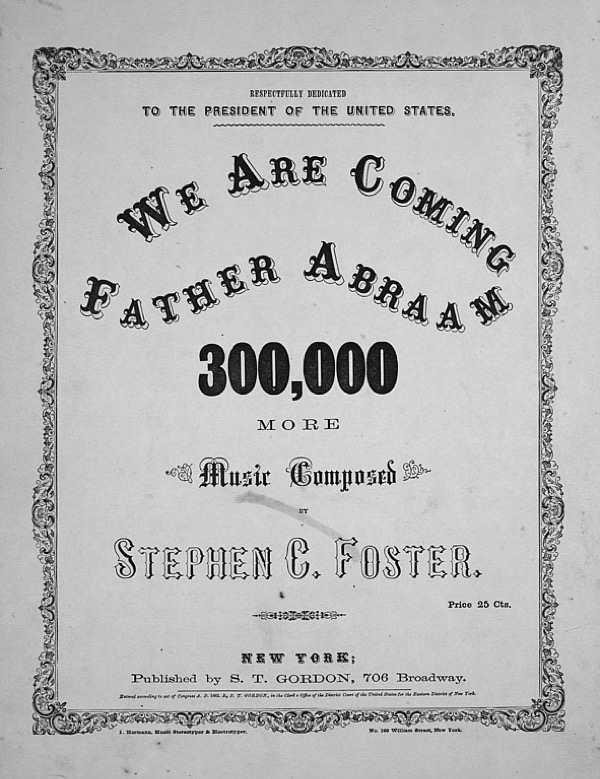
Sheet music for We Are Coming, Father Abra’am, 1862
Stephen Foster: We Are Coming Father Abraam, 300,000 More (Leslie Guinn, baritone; Washington Camerata Chorus; Douglas Koeppe, flute; Gilbert Kalish, piano; Joan Reinthaler, cond.)
In addition to these 250-odd songs, Foster also wrote church hymns in the 1860s and piano music, including his Old Folks at Home Variations, which he wrote in 1851.
Stephen Foster: Old Folks at Home Variations (Noel Lester, piano)
Foster also wrote a stage spectacle, The Invisible Prince, or The War with the Amazons, which was performed in Pittsburgh in 1853, but this has been lost.
His duet, The Hour for Thee and Me, has a distinctly operatic background.
Stephen Foster: The Hour for Thee and Me (Jan DeGaetani, soprano; Leslie Guinn, baritone; Douglas Koeppe, flute; Gilbert Kalish, piano)
One of his last songs was Beautiful Dreamer, not published until after his death, but remaining as one of his best-loved songs. It’s a serenade very much in the European lied tradition.
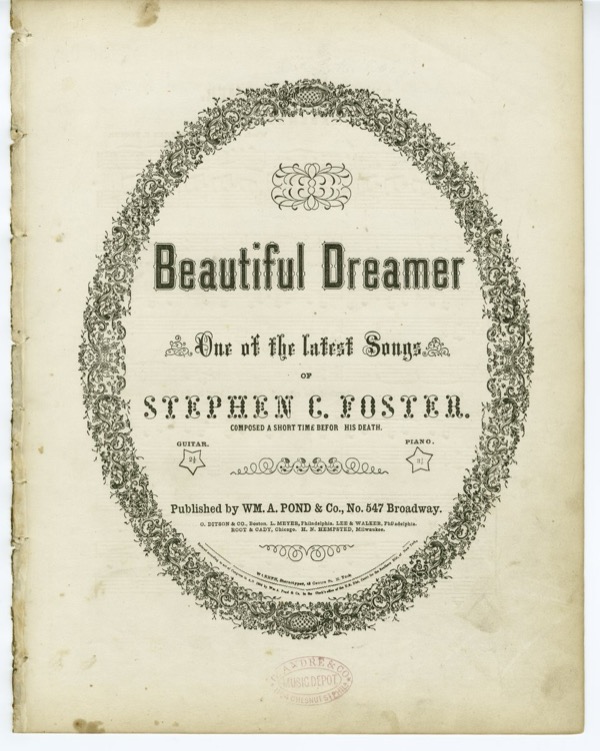
Sheet music for Beautiful Dreamer, 1864 (Indiana University)
Stephen Foster: Beautiful Dreamer (Frederick Urrey, tenor; John Van Buskirk, fortepiano)
Although many of his lyrics are problematic because of the changing times, Foster remains a fundamental part of American music. Starting in 1850, he was the first American to earn his living solely through the sale of music compositions to the public. He didn’t hold a position in any university; he didn’t have a day job after he left his brother’s company in 1849, but he made his living through his music. Eventually, he left Pittsburgh, where he had ‘rented an office…bought a piano…and set up his own one-man song factory’, and moved to New York City, where his publishers were. The death of his parents in 1855 brought his musical writing to a near end, but, needing money, he returned to his work. He died at age 37 in New York in mysterious circumstances – he may have died from an accidental fall or committed suicide – and was buried in Pittsburgh.
As one scholar summarised Foster’s contribution to music: ‘In the 1850s Foster’s songs were the first significant body of identifiably American song; in the early twenty-first century, a handful of Foster’s songs remained among the best-known music in the world’.
For more of the best in classical music, sign up for our E-Newsletter