Italian pianist Michele Tozzetti continues his advocacy for neglected repertoire with his latest recording, Giovanni Sgambati: Piano Works. The album shines a spotlight on a composer who played a crucial role in the development of Italian instrumental music during the nineteenth century, yet remains largely absent from today’s concert programs. Through works including the Pieces Lyriques, Nocturnes, and Poetic Melodies, Tozzetti invites listeners to discover a composer whose music bridges Italian lyricism and the broader European Romantic tradition.

Michele Tozzetti
For Tozzetti, championing lesser-known composers has become something of a mission. Now on his sixth album, he has consistently sought to bring overlooked repertoire to wider audiences.
“I chose to record the music of lesser-known composers, or famous composers’ piano music that is not considered enough, but is incredibly good music that I hope can reach more and more people,” he explains.
His own musical journey began at the age of five. What started as a childhood hobby gradually evolved into a professional calling through studies at the Anton Rubinstein Music School in Rome, followed by piano studies at the Conservatory of Santa Cecilia and a master’s degree in chamber music at the Conservatory Licinio Refice in Frosinone. Along the way, he benefited from the guidance of distinguished pianists Roberto Prosseda and Alessandra Ammara, whom he regards as important mentors.
Tozzetti credits them not only for shaping his approach to piano interpretation but also for nurturing his interest in recording. During the preparation of his first album, devoted to the piano music of Leonard Bernstein, he discovered a particular fascination with the recording process. “That’s the moment I fell in love with the art of recording other people’s music,” he recalls.
Interestingly, Sgambati was not initially a composer that Tozzetti knew well. In fact, the relative obscurity of the composer was part of the attraction.
“I must admit that neither I knew that much about Giovanni Sgambati before I started studying his music, and that’s why I chose him,” he says.
As he delved deeper, however, Tozzetti found a personal connection. Like Sgambati, he was born in Rome, and he became fascinated by the composer’s influence on the city’s musical life. Sgambati was not only a successful pianist and composer but also an important cultural figure who helped foster musical education in the Italian capital. He established a free music school that would eventually evolve into the Conservatory of Santa Cecilia, where Tozzetti himself would study more than a century later.
“Unfortunately, most people don’t know his story, including me,” Tozzetti says. “I think that this is a real pity, so I hope that this recording can help to give Sgambati what he deserves.”
Beyond the historical connection, it was ultimately the music itself that convinced him. Tozzetti describes himself as constantly searching for unfamiliar repertoire, often uncovering hidden treasures that have been unjustly neglected. What particularly impressed him about Sgambati was the composer’s ability to absorb and transform the musical language of his contemporaries.
“He could recreate the sonorities of Schumann piano pieces, imitate Chopin’s nocturnes and pay homage to Liszt’s evocative music without ever mocking any of it,” Tozzetti explains. “He could manage to make his versions of great composers’ styles.”
That ability may help explain why Sgambati earned the admiration of towering figures such as Franz Liszt and Richard Wagner. Liszt’s influence, in particular, can be heard throughout portions of the album. Tozzetti points to the Pieces Lyriques Op. 23, especially works such as À la fontaine and Vox Populi, as examples of Sgambati’s engagement with Lisztian musical storytelling.
Yet Tozzetti is careful to emphasize that Sgambati was never merely an imitator.
“I think that Sgambati’s music has less ‘fireworks,’ but can surprise the listener as well and lead them with his beautiful melodies.”
An important aspect of the recording is the instrument itself. The album was recorded on a 1890 C. Bechstein piano, an instrument dating from the same period as Sgambati’s mature creative life. For Tozzetti, the choice offered a unique opportunity to bring listeners closer to the composer’s sound world.
“I think that old instruments, when in good condition, have a really great sound; you can feel all their history,” he says. “In this case, it is even better because the piano is from the same years as Sgambati’s musical activity, so we can hear the sound he could have listened to in those years.”
While discovering neglected repertoire can be exciting, interpreting it brings its own challenges. For Tozzetti, the greatest responsibility lies in remaining faithful to the composer’s intentions.
“Great composers always know how to communicate what they want from the interpreter,” he explains. “Our job is to understand the meaning of the score and to add as little as possible in terms of our ideas.”
This philosophy guided his preparation throughout the recording project. Rather than imposing a personal agenda, Tozzetti sought to follow the musical directions already present in Sgambati’s writing, trusting the music to speak for itself.
That conviction also underpins his broader advocacy for neglected composers. He believes that today’s performers often focus too narrowly on a relatively small group of canonical figures, leaving many worthwhile voices unexplored.
“Sometimes we, as interpreters, only focus on studying the same 15 or 20 composers,” he observes. “But we should never stop researching different music because we are losing many great composers from the past that were extremely important in their own time.”
For listeners approaching Sgambati for the first time, Tozzetti hopes the album will serve as both an introduction and an invitation. Beyond its historical significance, he simply believes the music remains compelling and enjoyable.
“I also think that this music is very enjoyable today, so everybody should give it a chance.”
As for future recording projects, Tozzetti remains open to wherever curiosity may lead him next. Rather than planning years ahead, he prefers to allow new discoveries to emerge naturally.
“When I feel like it’s the right time, I start looking for some music I don’t know yet,” he says. “If the feeling is right, I usually fall in love with it.”
With Giovanni Sgambati: Piano Works, that sense of discovery is evident throughout. The album not only reintroduces an important figure in Italian musical history but also serves as a reminder that the rich landscape of Romantic piano literature extends far beyond the familiar names that dominate today’s stages.
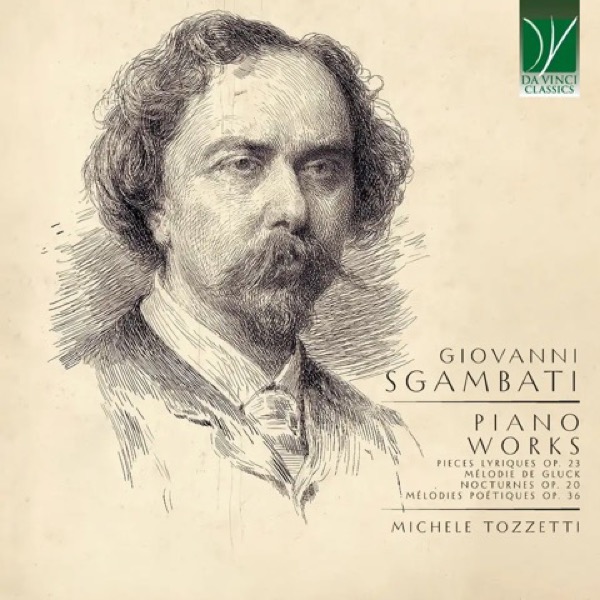
Giovanni Sgambati: Piano Works
Performed by Michele Tozzetti
Released by: Da Vinci Classics
For more of the best in classical music, sign up for our E-Newsletter