It is never easy to be the child of a great composer. Many children wilt under the pressure of being related to a genius: look at what happened to Mozart‘s failed composer son, Franz Xaver, or Robert and Clara Schumann‘s short-lived son, Felix.
One composer’s child who managed to make a hugely important career in music for herself was Imogen Holst, daughter of British composer Gustav Holst.
Today, we’re looking at her life, her decades of service to art and her community, the way she advocated for the work of her father and her dear friend Benjamin Britten, and some of the incredible music that she wrote along the way.
Imogen Holst’s Childhood
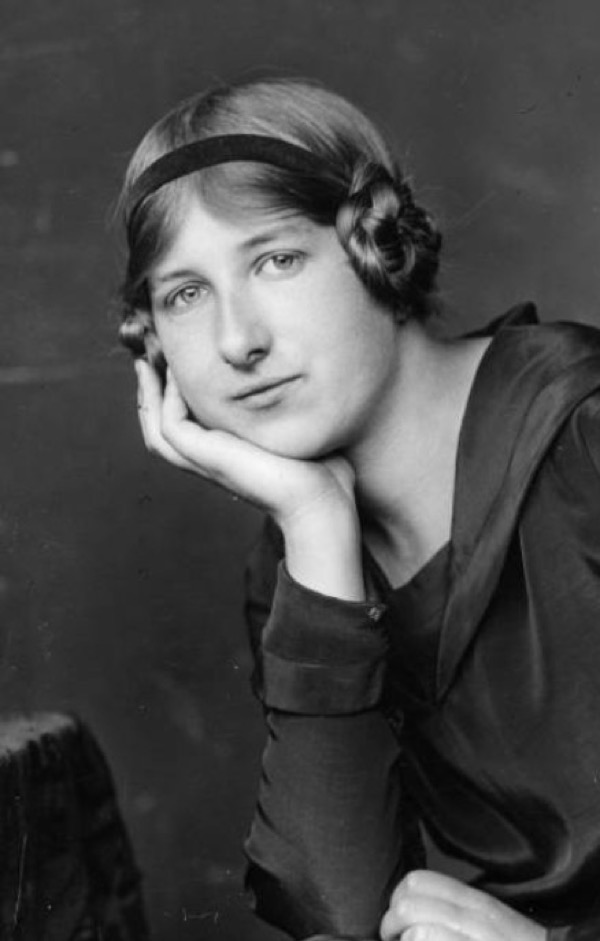
Imogen Holst
Imogen Holst was born on 12 April 1907 outside of London, the only child of Gustav and Isobel Holst.
Her father was a composer, conductor, and music teacher who met his future wife, Isobel, while conducting an amateur choir.
When Imogen was born, he was teaching at two girls’ schools, trying to cobble together a living while composing in the summer. (He would start writing his best-known work, The Planets, when Imogen was seven.)
Gustav Holst’s The Planets
She would later remember:
I first got to know my father as someone who played tunes on the piano for me to dance to… By the time I was four, he was teaching me to sing folk songs.
In 1917, when she was ten, her parents sent her to a girls’ boarding school called Eothen in Caterham, Surrey.
There she began studying piano, violin, and music theory, as well as composing. Works from her time at Eothen actually became her opus 1, 2, and 3.
Pursuing Music at St. Paul’s Girls School
In 1921, she began attending St. Paul’s Girls School in West London, where her father taught music.
While there, she continued progressing as a pianist. Upon graduation in 1925, she performed both a Chopin etude and the premiere of her father’s Toccata.
However, she also began developing chronic arm pain due to phlebitis. This ended up impacting her piano-playing.
This effectively redirected her musical energy away from solo performance and toward conducting, teaching, and composition.
Attending the Royal College of Music
She spent a year studying music privately before enrolling at the Royal College of Music (RCM), her father’s alma mater, in 1926.
There she studied piano with Kathleen Long and composition with George Dyson, a composer and veteran recovering from shell shock sustained during his service in the Great War.
Intriguingly, she also began showing interest in conducting, a field where women had very few role models at the time.
Despite this, she studied conducting at the RCM under W.H. Reed, a conductor and violinist who was a close friend of Edward Elgar.
Halfway through her first year, she conducted one of the college orchestras in the first movement of Mozart’s Prague Symphony to great praise.
Wolfgang Amadeus Mozart: Symphony No. 38 in D Major, K. 504, “Prague” — I. Adagio – Allegro (Philharmonia Cassovia; Johannes Wildner, cond.)
Recognition for Her Composing
She intensified her composition studies during the rest of her time at the RCM, producing a number of chamber music works.
In 1928, her Phantasy String Quartet won the RCM’s Cobbett prize. The following spring, a performance of it was broadcast on the BBC.
Imogen Holst’s Phantasy String Quartet
She also won a scholarship that would enable her to spend a year studying abroad.
For eight months, she traveled across Europe, visiting cities in Germany, Austria, Hungary, and Holland, taking in the unique musical culture of each city. But her heart was in Britain, and in the end, she was happy to return to England.
Over the next few years, she cobbled together work in London as a freelance accompanist, conductor, and teacher.
Her Father’s Death – And Her New Mission
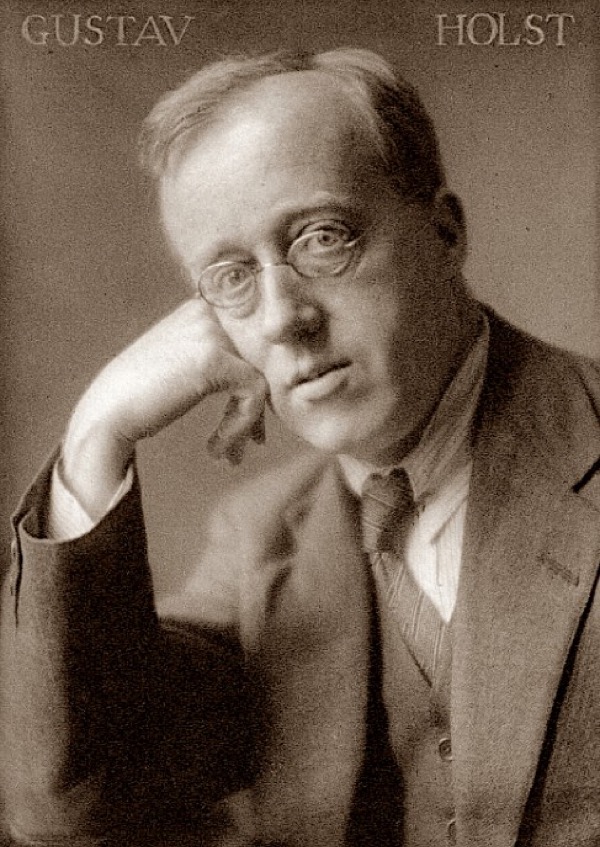
Gustav Holst
In early 1934, her father’s health declined. He died in May 1934, a few weeks after her twenty-seventh birthday.
After he died, she realised that one of the causes she wanted to devote herself to was promoting her father’s musical legacy. She conducted a memorial concert in the spring of 1935.
She also began working on a biography of her father, which was published in 1938 to high praise.
World War II and the CEMA
As war became increasingly likely, she found herself at a crossroads. She decided to become involved in more political work.
In 1940, she took a job with the Council for the Encouragement of Music and the Arts, or CEMA. There she worked as a “music traveller”, i.e., a musician who boosted wartime morale by travelling to various rural areas and organising musical activities.
The effort received limited government support, so she went above and beyond to carry out her mission. She commuted from city to city by bus, bicycle, or even on foot.
She blossomed as an arts administrator, making do on her own, doing everything from conducting brass bands to organising sing-alongs for evacuee children.
Despite the stresses of the situation and her health struggles, she flourished creatively in the high-pressure environment.
Teaching Future Conductors and Composing
In 1943, while working at Dartington Hall School, she created a course originally meant for women specifically, teaching them how to found and lead amateur orchestras in their communities.
She threw out the concept of formal exams and encouraged her students to learn by doing.
Rosamond Strode, a colleague who eventually worked as Benjamin Britten’s assistant, described how she went about her work:
“She knew exactly how, and when, to push her victims in at the deep end, and she knew, also, that although they would flounder and splash about at first, it wouldn’t be long before…they would be swimming easily while she beamed approval from the bank.”
She also composed more during the war. She was writing for more instruments, as evidenced by her Suite for String Orchestra and a work for chorus.
In June 1943, there was a concert of her music at Wigmore Hall.
Supporting Other Musicians
During the 1940s, she began developing her reputation as a contact who could help other musicians.
Just one example of many was her promotion of the career of Norbert Brainin, a violinist who had fled Vienna after Hitler’s invasion of Vienna, and then, due to his Austrian citizenship, was interned in Britain for a time as an “enemy alien.”
Holst encouraged him to form a string quartet, and she arranged for the ensemble’s first performances.
That quartet went on to become the Amadeus Quartet, one of the greatest string quartets of the twentieth century.
Mozart’s String Quartet No. 19, performed by the Amadeus Quartet
Working With Benjamin Britten and Peter Pears
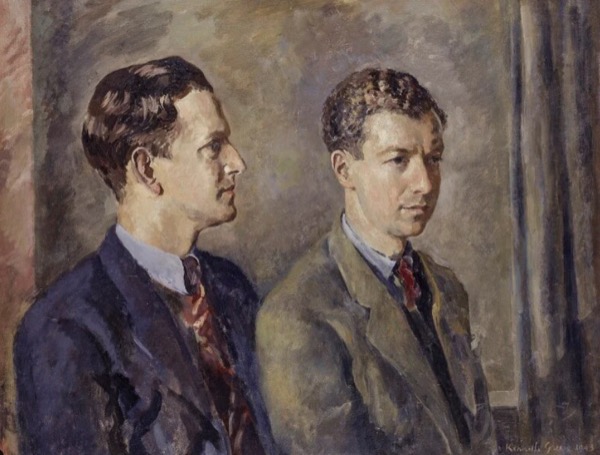
Benjamin Britten and Peter Pears
In the 1940s, her networking paid off in the most impressive way yet. It was then that she befriended Benjamin Britten and his personal and professional partner, tenor Peter Pears. Soon, she was helping Britten with preparing his scores.
Schubert’s Winterreise (excerpt), performed by Benjamin Britten and Peter Pears
For over a decade, she worked closely with Britten as his assistant, copying his sketches and helping to turn them into scores fit for performers to actually use.
She was a vital part of the creation of Britten’s operas Gloriana (1953) and The Turn of the Screw (1954), as well as the ballet The Prince of the Pagodas (1956).
But the work she did with him wasn’t just copying. In 1957, when he wrote his children’s opera Noye’s Fludde, she became a co-creator, suggesting a raindrop effect created by hitting mugs with wooden spoons.
Britten’s Noye’s Fludde
In 1956, she joined their professional lives in a more publicly binding kind of way when she agreed to become an artistic director at Britten and Pears’s influential Aldeburgh Festival, a role she would retain for two decades.
She oversaw all kinds of performances and also helped to develop a variety of educational programs.
Stepping Back from Britten
Holst gave so much time and energy to the Britten-Pears partnership and their work that, in 1964, she realised she had to take a step back.
The three never had a falling-out, but she wanted to spend the last part of her life advocating for her father’s works…and for herself.
She made good on both missions.
In the late 1960s, she began making a series of important reference recordings of her father’s works, keeping her father’s music from falling into obscurity.
Imogen Holst’s The Sun’s Journey (excerpts)
She also continued composing herself. In 1965, she was commissioned to write The Sun’s Journey and the Trianon Suite.
That said, she also continued working with Britten and Pears whenever it worked out. She only officially retired from Britten and Pears’s Aldeburgh Festival in 1977, at the age of seventy.
Cementing the Gustav Holst Family Legacy
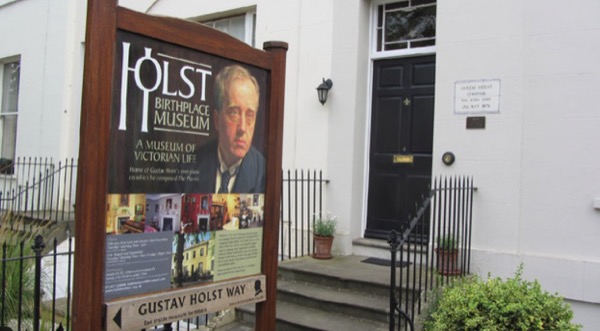
Holst Birthplace Museum
The 1970s were a decade of feverish promotion of her father’s works.
In 1974 alone, she published a catalogue of her father’s music, began publishing a series of facsimiles of his manuscripts, and organised concerts of his works at a variety of venues.
She also founded the Holst Birthplace Museum in Cheltenham, Gloucestershire, England, located in the home where her father was born.
One of the attractions there is the piano on which he composed The Planets, as well as a portrait of her father dating from the 1920s.
There are only three museums in Britain devoted to specific composers. (The other two are Handel and Elgar.) The fact that this one exists at all is due entirely to Imogen’s work.
In 1979, she attended the opening of a Britten-Pears School building in the town of Snape, Suffolk, near Aldeburgh. Inside was a library which had been dubbed the Gustav Holst Library. She donated a number of her father’s papers to the institution for scholars to study in the future.
Imogen Holst’s Death
Not long after her retirement from the Aldeburgh Festival, Holst began developing heart trouble, suffering from angina (a symptom of heart disease).
She died on 9 March 1984 and was buried a few yards away from her beloved creative partners Benjamin Britten and Peter Pears.
Imogen Holst’s A Hymne to Christ
Imogen Holst’s Remarkable Legacy
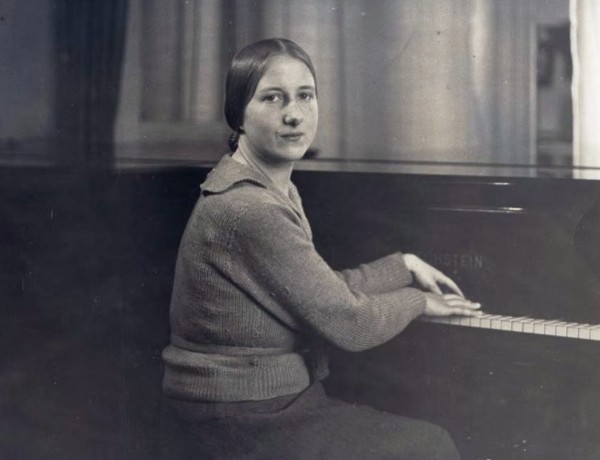
Imogen Holst
Imogen Holst was in an incredibly unusual position in music history.
Of course, she was a woman born in 1907, which complicated her career considerably from the start.
Despite that, she navigated countless societal barriers with grace. She became incredibly talented in a wide range of musical pursuits, including composition and performance, as well as teaching, arts administration, researching, and writing. Very few people, male or female, are so effortlessly adept at all of these things.
She was also the heir to a rich musical legacy from her father, and she felt a deep-seated desire to preserve and admire his music.
And, as if all of that wasn’t enough, she also crossed paths with Benjamin Britten, a genius in his own right who not only could advance British music generally, but her father’s legacy and ideals particularly.
Given all of the creative pulls in her life, she did a remarkable job at balancing them all.
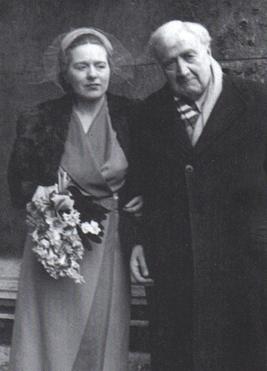
Ursula and Ralph Vaughan Williams in 1953
After Imogen Holst’s death, Ursula Vaughan Williams, composer Ralph Vaughan Williams‘s second wife, wrote about her friend:
“Imogen had something of the medieval scholar about her…content with few creature comforts if there was enough music, enough work, enough books to fill her days. Indeed, she always filled her days, making twenty-four hours contain what most of us need twice that time to do.”
For more of the best in classical music, sign up for our E-Newsletter