In 1802, Beethoven (1770–1827) returned to Vienna from his stay in Heiligenstadt, where he’d been sent on doctor’s orders so he could learn to deal with both his increasing tinnitus and encroaching deafness. This is where he decided that suicide was not for him, and he would continue to fight for his art.
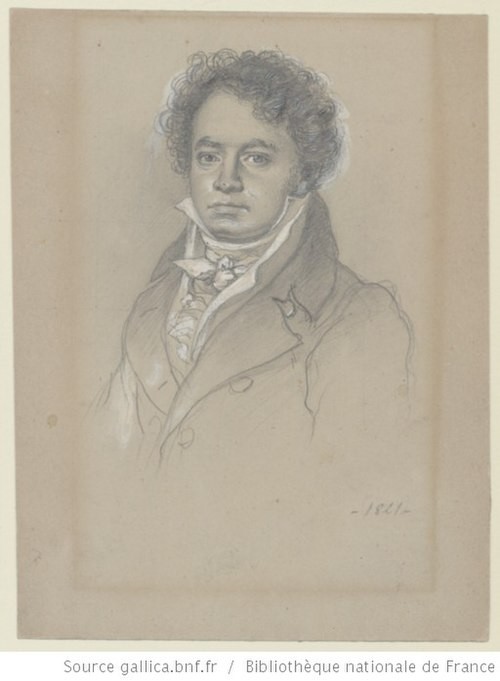
Louis Rene Letronne: Beethoven, ca 1814 (Gallica: btv1b8426399n)
The Beethoven who returned with his new resolution for life was someone who now thought big, thought heroic, and thought on a grand scale. In symphonies, we had the Eroica Symphony No. 3. In his piano concertos, we had his Emperor concerto.
Piano Concerto No. 5, nicknamed the Emperor in English-speaking countries, was composed in 1809 and dedicated to his patron, Archduke Rudolph (or, to give him his full title: Rudolph Johann Joseph Rainier, Archduke of Austria, Prince Royal of Hungary and Bohemia, Cardinal-Archbishop of Olomouc) (1788–1831).
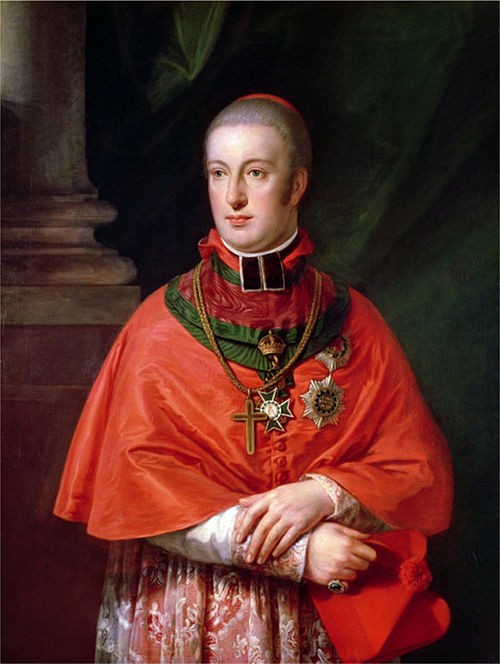
Johann Baptist von Lampi the Elder: Rudolph von Österreich, first half 19th century (Vienna Museum)
In addition to being his patron, the Archduke Rudolph was also Beethoven’s friend and pupil, studying with him from 1803 or 1804 until 1824.
We can see Beethoven’s innovations from the very first note as he dispenses with the usual extended orchestral introduction: one orchestral chord, and the solo piano starts with a cadenza. This is a new, longer first movement, in pure sonata allegro form, albeit with 3 rather than 2 themes. Another innovation of this work is the opening written-out cadenza – we’ve already remarked on the unusual aspect of opening with a piano statement, but the additional novelty is the writing out of the cadenza. Usually, this would be left to the soloist to improvise. Following Beethoven’s model, composers began writing out cadenzas for soloists. After the usual 2-theme exposition in the orchestra, Beethoven added a second exposition and introduced a 3rd theme that was solely for the piano, another innovation of Beethoven’s.
The work had its premiere on 28 November 1811 in Leipzig. Friedrich Schneider performed as the soloist under Johann Philipp Christian Schulz, conducting the Gewandhaus Orchestra. Although we would expect Beethoven to be the soloist, his failing hearing prevented this. Its Vienna premiere was 4 months later with Beethoven’s pupil Carl Czerny as soloist.
It’s not known where the Emperor title came from – Beethoven disliked it (because of the title’s associations with Bonaparte) and, as it is in English, rather than in German, may have originated with Beethoven’s London publisher, Cramer.
Ludwig van Beethoven: Piano Concerto No. 5 in E flat Major, Op. 73 “Emperor” – I. Allegro
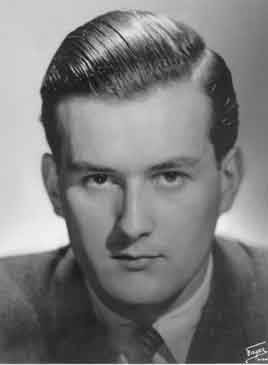
The young Alexander Jenner
This recording was made in 1957 with the Orchester der Wiener Konzert-Vereinigung, later known as the Vienna Symphony. The conductor, F. Charles Adler was a conductor born in Germany, but who moved to the US in 1933. The soloist, Alexander Jenner (b. 1929), studied in Vienna, and during his performing career was a champion of new music, being the first Austrian pianist to perform Gershwin‘s Rhapsody in Blue and Concerto in F in 1951. He also played the Austrian premiere of Khachaturian’s Piano Concerto, with the composer conducting. He taught at the Hochschule für Musik und darstellende Kunst in Vienna from 1969 until his retirement in 1997.
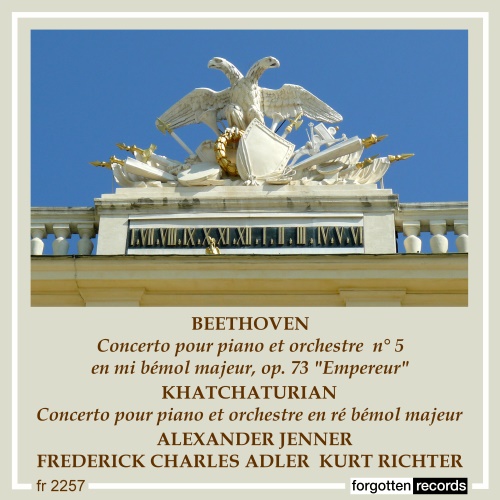
Performed by
Alexander Jenner
Charles Adler
Orchester der Wiener Konzert-Vereinigung
Recorded in 1957
Official Website
For more of the best in classical music, sign up for our E-Newsletter