In September 1939, a quiet, understated film called Intermezzo: A Love Story premiered in the United States.
Intermezzo premiered the same year as Gone With the Wind, The Wizard of Oz, Wuthering Heights, Of Mice and Men, and other classics.
(It also premiered three weeks after Hitler invaded Poland.)
So it’s understandable why it has been overshadowed in the years since.
Despite its age, it’s worth revisiting today. It remains one of the most positively reviewed classical music movies on Rotten Tomatoes…and it also happens to be the English-language film debut of legendary actress Ingrid Bergman.
Intermezzo: A Love Story (1939) ORIGINAL TRAILER
Here are some reasons why you might want to put Intermezzo on your to-watch list.
The Plot
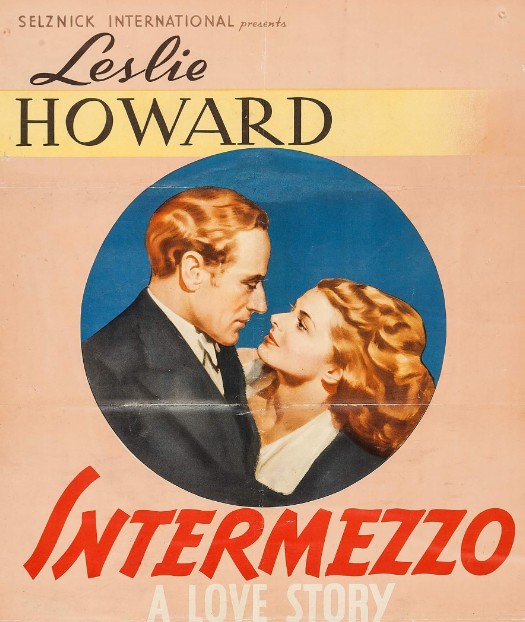
Intermezzo: A Love Story movie poster
Skip this section if you don’t want spoilers!
Intermezzo follows Swedish violinist Holger Brandt, played by Gone With the Wind’s Leslie Howard, as he returns home from a concert tour.
He becomes infatuated with his young daughter’s piano teacher, Anita Hoffman, played by Ingrid Bergman.
The two fall in love and go on tour together, and Brandt decides to leave his wife and children in order to be with her.
After an idyllic rest in Italy, Anita receives word that she has been chosen for a prestigious scholarship to study in Paris. After initially rejecting it, she notices that Brandt is missing his daughter. So Anita decides to leave him, enabling Brandt to return to his family, while she goes to Paris to continue her career.
Brandt returns to his former home and surprises his daughter at school. She runs across the road to greet him and is hit by a car.
At first, it appears that she may be dead, but she ends up making a recovery.
Toward the end of his daughter’s convalescence, Brandt is prepared to leave the family, assuming that his wife won’t want to be with him anymore after his betrayal. But despite her pain at his infidelity, his wife asks him to return home.
This is Ingrid Bergman’s first American film, and she is a revelation.
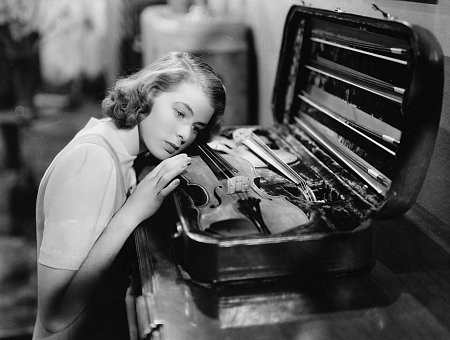
Scenes from Intermezzo: A Love Story
This story could easily have turned into sentimental schlock, but Ingrid Bergman’s performance almost single-handedly saves it.
She portrays the quiet, determined intensity of a rising pianist very well, in addition to the inner conflict of a young woman feeling guilty about having fallen in love with a married man.
Bergman knew how to play piano, and she actually does perform the segments of the Grieg piano concerto that are shown in the film.
The audio of her performance was later dubbed over by pianist Nora Drury, who frequently worked with composer Max Steiner. (Drury was also an actress and appeared in the film Stage Door.)
Leslie Howard and Ingrid Bergman in Intermezzo (1939)
Leslie Howard also gives a strong performance.
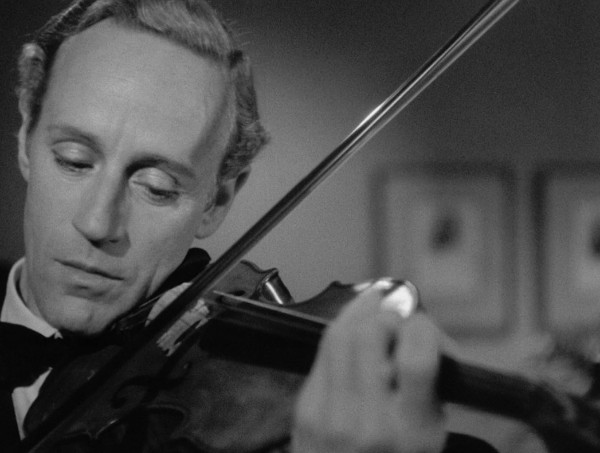
Scenes from Intermezzo: A Love Story
British actor Leslie Howard also shines here in the role of a patrician violin soloist, unexpectedly starstruck by a beautiful colleague.
Unlike Bergman, Howard did not play his instrument. The director solved the problem by shooting certain shots in close-up, having professional violinists bow and finger with Howard’s face in-shot.
Violinists can easily spot that Howard isn’t actually playing, but generally speaking, the method works well enough. It would later be used in the 1946 Joan Crawford film Humoresque.
Violinist Toscha Seidel provided the audio for the dub.
Max Steiner wrote most of the score for Intermezzo.
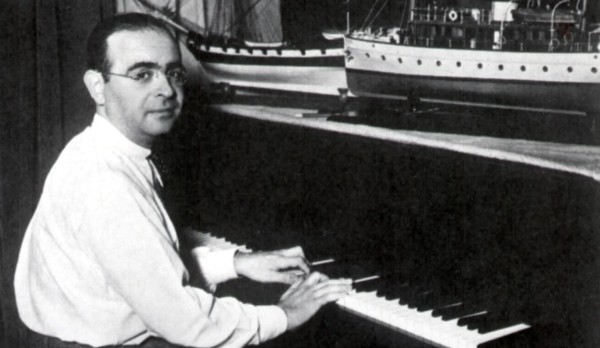
Max Steiner
Max Steiner was a startlingly proficient composer, proven by the films he scored in 1939.
He was born in 1888 in Vienna to a wealthy and artistic family (his godfather was composer Richard Strauss). Steiner was a child prodigy and became a professional musician by the time he was in his teens.
He moved to America during World War I and found work composing for the emerging American industry.
In 1939, he wrote an astonishing thirteen film scores, including two-and-a-half hours worth of soundtrack for Gone With the Wind. While composing that score, he worked twenty-hour days, aided by prescribed amphetamine injections.
It’s interesting to see a dramatisation of the effects of a travelling soloist on a family.
Many times in classical music movies, filmmakers don’t spend much time exploring the effect of musicians’ demanding careers on the families around them.
However, in Intermezzo, the consequences of Brandt’s chosen career are vitally important to both the plot and characters.
We learn about the loneliness of Brandt’s daughter when her father is on tour – her irrepressible joy at his return – how Brandt and his wife bonded early on in their relationship while travelling – as well as the intense pressure that bonds Brandt and Hoffman during the “intermezzo” that was their relationship.
In the end, this film may be more about personal relationships than classical music, but it’s still worth seeing for classical music lovers.
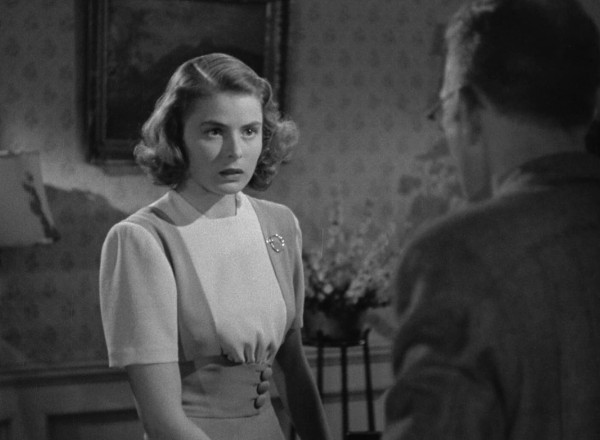
Scenes from Intermezzo: A Love Story
For the most part, Intermezzo still holds up today, especially the portions featuring Ingrid Bergman.
It remains a worthy addition to any classical music lover’s or early film lover’s to-watch list.
If you want to experience a full-circle cinematic moment, you could create your own double feature with 1978’s Autumn Sonata. Intermezzo was Bergman’s first Hollywood film, and Autumn Sonata her last, and she plays a concert pianist in both!
For more of the best in classical music, sign up for our E-Newsletter