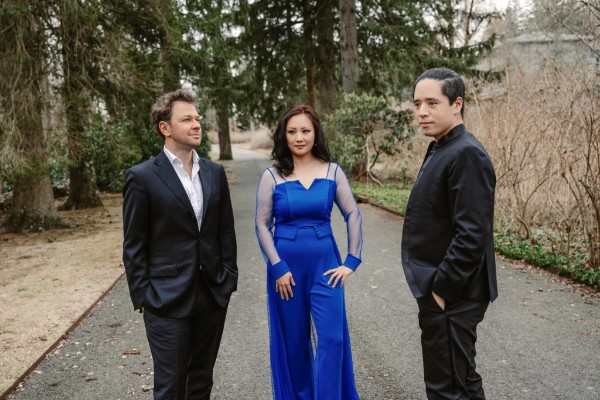
Sitkovetsky Trio © Jiyang Chen
To mark the 250th anniversary of Beethoven’s birth, the Sitkovetsky Trio embarked on an ambitious project to record the complete set of the composer’s piano trios for BIS Records. This project, with the exception of a couple of small fragments, has now been concluded with the release of the third volume in 2024. In a nutshell, violinist Alexander Sitkovetsky, cellist Isang Enders, and pianist Wu Qian have delivered a compelling traversal of Beethoven’s works for piano trio; a most valuable addition to the contemporary chamber music landscape.
Sitkovetsky Trio performs Beethoven: Piano Trio in E-flat Major, Op. 1, No.1
Two Decades of Dynamic Harmony
BBC Music Magazine awarded the set five stars, and likened the “trio’s convivial interplay to three good friends enjoying a glass of wine and a natter.” And that might well be at the heart of the matter, as the original trio met as students at the Yehudi Menuhin School in London in 2007. In 2019, German-Korean cellist Isang Enders joined the trio, replacing Leonard Elschenbroich, and he brought fresh energy to the trio as they approach their 20th anniversary in 2027, coinciding with the commemoration of Beethoven’s death.
Their 2021 album featuring Ravel’s Piano Trio and Saint-Saëns’ Trio No. 2 earned critical acclaim, winning the BBC Music Magazine’s Chamber Music Award in 2022 and a Supersonic Award from Pizzicato Magazine. The Sitkovetsky Trio was appointed Ensemble in Residence at the Beethovenfest Bonn 2024. They performed three concerts, including Beethoven piano trios, a commissioned work by Lena Sierova, and the world premiere of Ferran Cruixent’s Trinity with the hr-Sinfonieorchester.
Sitkovetsky Trio performs Beethoven: Piano Trio in B-flat Major, Op. 97 “Archduke” (excerpt)
Beethoven’s Piano Trios Unveiled
The piano trios by Ludwig van Beethoven represent a significant evolution within the chamber music repertoire, from a young composer rooted in Classical traditions to a mature artist expanding the expressive and structural boundaries of the genre. His set of Opus 1, composed between 1793 and 1795, reflects the influence of Haydn and Mozart, while the transitional Trio Op. 11 (Gassenhauer) features a popular theme and subsequent variations signalling Beethoven’s early interest in thematic transformation.
Beethoven’s middle-period trios, Op. 70 Nos. 1 and 2 (1808) reveal deeper dramatic contrasts and motivic development. The “Ghost” Trio is celebrated for its slow movement, evoking a “mysterious atmosphere that departs from classical norms,” while the companion Op. 70 No. 2 contrasts with its calmer lyricism but shares Beethoven’s growing command of dialogue among the instruments.
The apex of Beethoven’s piano trio output is undoubtedly the Op. 97 “Archduke” Trio dedicated to his patron, Archduke Rudolph. This four-movement work integrates symphonic breadth with chamber intimacy, featuring fully equal roles for piano, violin, and cello, and showcases Beethoven’s mature handling of form and harmonic innovation. In essence, Beethoven transformed the piano trio from a domestic pastime into a profound chamber genre, emphasising motivic unity, emotional depth, and ensemble equality.
Sitkovetsky Trio performs Beethoven: Piano Trio No. 3 in C minor, Op. 1, No. 3 “Allegro”
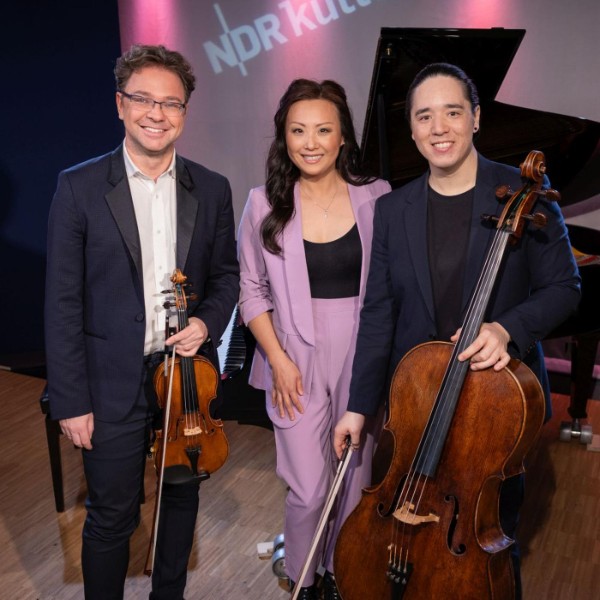
Sitkovetsky Trio
A Distinctive Voice in a Crowded Field
The Sitkovetsky Trio’s Beethoven cycle distinguishes itself within a crowded field of piano trio recordings through a combination of interpretive nuance and technical finesse. Their approach throughout is marked by clarity and structural coherence, sidestepping exaggerated theatrics to illuminate the music’s architectural genius.
This modern sensibility, both cerebral and emotionally engaging, contrasts with the Beaux Arts Trio’s warmer lyricism and the Suk Trio’s robust drama, offering a fresh lens on these ingenious Beethoven works. Wu Qian’s “pearly runs” and “discreet pedalling,” ensure a clarity that allows intricate counterpoint and harmonic shifts to shine without lush excess, particularly in introspective passages where emotional weight meets unflinching precision.
Central to their success is a “beautifully matched sound,” reflecting a seamless blend of all instruments that honours Beethoven’s vision. This ensemble dynamic underscores Beethoven’s ideal, as the music becomes a dialogic dance rather than a contest for dominance. This remarkable cohesion, interpretive nuance, and technical finesse could only emerge from a dedicated trio, forged and refined through decades of shared growth and unwavering commitment to their craft.
For more of the best in classical music, sign up for our E-Newsletter