There is no other sound in the classical music world like a solo viola.
It’s not quite a violin, and not quite a cello; instead, it’s an otherworldly cross between the two.
There have been a number of works for solo viola written over the past few centuries, but today we’re focusing on a specific subset of them: works for solo viola written by women composers.
Whether you’re a violist looking for new repertoire or a listener seeking to expand your horizons, we hope you enjoy these seven selections, dating from between 1930 and 1998, and written by seven boundary-breaking composers.
Imogen Holst – Sonata for Unaccompanied Viola (1930)
Imogen Holst was born in 1907, just outside London, to composer Gustav Holst and his wife.
Her musical education began early; her father began teaching her folk songs when she was very young. She would treasure memories of sitting on his lap while he played the piano.
In 1917, at the age of ten, she enrolled in a private boarding school, where she began her serious study of piano, violin, and theory. She composed her first works soon after.
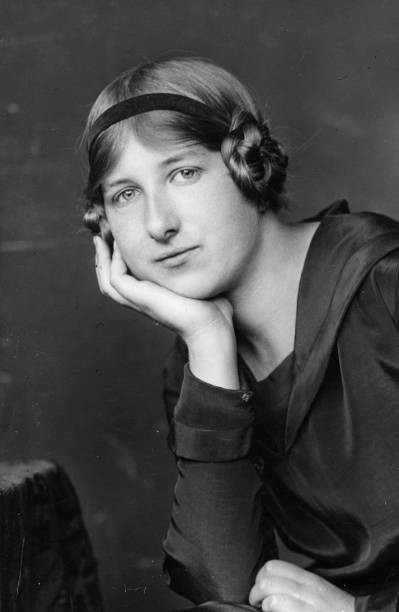
Imogen Holst
Her primary focus was the piano until 1923, when she developed phlebitis in her left arm, leading her to focus more and more on composition.
She enrolled at the Royal College of Music in 1926. In 1928, she won a prize for her Phantasy string quartet and was named the best all-around student. In 1929, the quartet was broadcast across the country on the BBC, bringing national attention to her work.
She wrote this sonata for unaccompanied viola in 1930, her final year at the RCM. She was just 23.
Lillian Fuchs – Sonata Pastorale (1956)
Lillian Fuchs was born in New York City in 1901.
Her entire family was musical; her brothers Joseph Fuchs and Harry Fuchs went on to become a professional violinist and cellist, respectively, and she often performed with both.
She studied piano, violin, and composition at the Juilliard School. She only switched to viola in the mid-1920s after her teacher, Franz Kneisel, suggested it.
She was also a founding member of the Perolé Quartet, serving as violist between 1925 and 1945.
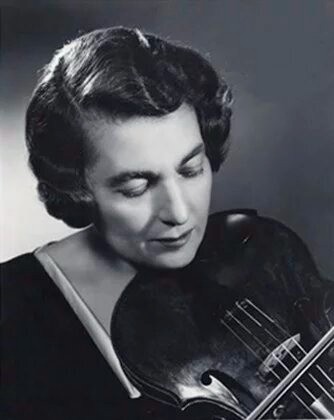
Lillian Fuchs
She taught at Juilliard and the Manhattan School of Music, and counted Pinchas Zukerman, Isaac Stern, and Dorothy DeLay among her students.
Even as she pursued her performing and teaching careers, Fuchs continued to compose. Her solo Sonata Pastorale was created in her fifties, after she had written a set of etudes for solo viola.
Marga Richter – Darkening of the Light (1978)
Marga Richter was born in 1926 in Wisconsin, studied in Minneapolis, and then moved to New York to attend the Juilliard School.
She graduated with a composition degree in 1951 and was the first woman to earn a master’s degree in composition from Juilliard.
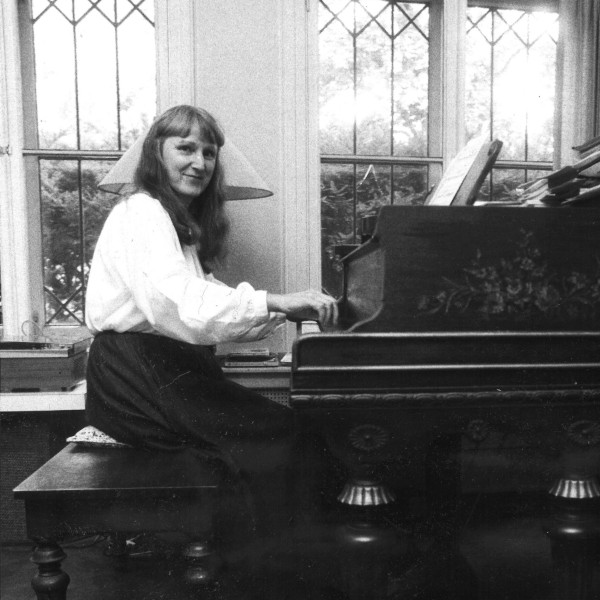
Marga Richter
She wrote a number of large-scale orchestral works in the 1970s. Later that decade, she tried her luck with a smaller canvas: solo viola.
The dedicatee of this work was violist Walter Trampler, a founding member of the Chamber Music Society of Lincoln Center.
“Darkening of the Light” consists of nine brief movements linked together. It was inspired by lines from the I Ching:
The light has sunk into the earth:
The image of Darkening of the Light.
Wounding of the Bright.
The Light is veiled, yet still shines.
Elisabeth Lutyens – Echo of the Wind (1981)
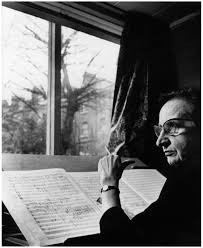
Elisabeth Lutyens
Elisabeth Lutyens: Echo of the Wind, Op. 157 (Rosalind Ventris, viola)
Elisabeth Lutyens was born in London in 1906, making her a near contemporary of Imogen Holst.
She decided to become a composer at the age of nine. In 1922, when she was sixteen, she began studying at the École Normale de Musique in Paris.
She went to India with her mother in 1923, then returned to England for additional training. Between 1926 and 1930, she studied at the Royal College of Music.
During the 1930s, her creative life was thrown off-balance by her first marriage and the early years of motherhood. She had four children, got divorced, remarried, developed an alcohol addiction, and, in 1948, had a mental breakdown. It took until the early 1950s for her to get sober.
Over the course of her career, she wrote a number of well-received concert pieces and film scores. She also wrote a number of “serious” concert works.
Two years before she died, she wrote this solo viola piece for violist Paul Silverthorne. It is a virtuosic work that includes spooky effects like harmonics and playing with the clackety wood of the bow.
Elizabeth Maconchy – Five Sketches for Viola (1984)
One year after Lutyens’s “Echo of the Wind” was written, British composer Elizabeth Maconchy wrote her Five Sketches for Viola.
Elizabeth Maconchy was born to Irish parents in Hertfordshire in 1907. When she was ten, the family returned to Ireland.
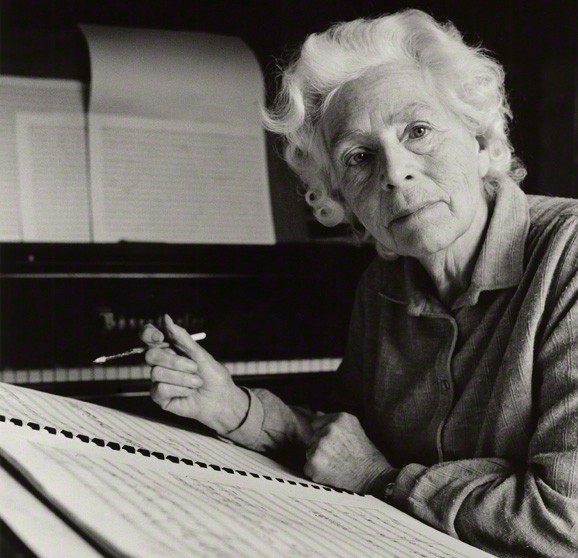
Elizabeth Maconchy
She began studying music in Dublin. Then, at sixteen, she moved to London to study composition at the Royal College of Music under Ralph Vaughan Williams.
She had a long and impressive career, despite the fact that she was often overshadowed by male contemporaries like William Walton and Benjamin Britten.
Ten years before she died, she wrote these five slim pieces for solo viola. They were commissioned by violist Nicholas Logie, who had discovered her work after recording her Romanza for viola and chamber orchestra.
Thea Musgrave – In the Still of the Night (1997)
Thea Musgrave was born in an Edinburgh suburb in 1928. Her early education took place at a girls’ boarding school, and then at the University of Edinburgh, after which she went to France to study with Nadia Boulanger.
In the summer of 1958, she went to the Tanglewood Music Festival outside of Boston to study with Aaron Copland.
In 1970, she became a guest professor at the University of California, Santa Barbara. The following year, she married American violist Peter Mark. The marriage cemented her ties with America.
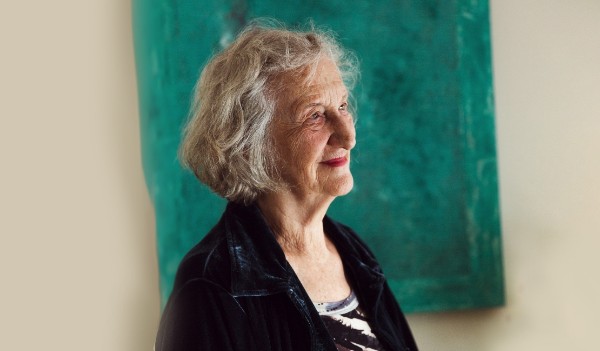
Thea Musgrave
Between 1987 and 2002, she was a professor at Queens College, City University of New York.
She wrote “In the Still of the Night” in 1997.
The brief program note on her publisher’s website notes simply, “It is intended as a moment of peaceful contemplation after the day’s activities cease. The duration is about three and a half minutes.”
Sally Beamish – Penillion (1998)
Sally Beamish: Penillion (Rosalind Ventris, viola)
Sally Beamish was born in 1956 in London. She studied music at the Royal Northern College of Music and the Hochschule für Musik Detmold.
In addition to studying composition, she became a professional violist, playing in the string sextet the Raphael Ensemble, making her deeply familiar with the instrument.
The note on her publisher’s website reads:
Penillion is a form of extemporised singing known only in Wales. The singer improvises a sort of counterpoint while a harpist plays several stanzas of a well-known melody. The singer only states the melody at the end.
I have adapted this idea to make a set of variations on the Welsh tune Gwenllian’s Repose; incorporating, as well as the idea of singing, imagined sounds of the ‘crwth’ – an ancient Welsh fiddle, now extinct.
Penillion was commissioned by Heather Gibbard and dedicated to her niece, the viola player Rebecca Mair Jones, on the occasion of her 18th birthday (22nd July 1998).
Conclusion
We hope you’ve enjoyed this tour through seven intertwined decades of viola history and women’s history!
Which of these seven pieces is your favourite? Do you know of any other works for solo viola written by women?
For more of the best in classical music, sign up for our E-Newsletter