Johann Sebastian Bach was one of the most productive composers in classical music history.
The size and consistency of his output are all the more extraordinary when you consider how many deaths of loved ones he endured, and how intimately familiar he was with the physical, mental, and emotional strains of grief.
Today we’re looking at eighteen deaths that would have impacted Johann Sebastian Bach…and if the music he wrote around those times might have any connection to his personal experiences.
March 1685 – Bach was born.
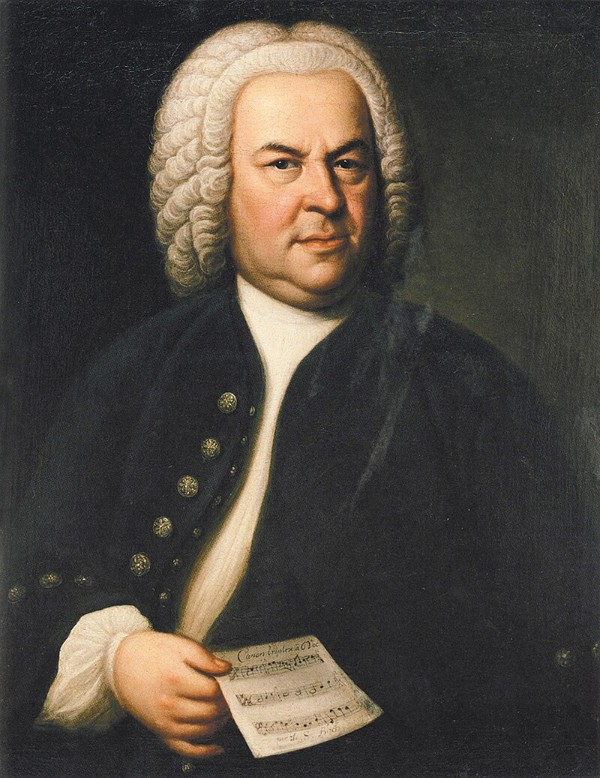
Johann Sebastian Bach
Johann Sebastian Bach was born in the German town of Eisenach in 1685 to a sprawling musical family.
He was the youngest child born to Johann Ambrosius Bach, one of two identical twin brothers who were also professional musicians.
His mother, Maria Elisabeth, had known her husband since childhood. Although her father was a furrier and coachman, it seems likely that music ran in the family, too, given that one of her nephews was a composer who wrote the first musical dictionary in the German language.
Bach would have started to learn the family trade at an early age, surrounded by a large extended family.
Bach’s uncle Johann Christoph, his father’s twin, introduced Bach to the organ, which would become his instrument of choice in the years to come.
1693–1695 – Years of Parental Loss
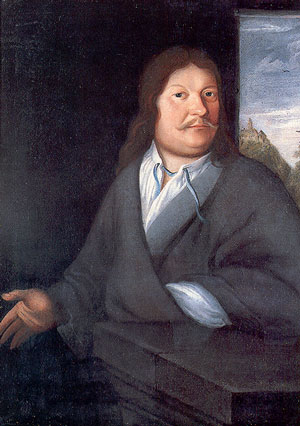
Johann Ambrosius Bach
September 1693 – Bach’s uncle Johann Christoph died.
May 1694 – Bach’s mother Maria Elisabeth died.
November 1694 – Bach’s father quickly remarried Barbara Margaretha Keul.
February 1695 – Bach’s father Johann Ambrosius died.
1695 – Bach moved in with his older brother Johann Christoph.
Between September 1693 and February 1695, around the time he was nine years old, a trio of traumatic losses shook Bach’s life.
First, the uncle who had introduced him to the organ died in the autumn of 1693.
The following spring, his mother died, a few months after her fiftieth birthday.
That November, his father remarried a 37-year-old widow. However, the marriage quickly ended in tragedy in a matter of months, when in February 1695, Bach’s father died, too.
Instead of staying with his stepmother (perhaps she was too impoverished, or they had a rocky relationship, or both), the nine-year-old orphaned Bach moved in with his newlywed older brother. He moved with his thirteen-year-old brother Johann Jacob.
Confusingly for historians, this older brother was named Johann Christoph, just like his uncle.
While living with Johann Christoph, Bach continued to study music.
One anecdote from a biographer paints a picture of what life was like for him during this time:
Johann Christoph possessed a book containing several pieces by these masters, and [Johann Sebastian] Bach begged earnestly for it, but without effect.
Refusal increasing his determination, he laid his plans to get the book without his brother’s knowledge.
It was kept on a bookshelf which had a latticed front. Bach’s hands were small. Inserting them, he got hold of the book, rolled it up, and drew it out.
As he was not allowed a candle, he could only copy it on moonlight nights, and it was six months before he finished his heavy task.
As soon as it was completed, he looked forward to using in secret a treasure won by so much labour.
But his brother found the copy and took it from him without pity…
Paper was expensive at the time, so if this anecdote is true, Johann Christoph’s exasperation is understandable!
It appears that any bad feelings between the brothers were short-lived. Around 1707, Bach would write a capriccio for harpsichord in honour of his brother.
Bach Capriccio E major BWV 993 Rinaldo Alessandrini harpsichord
October 1707 – Bach married his second cousin, Maria Barbara Bach.
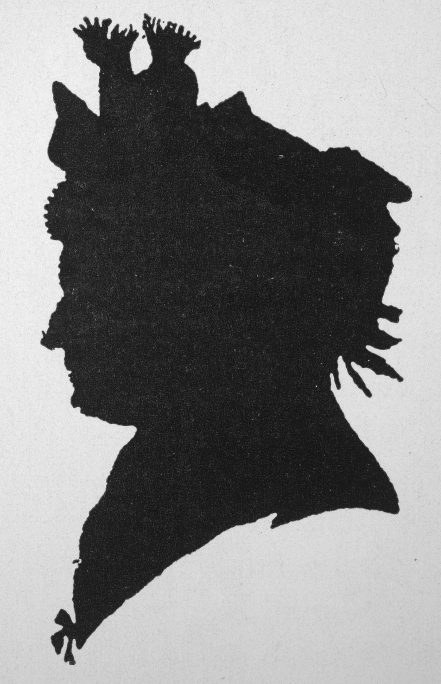
A silhouette of Maria Barbara Bach
Around the same time that Bach wrote that capriccio, he married his second cousin, Maria Barbara Bach.
Their marriage would last for thirteen years, and they would have seven children together. Tragically, three would die in infancy. (Read more about “What Happened to Bach’s Twenty Children?“)
Spring 1713 – Losing the Twins
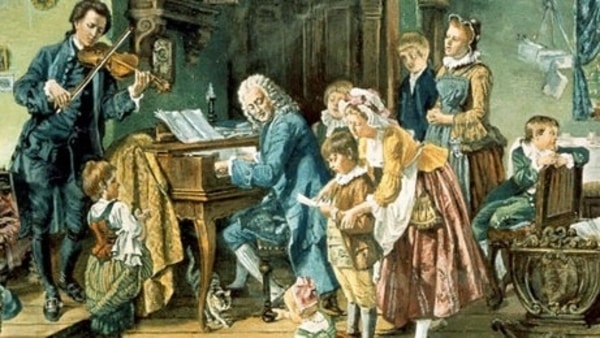
The Bach Family © Oxford Bach Soloists
February 1713 – Bach’s son Johann Christoph died.
March 1713 – Bach’s daughter Maria Sophia died.
Twins ran in the Bach family. Twins were dangerous to carry and deliver in the eighteenth century, and often one or both children would die.
On 23 February 1713, Maria Barbara Bach gave birth to twins, but both babies died within weeks.
We don’t have a complete chronological record of when Bach’s works were written, but it is believed that his cantata “Ich hatte viel Bekümmernis” (“I had much grief”), BWV 21, could date from 1713, around the time of the losses.
Bach’s cantata “Ich hatte viel Bekümmernis”, BWV 21
Historians believe that portions of the cantata may have been written in the summer of 1713 for the funeral of Aemilia Maria Haress, the wife of a former prime minister of Schwarzburg-Rudolstadt.
But perhaps Bach wrote his own personal grief into the piece, too.
1719–1720 – Losing His Son and Wife
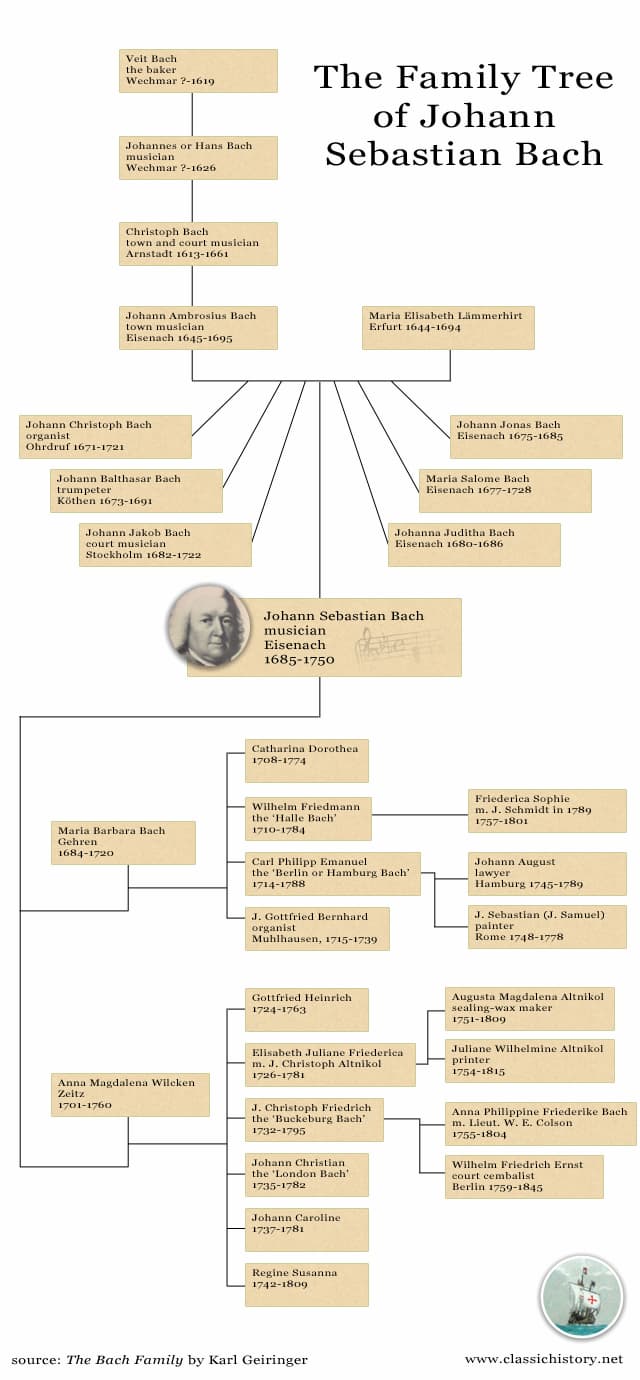
Bach’s family tree
September 1719 – Bach’s son Leopold Augustus died.
July 1720 – Bach’s wife Maria Barbara Bach died.
Another wave of loss struck a few years later in the ten-month period between September 1719 and 1720.
In September 1719, Bach’s infant son Leopold Augustus died.
The following year, in the summer of 1720, Bach traveled with his employer, Prince Leopold of Anhalt-Köthen, to a spa in Carlsbad.
When he returned two months later, he was horrified to discover that his 36-year-old wife had died and been buried during his absence. We do not know what caused her death.
There is a legend that Bach wrote his grief over her loss into the heartbreaking Chaconne from the D-minor partita for solo violin: one of the rawest expressions of grief that Bach ever wrote.
Bach’s Chaconne from the Partita No. 2 in D-minor
1721-1722 – Losing His Brothers
February 1721 – Bach’s older brother Johann Christoph died.
April 1722 – Bach’s older brother Johann Jacob died.
Unfortunately for Bach, more loss was on the horizon.
In February 1721, Johann Christoph, the brother who had taken Bach and his brother Johann Jacob in as orphaned boys and who had served as a surrogate father figure to them, died.
Just a few weeks after Johann Christoph’s death, Bach submitted his six Brandenburg concertos to Christian Ludwig, Margrave of Brandenburg-Schwedt, in the hopes of gaining favour with him. It’s unclear when exactly the concertos were written, but he was almost certainly copying them out after hearing about his brother’s death.
Then, in April 1722, the brother with whom Bach had shared the experience of being orphaned died, too. It must have been a profoundly isolating loss.
Bach’s Brandenburg Concerto No. 5
December 1721 – Bach married his second wife Anna Magdalena Wilcke.
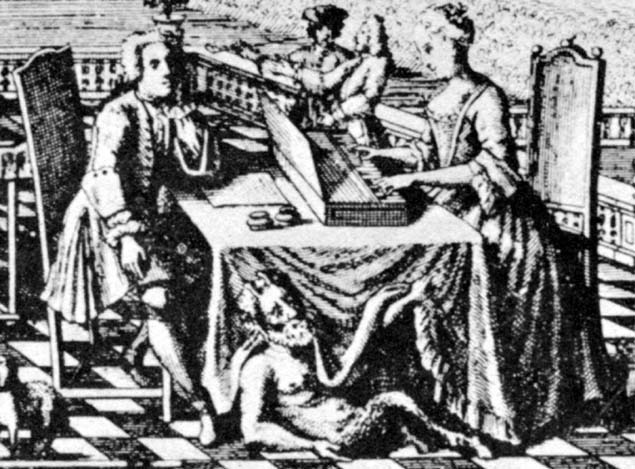
Bach and his wife Anna Magdalena
Thankfully, to help blunt the grief of some of these losses, he fell in love with a young and talented singer named Anna Magdalena Wilcke.
She would serve as a musical partner and stepmother to Maria Barbara’s children.
Anna Magdalena and Bach had thirteen children together, but unfortunately, many of them died young.
Beginning in 1726, they would endure nearly annual losses.
1726–1728 – First Wave of Loss
June 1726 – Bach’s daughter Christiana Sophia Henrietta died.
November 1727 – Bach’s son Ernestus Andreas died.
September 1728 – Bach’s son Christian Gottlieb died.
Their first loss was their firstborn child, a three-year-old daughter named Christiana Sophia Henrietta.
Bach’s most famous work from this time was arguably the St. Matthew Passion. We don’t know for sure, but modern scholarship believes that it was premiered on Good Friday 1727, which fell on April 11 that year.
Bach’s St. Matthew Passion
Ernestus Andreas was a couple of days old when he died. Christian Gottlieb was three years old.
1730–1733 – Second Wave of Loss
January 1730 – Bach’s daughter Christiana Benedicta died.
August 1732 – Bach’s daughter Christiana Dorothea died.
April 1733 – Bach’s daughter Regina Johanna died.
November 1733 – Bach’s son Johann August Abraham died.
In 1729, the family experienced no deaths. But they continued at a brutal pace through the early 1730s.
Bach’s best-known work from this time may be the Kyrie and Gloria from his Mass in B-minor. He began it after Augustus II the Strong, King of Poland, Grand Duke of Lithuania and Elector of Saxony, died in February 1733, kicking off a mourning period and a five-month suspension of public music-making.
This period of time just happened to overlap with the death of his daughter, Regina Johanna, who passed away in April 1733 at the age of four and a half.
Bach used the period of silence to presumably grieve and to write a mass that would gain him a court title.
In the early 1740s, Bach returned to the B-minor Mass to revise and add to it, resulting in the completed masterpiece we know today.
Bach’s Mass in B-minor
May 1739 – Bach’s son Johann Gottfried Bernhard died.
A few more years passed before another child’s death, which ultimately occurred in May 1739 when Johann Gottfried Bernhard Bach died.
He was the first adult child in the family to die; his mother had been Bach’s first wife. He had just turned 24 years old.
We know that he was a musician, but we don’t know much more about him. He served as organist in the German town of Mühlhausen, but then abandoned his musical career to pursue law studies. He died in debt.
July 1750 – Bach died.
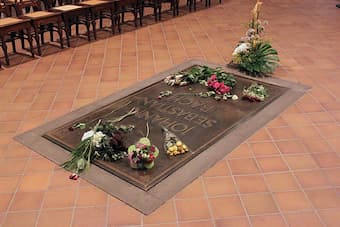
Grave of Bach in Leipzig
Bach’s health deteriorated as he got older.
One of his most alarming symptoms was increasingly poor eyesight: a disastrous disability to befall a working musician.
In early 1750, he had two operations done on his eyes. The operations were unsuccessful, and he became completely blind, with pain in his eyes.
You can learn more about Bach’s agonising final months.
One of Bach’s major works dating from around this time was the Art of Fugue, a mysterious work featuring unspecified orchestration, and one of the most technically accomplished pieces of music ever written.
Bach’s Art of Fugue
In the manuscript, his son Carl Philipp Emanuel Bach wrote under an unfinished fugue: “While working on this fugue, which introduces the name BACH [for which the English notation would be Bb–A–C–B natural] in the countersubject, the composer died.”
Modern scholarship is skeptical of this claim (it is now believed the work dates from a time when Bach’s handwriting was better, perhaps around 1747-48), but the story has become part of the lore behind Bach’s death.
His final work may be “Vor deinen thron tret ich hiermit” (“I hereby come before your throne”), which is also known as the Deathbed Cantata. It is believed that Bach dictated this to a friend or family member once he could no longer see to write.
Its atmosphere is resolved and even relaxed: the work of a man of deep faith, who perhaps, by the end of his prodigious but painful life, was ready for the end.
For more of the best in classical music, sign up for our E-Newsletter