I recently listened to a 1974 EMI recording by Aldo Ciccolini, a pianist who had a fascination with neglected repertoire. He championed the piano works by Satie, Rossini, Massenet, De Falla and Déodat de Séverac, a composer completely unknown to me.
Once I started listening a bit closer, I found piano music with plenty of charm that blends impressionistic harmonies with folk-like melodies. There is plenty of sincerity and elegance in his picturesque soundscapes, and it all radiates a joyful human quality.
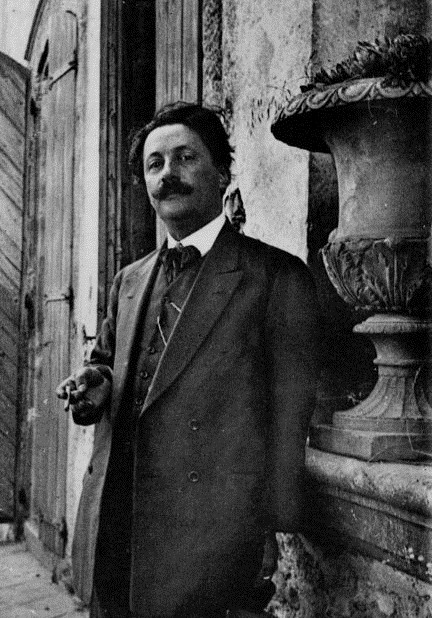
Déodat de Séverac
Plenty of reasons, it seems to me, to take a closer look at this essentially hidden composer.
Déodat de Séverac: En Vacances (1er recueil)
Noble Roots and Languedoc Soul
Marie-Joseph Alexandre Déodat de Séverac was born on 20 July 1872 in Saint-Félix-Lauragais, a charming village in Haute-Garonne not far from Toulouse. He came from a noble family with roots stretching back to the 11th century.
His father, Gilbert de Séverac, was a talented painter, and young Déodat started early music lessons with his dad and with Louis Amiel, the local organist.
Music became a lifelong passion, and his upbringing in Languedoc, a region rich with rolling hills, vibrant folk traditions, and a distinct cultural identity, shaped him profoundly. Before he could fully embrace his musical calling, however, he was expected to train for a real job. And that meant law studies in Toulouse.
Déodat de Sévérac: En Vacances, Vol. 2 (Aldo Ciccolini, piano)
From Law to Lyrical Paris
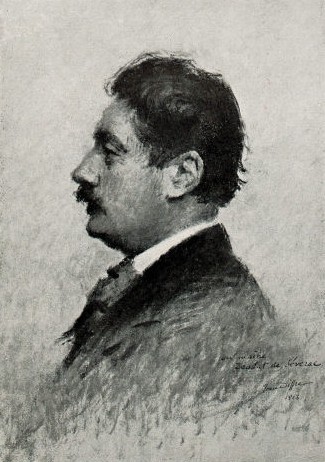
Déodat de Séverac
Law clearly wasn’t his thing, and by 1896, he tossed out the legal books for the Schola Cantorum in Paris. That private music conservatory, founded by Charles Bordes, Alexandre Guilmant and Vincent d’Indy, focused on the study of Baroque and early Classical works, and represented a counterpoint to the Paris Conservatoire’s emphasis on opera.
Déodat studied composition with d’Indy and Albéric Magnard, soaked up organ lessons from Alexandre Guilmant, and even worked as an assistant to the brilliant Spanish composer Isaac Albéniz.
However, Paris wasn’t just about music lessons, as it was a cultural playground. Déodat rubbed shoulders with the likes of Claude Debussy, Maurice Ravel, Paul Dukas, and even Pablo Picasso. And he frequented the salon of the Princesse de Polignac, a hotspot for artists, poets, and intellectuals.
Déodat de Sévérac: Stances à Madame de Pompadour (Aldo Ciccolini, piano)
From Paris to the Provinces
However, Déodat wasn’t enamoured with the Parisian elite’s obsession with centralised, cosmopolitan culture. His heart belonged to the provinces, to the folk songs and dances of Languedoc.
In 1907, he wrote a thesis, more of a manifesto, condemning the Parisian stranglehold on French culture. He argues that the provinces held the true soul of French music and that it was not found in the polished salons of the capital.
This ruffled some feathers, with Ravel poking fun at him, even calling him “docteur” with a sarcastic smirk. But Déodat didn’t care, as he was ready to leave Paris behind. He packed his bags and headed south.
Déodat de Sévérac: Les naiades et le faune indiscret (Jordi Masó, piano)
Catalan Inspiration
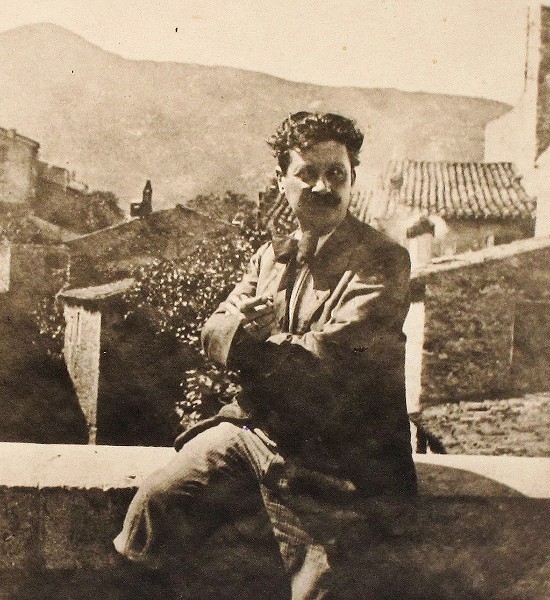
Déodat de Séverac
He eventually settled in Céret, a picturesque town in the Pyrénées-Orientales, in 1909. Céret was a magnet for artists, where Picasso, Georges Braque, and the sculptor Manolo Hugué drew inspiration from vibrant Catalan culture and stunning landscapes.
Déodat fell head over heels for the place, writing to his poet friend Jean Amade about his love for the Vallespir region and the “divine” Canigou mountain. The region was not just a change of scenery; it was a turning point in his music as well.
Déodat’s compositions began to reflect the sounds and spirit of his new home. He dove into the folk traditions of Languedoc and Catalonia, blending them with his classical training to create something fresh yet deeply rooted.
Déodat de Sévérac: En Languedoc (Aldo Ciccolini, piano)
Regional Brilliance
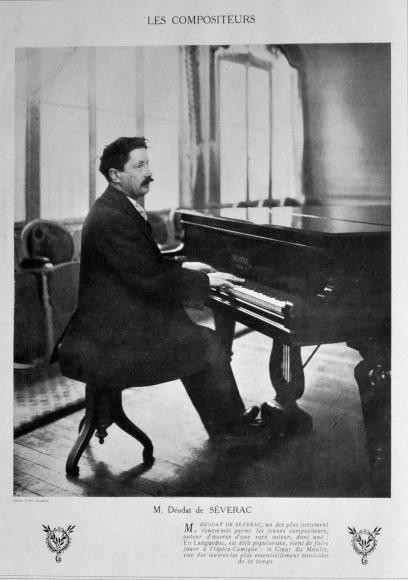
Déodat de Séverac
His music wasn’t about nationalism but about celebrating regional identity. It became something like a postcard from southern France, vivid, evocative, and full of character.
He did write operas, songs, organ pieces, and symphonic poems, but his key works are written for the piano. He certainly shines brightest in his piano music. En Languedoc of 1904 shows his talent for painting musical landscapes.
It is a radiant piano suite that paints a vibrant musical portrait of his beloved France. Each movement unfolds like a sunlit scene, capturing the rolling hills, rustic villages, and the lively folk traditions of the Languedoc region with warmth and clarity.
Séverac weaves impressionistic harmonies, reminiscent of Debussy, with modal scales and cyclical structures that evoke an almost timeless, pastoral charm. The music feels alive, brimming with the scents of lavender fields and the rhythms of local dances, yet it never slips into mere sentimentality.
Déodat de Sévérac: Cerdaña, 5 études pittoresques (Aldo Ciccolini, piano)
A Musical Ode to Catalan Life
After moving to Céret, his musical style evolved. Cerdaña from 1911 is a set of five picturesque études. Essentially, it is a love letter to Catalonia, with lively dances and melodies that feel like they’re straight out of a village festival.
Inspired by the vivid Catalan culture, this piano suite captures the essence of the region with a blend of impressionistic finesse and earthy folk melodies. Each of the five movements paints a distinct scene, from mule drivers trudging through mountain passes to the quiet beauty of pastoral life.
The music shimmers with modal scales and cyclical structures, and the Debussy-like harmonies add a layer of sophistication. The suite is not just a musical depiction but a celebration of place and people, infused with the rhythms of local traditions and the vivid colours of the landscape.
Déodat de Sévérac: Sous les lauriers roses, “Soir de carnaval sur la cote catalane” (Aldo Ciccolini, piano)
Twilight Serenade
Sous les lauriers roses of 1919 is another radiant gem, capturing the languid beauty, warmth, and vibrant colours of his beloved Catalonia. This evocative piece, basically titled “Under the Oleanders,” conjures a serene garden scene, where the scent of blooming flowers mingles with the soft hum of twilight.
Séverac’s signature blend of impressionistic harmonies and folk-inspired melodies weaves a tapestry of delicate, shimmering textures, with modal scales that lend an almost ancient, timeless quality. The music sways gently, like a breeze rustling through leaves, while its cyclical structure evokes the unhurried rhythm of rural life in the Pyrénées-Orientales.
Far from mere nostalgia, Sous les lauriers-roses is a vivid, heartfelt celebration of place, capturing the quiet beauty and soulful charm of a moment suspended in time.
Déodat de Sévérac: Le soldat de plomb (Aldo Ciccolini, piano)
Whimsical March of Childhood
The early piano miniature Le soldat de plomb of 1904, or “The Tin Soldier,” sparkles with whimsy and nostalgia, evoking the innocence of childhood play. It paints a vivid musical picture of a toy soldier’s steadfast march, infused with a tender hint at the fleeting nature of youth.
Séverac’s deft use of bright, sprightly rhythms and delicate modal melodies creates a soundscape that feels both lively and intimate, with impressionistic flourishes reminiscent of Debussy yet distinctly grounded in the composer’s warm, folk-inspired style.
The music dances with a playful rigidity, as if the tin soldier is proudly strutting despite his fragile, toy-like nature, inviting listeners into a world of imagination where simple joys and poignant memories intertwine.
Déodat de Sévérac: Pippermint-Get Waltz (Aldo Ciccolini, piano)
Passionate Life and Legacy
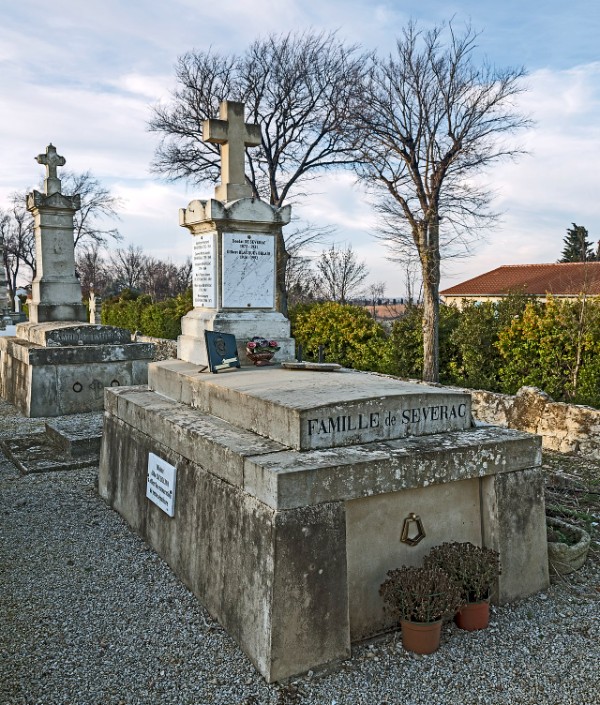
Tomb of Déodat de Séverac
Déodat’s life wasn’t all music and manifestos. He was a man of deep friendships, with close ties to fellow southerners like pianist Blanche Selva and composer Joseph Canteloube. His letters reveal a warm, passionate personality, someone who adored his homeland and found inspiration in its people and places.
He never married, and details about his personal life are scarce, but his music suggests a heart full of love for his region, his friends, and the beauty of everyday life. Tragically, Déodat’s life was cut short. He died on 24 March 1921, in Céret, at just 48, possibly from health issues exacerbated by his intense dedication to his work.
He was buried in his hometown of Saint-Félix-Lauragais, where a bronze bust by his friend Joseph Lamasson was erected in 1924. His death marked the end of a brief but brilliant career, and his music fell into relative obscurity for decades.
Déodat de Sévérac: Baigneuses au soleil, “Souvenir de Banyuls-sur-mer” (Aldo Ciccolini, piano)
From Obscurity to Acclaim
His piano music was not recorded during his lifetime, as his choice to prioritise regional identity over Parisian prestige didn’t help his fame. However, Claude Debussy himself called Séverac’s work “exquisite and rich with ideas.”
His piano pieces, in particular, have found new life through recordings, and his operas are slowly gaining attention as well. Scholars like Robert F. Waters have helped revive interest in his work, highlighting his unique blend of Impressionism, folk traditions, and Catalan influences.
Recordings of his piano music, though initially scarce, have gained prominence through dedicated efforts to preserve his evocative and regional-inspired works. Isolated recordings existed from 1925, but the definitive milestone came in 1974 with Aldo Ciccolini recording the complete piano works. Follow-up recordings have been produced by Jordi Masó for Naxos and by François-Michel Rignol for Disques du Solstice.
For more of the best in classical music, sign up for our E-Newsletter
Déodat de Sévérac: Le chant de la terre (Jordi Masó, piano)