For Toronto-based string quartet Cicada Woods, tango is more than a musical style. It is an opportunity to explore new sounds, experiment with instrumental techniques, and bring together different musical backgrounds. Their debut album, Seasons, pairs Astor Piazzolla‘s The Four Seasons of Buenos Aires (Estaciones Porteñas) with The Four Seasons of Toronto, a newly commissioned composition by Canadian composer Robert Carli. While Piazzolla’s music reflects the energy and character of Buenos Aires, Carli draws our attention to Toronto’s changing climate and urban landscape. Together, the two works reveal how different musical and cultural identities can find common ground. The following conversation with cellist Sybil Shanahan and violinist Suhashini Arulanandam explores the ideas behind the album, their approach to tango, and the creative process of bringing the project to life.
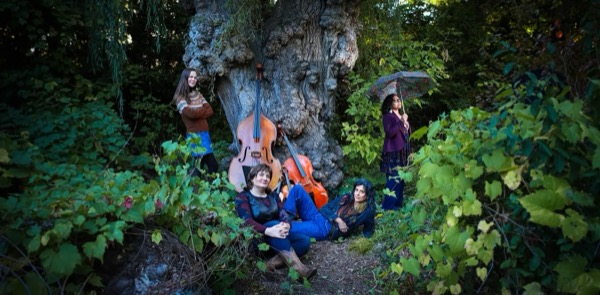
Cicada Woods
The quartet’s name also connects to tango. As Suhashini explained, it comes from the tango technique known as chicharra, in which the bow hair is rubbed along the winding of the strings to produce a scratchy, chirping sound reminiscent of a cicada. The second part of the name refers both to the woods where the four musicians first played together at a cottage and to the wooden instruments they play. “We thought it would sound a little mysterious. Nobody would know what Cicada Woods was,” she said.
Cicada Woods consists of cellist Sybil Shanahan, violinist Suhashini Arulanandam, violist Esme Allen-Creighton (viola), and double bassist Shannon Wojewoda. Sybil and Suhashini, who have played together for years, initially formed a violin-cello duo. Both have extensive classical backgrounds, having started playing their instruments at a young age. Sybil studied in Canada and Europe, while Suhashini began her musical education through the Suzuki program in Newfoundland and has since performed extensively with orchestras and chamber ensembles, including in contemporary music.
Their interest in tango developed through several years of study and performance, including lessons in Buenos Aires with violinist Guillermo Rubino, double bassist Ignacio Varchausky, and flautist Paulina Fain, who organises Tango Sin Fin. For Sybil, Piazzolla was a gateway to jazz and its “groovy syncopations.” Rather than simply recreating traditional tango sounds, the musicians wanted to bring what they had learned into their own musical backgrounds and explore new possibilities for the string quartet.
Piazzolla’s The Four Seasons of Buenos Aires was originally written for his quintet of bandoneon, violin, electric guitar, piano, and double bass, and relies on a distinctive mix of melodic, rhythmic, and percussive sounds. Cicada Woods wanted to retain some of these qualities while adapting the music for just four acoustic strings. They first approached New York-based tango musician Pedro Giraudo to arrange the work, then further modified his arrangement through their own experimentation, making the process a collaborative effort.
“We had to find a way of bringing some of the grit, the percussion and those sounds,” Sybil explained. “We don’t have bandoneon, which is kind of the quintessential tango instrument, and so we had to find a way to make it feel like Piazzolla without those elements.”
Drawing on their tango training, the musicians incorporated percussive techniques and different ways of producing sounds from their instruments. They also listened closely to recordings of Piazzolla’s original quintet, looking for ways to recreate particular effects through the string quartet. Their arrangement follows Piazzolla’s original version rather than the more familiar orchestral arrangement that incorporates quotations from Vivaldi’s The Four Seasons.
For the other half of the album, Cicada Woods invited Toronto-based composer Robert Carli to write a work inspired by the city’s character and changing climate, giving him creative freedom to explore the quartet’s unusual instrumentation. With three lower-string instruments and only one violin, the ensemble has a distinctive balance, which Carli uses to give each musician a moment in the spotlight. The work opens with a double bass solo for Spring, featuring high harmonics and percussive bow effects. Summer, represented by a viola solo, captures the bustle of Toronto’s streets, traffic, and construction. Autumn features a lyrical cello cadenza followed by a waltz, while Winter brings a quieter, more reflective violin solo.
For Sybil, the summer movement captures a particularly recognizable aspect of Toronto life. “One of the seasons of Toronto is construction,” she said, referring to the city’s seemingly endless roadwork and building projects.
The two works also share an interest in portraying urban life, with both incorporating sounds associated with their respective cities, from traffic to the harsher aspects of the urban environment. However, Carli’s portrait of Toronto reflects the city’s changing climate. As Suhashini observed, “With climate change, there have been changes in our seasons also. Sometimes Toronto feels like the seasons are blending into each other.” This sense of transition is reflected in the composition’s structure, with spring and summer forming one connected section, followed by autumn and winter.
Recorded in January at Union Sound in Toronto, Seasons marked an important step for the quartet, which had only begun playing together the previous August. The project came together quickly, encouraged by people around them who felt it was time to bring their music to a wider audience.
Cicada Woods hopes to bring the album’s repertoire to the concert stage while exploring new directions, including film music, improvisation, and electronic effects such as loop pedals. Beyond their shared musical interests, the quartet is also built on friendship and a strong sense of collaboration. In Seasons, the rhythmic drive of Piazzolla’s tango meets Carli’s vivid portrait of Toronto, from the bustle of its streets to its quieter moments. Moving between these contrasting musical worlds, Cicada Woods brings fresh colours and unexpected sounds to the string quartet, leaving room for further experimentation.
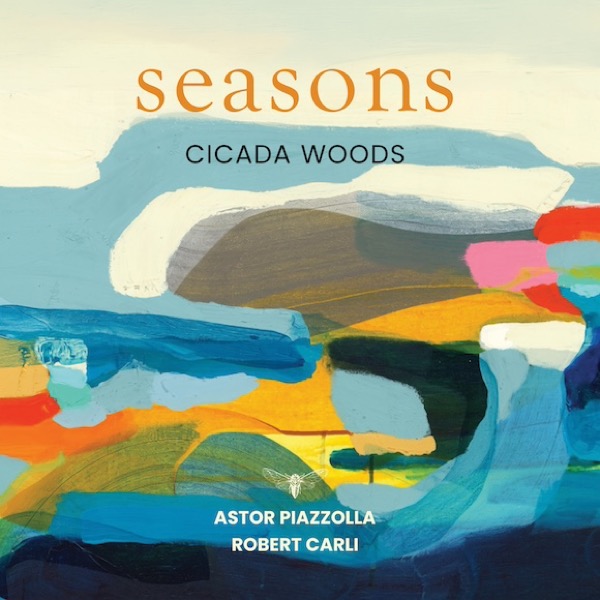
Performed by Cicada Woods: Suhashini Arulanandam, violin
Esme Allen-Creighton, viola
Sybil Shanahan, cello
Shannon Wojewoda, double bass
Release date: October 30, 2026
For more of the best in classical music, sign up for our E-Newsletter