One unforeseen benefit of the 2020 COVID lockdown was the opportunity many composers and performers had to sit alone and work. They worked on solo and group projects, the latter in particular as group-collaboration technology improved.
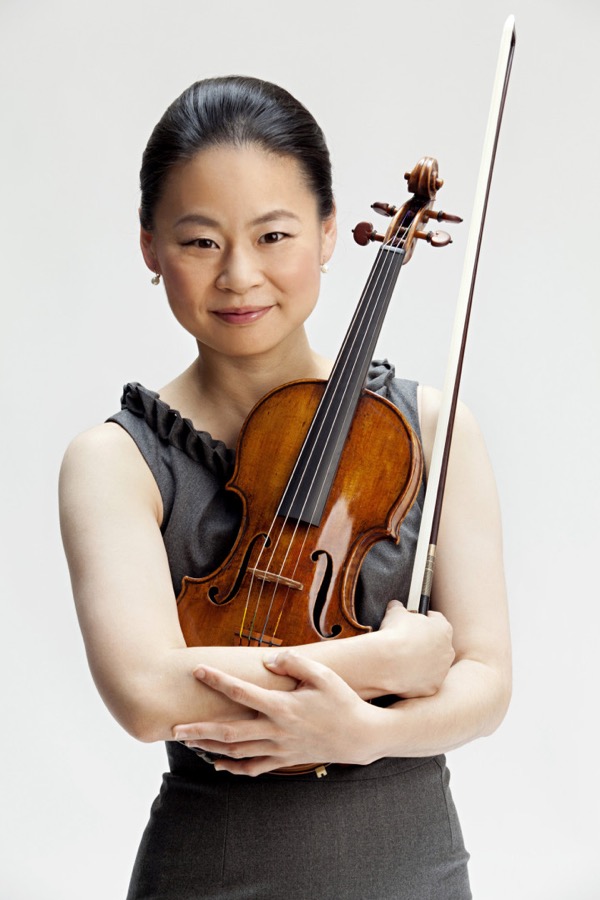
Midori (photo by Timothy Greenfield-Sanders)
The Japanese-American violinist Midori (b. 1971) was particularly concerned about the sudden falloff in music education. So many of the parts of a student’s musical life, from simple things like tuning, to interactions with other musicians, to playing in ensembles, had to be taken online, with varying degrees of success. The hands-on part of education had to become hands-off, to everyone’s detriment.
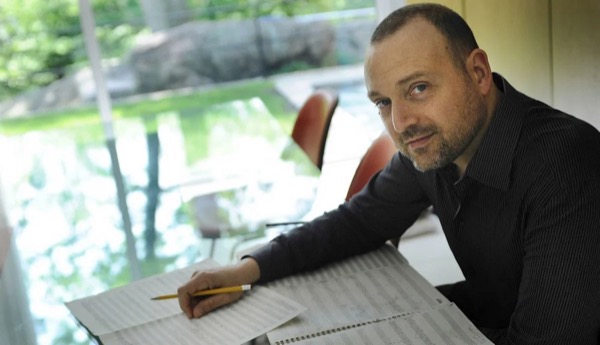
Derek Bermel
Midori approached the American composer Derek Bermel (b. 1967), who had written a set of violin etudes for her in earlier times, for a work that youth orchestras could play under lockdown. The vision was for a work that the orchestras could perform with Midori as a virtual soloist. Accordingly, Bermel’s work is like a series of interlocking cadenzas, with each movement played after the next without pause.
The movement titles come from 3 haiku by the most famous Japanese poet of the 17th-century Edo period, Matsuo Bashō.
Fields, mountains
of Hubaku. In
nine days – spring.Wake, butterfly –
it’s late, we’ve miles
to go together.Unknown spring –
plum blossom
behind the mirror.
By making the soloist the anchor of the piece, we can make problems with the online nature of the ensemble performance less critical. The original orchestration was for a first movement with strings only and a finale with winds only. The middle movement would be a solo part for Midori alone. The violinist’s role emphasises the drama of the construction. In the composer’s words, ‘All the motifs felt naturally embodied in Midori’s own brilliant violin technique, but each also contained contradictory impulses that offered possibilities for inner drama – in the opening movement bubbling arpeggios tempered with an icy octatonic retort, in the second movement a sighing, stretching melody coloured by a descending chromatic bass, and in the third movement gestures that diverged startlingly, at first snaky and searching, then hovering, jittery, fluttering’.
Derek Bermel: Spring Cadenzas – III. unknown, spring
As normalcy returned, Bermel rewrote the work, expanding the orchestration and making it less sectional. Midori’s Orchestra Residencies Program (ORP) provided the musicians for the initial online foray and, for this recording, the virtuosic orchestra, A Far Cry, along with students in Boston’s STEP Program, were led by Earl Lee, winner of the 2022 Sir Georg Solti Conducting Award.
The work, consisting solely of cadenzas for the violin, is instantly striking. Whether played by youth orchestras or professionals, the accompaniment part provides a satisfying backdrop for the virtuoso explorations. That this work was created in response to a particular need for ensemble music that could be successfully played with performers spread across the world and then rewritten for a more standard in-room ensemble speaks well to Bermel’s creativity and vision.
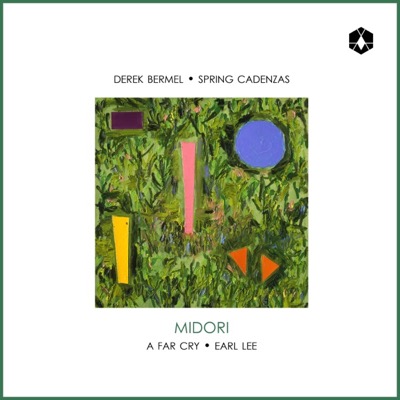
Spring Cadenzas
Midori, violin; A Far Cry with Project STEP; Earl Lee, conductor
Orchid Classics ORC100481D
Official Website
For more of the best in classical music, sign up for our E-Newsletter