Kirill Gerstein, born on 23 October 1979 in Voronezh, Russia, is one of the most distinguished classical artists of his generation. He is a phenomenon, displaying ferocious technique and discerning intelligence, all paired with a serious grounding in jazz.
Thomas Adès started his musical career as a percussionist, at one point playing percussion in Stravinsky’s Les noces under Sir Simon Rattle. As a pianist, he was runner-up in the BBC’s Young Musician of the Year competition in 1990, and he has served as music and artistic director at several venues.
Born of Friendship
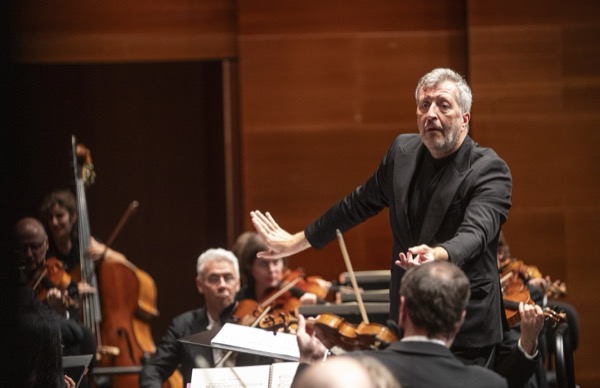
Thomas Adès
Gerstein and Adès had been collaborating musically since 2007. In 2012, while preparing performances of Adès’ piano concerto In Seven Days with the Boston Symphony Orchestra, Gerstein suggested commissioning a new work from the composer.
The result was the Concerto for Piano and Orchestra, which premiered on 7 March 2019 with Gerstein as soloist and Adès conducting the Boston Symphony Orchestra. To celebrate Gerstein’s birthday, let’s explore a composition whose recording received a Gramophone Award and three Grammy nominations.
Kirill Gerstein plays Adès: Piano Concerto
Something Was Missing
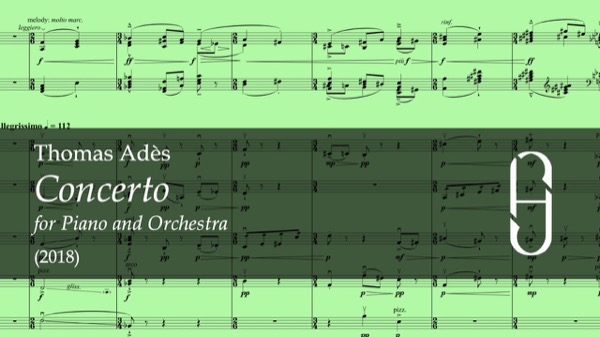
Thomas Adès: Concerto for Piano and Orchestra
Thomas Adès described his Concerto for Piano and Orchestra as a return to the piano concerto tradition, shaped by his own musical language and his close artistic relationship with Kirill Gerstein.
When Gerstein approached him, Adès immediately sensed an opportunity. As he explained, “When Kirill said, ‘how about a piano concerto?’ I immediately saw that was something in my universe that needed to be done; it was sort of missing.” (Ortiz, Chicago Symphony, 2023)
And in a 2019 interview, Adès explained his interest in that genre. “With the concerto, I was fascinated by the way a 19th-century piece, I’m talking about a symphony or a sonata or whatever, has this way of seeming like a complete sphere, a sort of rounded emotional experience.” (Kallio, Adventures in Music, 2019)
Thomas Adès: Piano Concerto: I. Allegramente (Kirill Gerstein, piano; Boston Symphony Orchestra; Thomas Adès, cond.)
Between Two Worlds
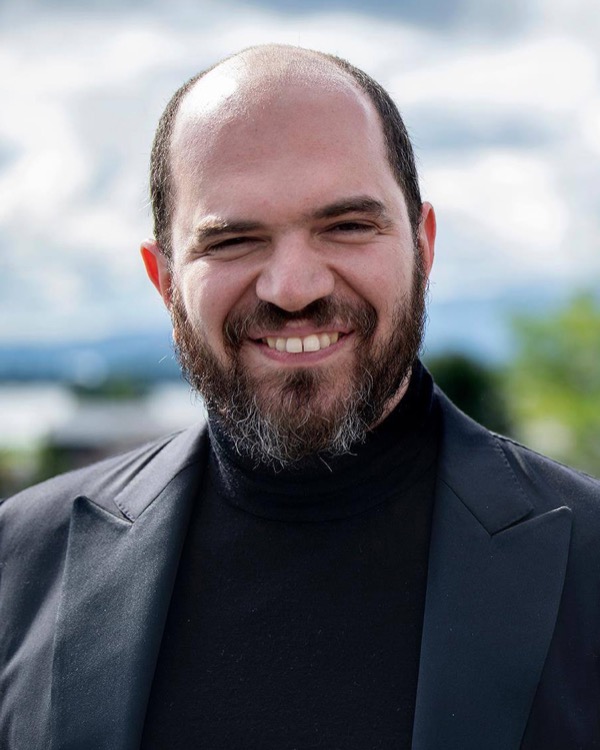
Kirill Gerstein
Kirill Gerstein loves to probe the stylistic borders in music. He taught himself jazz by imitation at a very young age, and he developed as both a classical and jazz musician.
When Gerstein met the legendary jazz vibraphonist Gary Burton in St. Petersburg at age 14, Burton was highly impressed by Gerstein’s improvisational talent and arranged for him to study jazz at Berklee. Initially, he studied jazz piano alongside his classical piano studies, but after three years, he decided to focus on classical music.
He may have realised he couldn’t play both styles at the level he wanted. He still plays jazz in his spare time as a hobby, and he compares playing jazz to speaking another language. For Gerstein, “It certainly informs how I hear music and how I play whatever style of music.” (KSMU, Pianist Kirill Gerstein Talks Jazz, 2016)
Thomas Adès: Piano Concerto: II. Andante gravemente (Kirill Gerstein, piano; Boston Symphony Orchestra; Thomas Adès, cond.)
A Modern Classic
The traditional fast-slow-fast structure might seem conventional, but Adès infuses it with contemporary harmonic colours, unusual instrumental combinations, and great rhythmic flexibility.
The dramatic opening movement develops two distinct themes, with glittering instrumentation and keyboard acrobatics, including an octave mini-cadenza. Slow and reflective, the second movement opens with a chorale introduction and melody, joined by a countermelody and, eventually, a second idea. The concluding movement features tumbling motifs and musical arguments over tonal direction, giving it an almost humorous character.
As Gerstein told The Boston Globe, the piece “does what a piano concerto should do; it has octaves, a cadenza, a slow movement of gravitas.” Adès, meanwhile, joked that it was “no more difficult than your average very difficult concerto.” (Weininger, The Boston Globe, 2019)
The Piano Concerto was enthusiastically received, and Anthony Tommasini of The New York Times wrote, “This breathless, 20-minute concerto, structured in three essentially traditional movements (fast, slow, fast), comes across as zesty and accessible. But don’t be fooled. Just below the surface, the music sizzles with modernist harmonies, fractured phrases, gaggles of counterpoint and lyrical strands that keep breaking into skittish bits.” (Tommasini, The New York Times, 2019)
For more of the best in classical music, sign up for our E-Newsletter
Thomas Adès: Piano Concerto: III. Allegro giojoso (Kirill Gerstein, piano; Boston Symphony Orchestra; Thomas Adès, cond.)