A thirteen-year-old boy walks into a music shop in Barcelona with his father and comes across a score. It is Friedrich Grützmacher’s edition of Johann Sebastian Bach’s Suites for Solo Cello, a work he had never heard of. Half a century later, after shattering conventions and becoming the defining figure of the modern cello, the same musician would make a recording that transformed the history of the cello and of recorded music. By then, he was an exile in his sixties, living through one of the darkest periods of his life. Pablo Casals (Pau in the world from which he came) devoted his life to studying, performing, and teaching these works until his final days. For him, Bach’s Suites became an inexhaustible source of discovery.
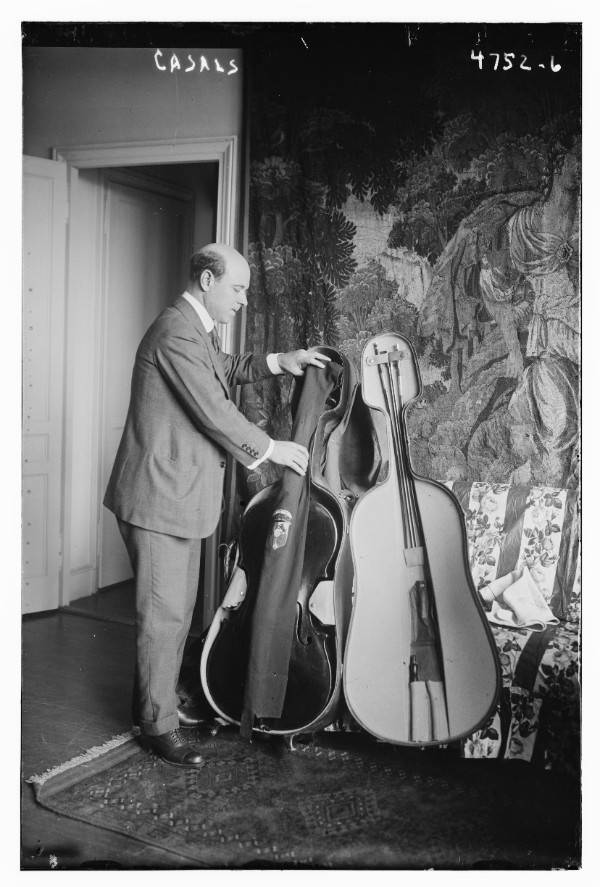
Pablo Casals © Library of Congress
It was through this lifelong engagement that one of the defining features of his musical thinking took shape: his command of time through a masterful use of rubato. Agogics is the art of shaping musical time through subtle fluctuations while remaining faithful to the score. Casals had an extraordinary ability to guide musical discourse with an inner elasticity in which time ceased to function as a fixed measure and became a material to be worked from within, note by note, phrase by phrase.
Cello Suite No. 5 in C Minor, BWV 1011: IV. Sarabande
The Sarabande of Suite No. 5 offers a particularly revealing example of this approach: a work of apparent rhythmic simplicity, just 108 notes long, yet one that reveals extraordinary interpretive complexity in the shaping of time. With Casals, the pulse remains intact, though its function extends beyond metre alone. What emerges is an active suspension of musical time in which every note acquires a distinct weight within the whole, changing the listener’s perception of the piece and producing a remarkable sense of continuity built through micro-variation.
This same understanding of time offers a way of rethinking his legacy today. In 2026, the 150th anniversary of his birth brings a new cycle of commemorations, performances, and familiar narratives. In the process, Casals has gradually been reduced to a set of recurring images. Once a cultural figure reaches that degree of fixity, depth is often the first casualty. In time, memory itself begins to fade. During the final years of his life and after his death, Casals’s public legacy came increasingly to be shaped by his closest circle, influencing the ways in which he is read, interpreted, and situated today through a singular and carefully constructed narrative. Over time, a preservation structure reluctant to revisit that process has also taken shape.
Canciones populares espanolas, No. 5: VII. Nana
That narrative has coexisted with a strong tendency towards mythmaking, reinforcing an image of the musician forever associated with El cant dels ocells (Song of the Birds), the Republican exile unable to return home, the moral voice of his age. All of these things are true. Yet they do not exhaust the complexity of the man. They create a distance between the public and a figure cast as a hero rather than a human being, while also obscuring the musician himself. The paradox is particularly striking in Casals’s case because much of his art was devoted to resisting every form of fixation. His use of rubato stands among the finest examples of that impulse. Musical time itself seemed to breathe within an architecture of extraordinary sophistication.
This Casals year offers more than commemoration. It presents an opportunity to reorder his history, recover what has been silenced, and reclaim time itself. That work is necessary if there is to be a meaningful bicentenary. The moment has come to revive interest, reopen questions, secure institutional support for these efforts, and encourage further study of the most important cellist of his age.
In his musical practice, Casals defended a simple yet profound idea: continuity depends upon the capacity to generate variation within a form. That insight offers a way of thinking about the future of his legacy as well.
Anniversaries fulfil an essential function in preservation: they archive, catalogue, exhibit, and commemorate. These are indispensable tasks in sustaining cultural memory. Yet living heritage requires something more. Such an inheritance remains alive when it continues to generate questions, welcomes new interpretations, and inspires research capable of reshaping earlier understandings.
For years, the public image of Casals has circulated around a series of partial representations. Less explored territories still await attention: the scholar of Bach, the thinker of musical interpretation, the musician who spent decades investigating the relationship between time, structure, and expression, the figure through whom valuable knowledge about the century he inhabited can still be recovered.
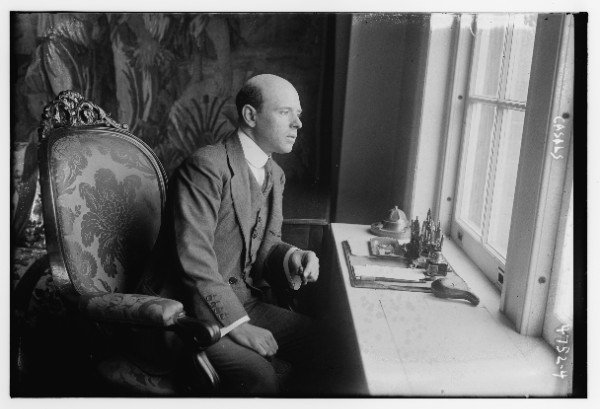
Pablo Casals © Library of Congress
Every generation decides what it will do with the figures it inherits. Some choose to administer them. Others return to them with new questions. Both approaches are necessary. Administration ensures continuity. Questioning generates knowledge. The 150th anniversary offers an exceptional opportunity to recover what has been omitted, incorporate fresh perspectives, and listen to voices working beyond established narratives. We must accept that every historical figure contains light and shadow, contradictions and unresolved questions. Far from diminishing Casals, that willingness to engage with complexity may save him from oblivion.
Casals devoted his life to returning to Bach’s pages, works that continued to change before his eyes. Perhaps the best way to celebrate his legacy is to apply that same principle to the memory we have built around him. There is still time. If that work is undertaken and allowed to flourish, the legacy of Pablo Casals will breathe once again.
Dr Igor Saenz Abarzuza is a cellist and Associate Professor at the Public University of Navarre (Spain). Alongside his performing activity, he develops research and artistic projects centred on musical interpretation, artistic creation, and artistic research.
His PhD examined Pablo Casals’s performance of Bach’s Cello Suites, and his publications focus on artistic research, Pablo Casals’s performance practice and legacy, and the intangible musical heritage of the Basque Country and Navarre. He is a co-founder of Farout Artistic Research, a collective exploring the intersections of artistic creation, performance, and scholarly inquiry.
For more of the best in classical music, sign up for our E-Newsletter