In 1987, American conductor Lorin Maazel, in collaboration with the Berlin Philharmonic, captured Richard Wagner’s mammoth opera cycle in purely orchestral form—the Ring Without Words stripped away all vocal elements while preserving the cycle’s dramatic integrity.
Filmed in Geneva in June 2026, Daniel Harding and the Orchestre de la Suisse Romande take us on a musical journey from Rhinegold through to Götterdämmerung in a concert experience that begins in the mysterious depths of the Rhine and concludes with the destruction of the gods.
Richard Wagner: The Ring Without Words
From Grand Opéra to Musical Drama
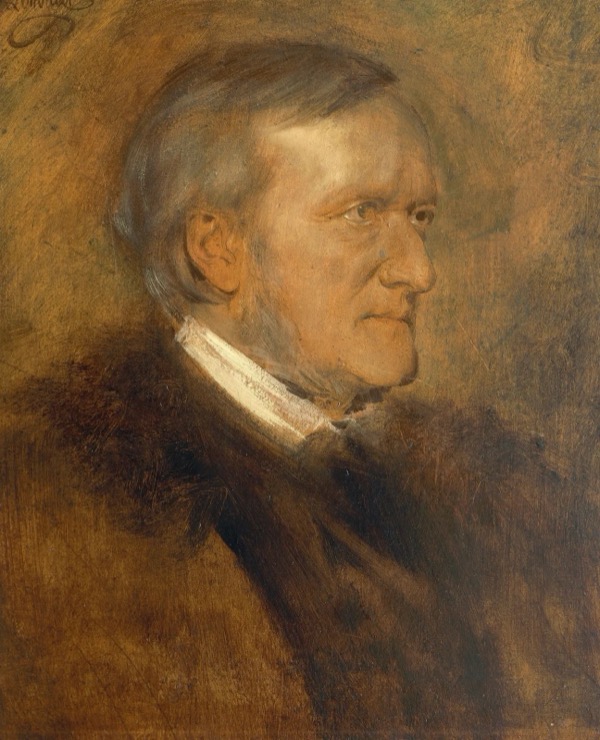
Richard Wagner, painting by Franz von Lenbach, 1882
Richard Wagner is one of the most important and most controversial figures in the history of nineteenth-century music. He single-mindedly pursued his artistic aims with ruthless determination in his public and his private life. Receptive to literary, philosophical, political and musical influences, Wagner began his career as the author and composer of operas in the German Romantic manner.
During his tenure at Magdeburg (1834–6) and Riga (1837–8), Richard Wagner discovered an entirely new operatic genre. “Grand Opéra,” as this genre came to be known, projected romantic love and passion against a background of historical events. Librettos were created to exploit spectacular stage effects, and large orchestras and choruses intoned popular melodies.
Wagner encountered the pioneering operatic efforts of Giacomo Meyerbeer during his years in Parisian exile, and he eagerly took on board all the toppings of Grand Opéra, including ballets, rousing processionals, huge choral numbers and special stage effects. These elements paved the way for his idea of “musical drama.”
Wagner’s Grand Design
Wagner could not make his mark in Paris. Still, he first advocated a synthesis of poetic, visual, musical, and dramatic arts, with music subsidiary to drama, in a series of essays between 1849 and 1852.
Critics and scholars called this new genre “music drama”, and it sought a return to the expressive ideals of Greek antiquity, as Wagner understood them at the time. It meant publicly expressing national human aspirations in symbolic form by enacting myths and using music to express the dramatic action fully.
Wagner’s idea of the “Gesamtkunstwerk” (total work of art) is fully and magnificently realised in his four-opera cycle The Ring of the Nibelung. A master of orchestral colour, Wagner’s music immediately appealed to a wider public, as its monumentality could create an all-embracing, sensuous, mystical state of ecstasy at the heart of Romantic art.
Web of Musical Clues
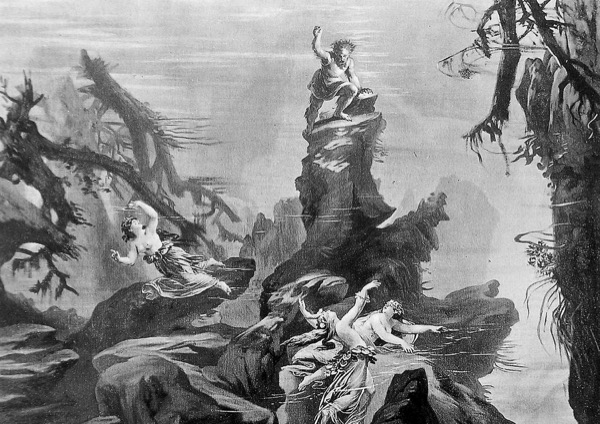
Rheingold stage design (Bühnenbildentwurf)
Wagner’s Ring cycle is a full-scale mythological mammoth project featuring bossy gods, rebellious Valkyries, fearless and frequently clueless heroes, dragons guarding bling, siblings who fall in love way too easily, and a river of gold that causes problems for literally everyone who touches it.
The drama is enormous, and the emotions are supersized, with the orchestra working overtime. While the spoken or recited word explains the story’s action, the music carries meaning and emotion through musical cyphers.
The leitmotif is a musical idea associated with characters, objects, emotions, or ideas. It provides a musical guide so you don’t get lost in the overwhelming, complicated story. After all, the four-part cycle takes roughly fifteen hours to perform. Essentially, Wagner’s instrumental writing contains the saga’s essential narrative and symbolic structure.
All the Drama, None of the Words
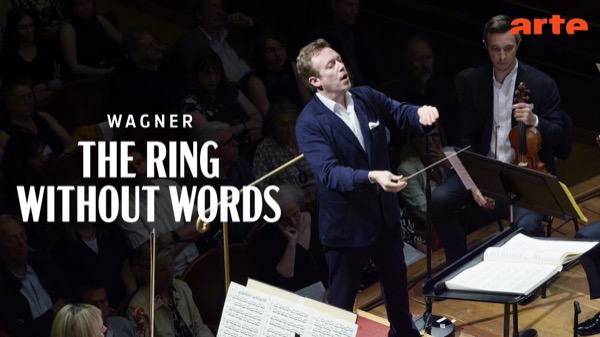
Daniel Harding, The Ring Without Words
When Lorin Maazel worked on a full production of the Ring, he envisioned an orchestral suite that distilled key symphonic episodes without adding a single note Wagner didn’t write. In his version, Maazel adheres strictly to the through-composed narrative and avoids stylistic or structural modifications.
All passages follow their original sequence, with no additions or reorchestrations. Occasionally, vocal lines are assigned to instruments when it is musically essential. In the end, this symphonic creation is profoundly Wagnerian.
Daniel Harding’s delightful interpretation accentuates the music’s cinematic qualities rather than treating it as a succession of orchestral highlights. The music unfolds like a vast mythological film, concentrating Wagner’s epic drama in orchestral form.
For more of the best in classical music, sign up for our E-Newsletter