The combination of piano and bass trombone may be unfamiliar to many listeners. Still, for The Heritage Duo Ensemble, this unusual pairing offers an opportunity to explore the lyrical and expressive possibilities of both instruments. Their new album, Poetic Song, brings together European repertoire from the Baroque and Romantic periods with traditional Korean melodies, creating a program shaped by ideas of storytelling, memory, and emotional expression.
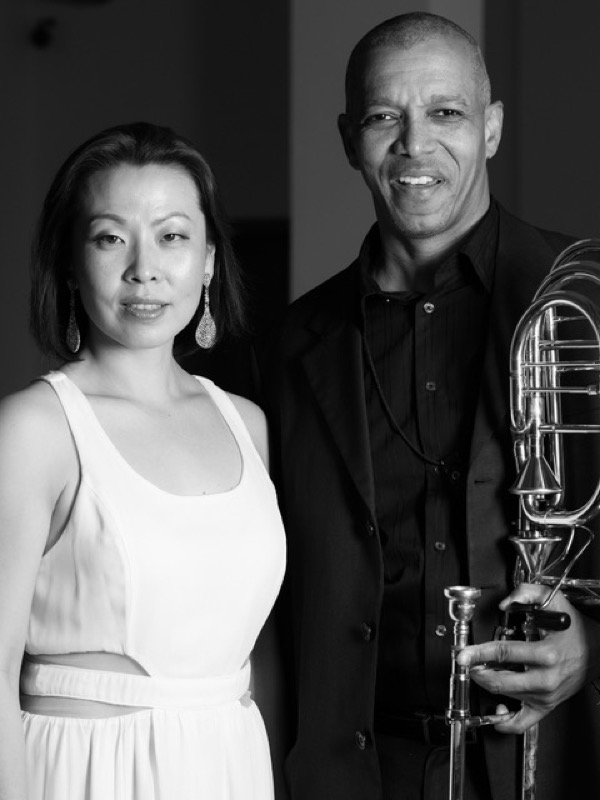
The Heritage Duo Ensemble
Bass trombonist Darrin C. Milling and Uzbek pianist Olga Kopylova co-founded the ensemble in 2016, with their first performance at the Campos do Jordão Winter Festival in Brazil in July 2017. The concert led to invitations to perform in Brazil and abroad. After Kopylova’s departure, pianist Sin Ae Lee became Milling’s artistic partner, and the two performed extensively between 2017 and 2022, including their first tour in the United States. They also recorded audiovisual projects and an album during this period. Today, Brazilian pianist Lígia Moreno is Milling’s artistic partner in the Heritage Duo Ensemble, continuing the ensemble’s original concept while bringing her own musical identity to the group.
To Milling, the bass trombone is not only an instrument associated with “power and orchestral foundation,” but also one with an “extraordinarily warm, lyrical, and vocal quality” that he wants audiences to hear. For Lee, who worked with Milling from 2017 to 2022, this was part of what attracted her to the ensemble. She was drawn to the way his playing challenged traditional perceptions of the instrument and revealed a natural blend between piano and bass trombone.
That idea of dialogue is central to Poetic Song. For Lee, the album reflects “our intersecting worlds and identities.” As a musician of Korean heritage who has lived and worked internationally, she has felt a strong connection between the storytelling quality of traditional Korean music and the lyricism of European classical repertoire. Rather than presenting these traditions as separate musical worlds, the duo wanted to create a bridge between them.
The repertoire developed from different stages of Milling’s musical life. Some works came from his years performing with the Luzerne Chamber Players at the Luzerne Music Centre in New York. Others grew out of his collaboration with Bulgarian pianist Lubislava Beltcheva in Duo BelMill. Working with Lee provided an opportunity to bring these experiences together with traditional Korean melodies. The guiding principle was simple: “every piece on the album had to sing,” Milling says.
This emphasis on singing provides one of the album’s most interesting connections. Although the European and Korean works come from very different cultural and historical contexts, the musicians found common ground in how they treated melody and expression. Lee identifies han, a Korean concept associated with deep emotional feeling, as one thread connecting the traditions. Longing, nostalgia, joy, and other human emotions become shared territory. Milling notes that the “subtle microtonal shifts, ornamentation, and an elastic sense of time” in traditional Korean music remind him of the expressive freedom found in Romantic European art song. In adapting works such as Fauré‘s Après un Rêve alongside Korean repertoire, these parallels became especially apparent.
The unusual instrumentation also shapes how the music is performed. For Milling, playing this repertoire requires him to move away from conventional brass-playing habits and approach the music as a chamber musician. His musical experiences at the Curtis Institute of Music, including guidance from vocalists and string players, influenced his approach to phrasing, breathing, and musical dialogue. His work with the RCA Red Seal recording team on Vladimir Horowitz‘s final album also gave him a different perspective on piano projection and placement.
Even the performers’ physical arrangement became part of this process. Milling plays laterally from the piano’s bow rather than directly toward the audience, allowing the bass trombone and piano to interact acoustically before reaching the listener. “For me, this is fundamentally a chamber-music partnership,” he says, “a dialogue between two equal musical voices rather than a trombone recital accompanied by piano.”
Lee describes their partnership as an attentive process, listening closely to Milling’s breathing and articulation. At the same time, his warm, vocal sound allows her to explore a wider range of colours and textures. “We no longer need to signal cues,” she says. “We simply breathe and move together through the phrasing.” Milling says working with Lee has made him a more complete listener, and the recording process revealed how closely their artistic instincts had developed, with both often arriving at the same emotional destination even when experimenting in the studio.
Through Poetic Song, the Heritage Duo Ensemble hopes listeners will hear not only the distinctive sound of piano and bass trombone, but also the common emotional language that can emerge between different musical traditions.
The ensemble’s journey will continue in several directions. Milling and Moreno are continuing the Heritage Duo Ensemble with contemporary repertoire and new commissions, while Milling and Lee are considering a future project featuring more music from Asia. For Lee, the goal remains to invite listeners “to listen across cultures and find common emotional ground.” In that sense, Poetic Song is not simply a meeting of two instruments or two musical traditions. It invites listeners to listen for the connections between them.
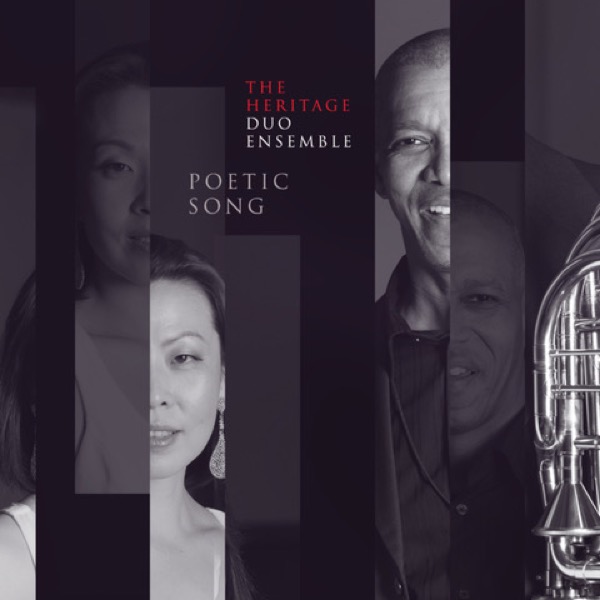
Catalogue No: AMDA2310
Label: Azul Music
For more of the best in classical music, sign up for our E-Newsletter