The Innsbrucker Festwochen der Alten Musik has long been a premier incubator for Baroque opera. Through its annual “Barockoper:Jung” initiative, the festival provides a crucial professional platform for former Cesti Competition winners and other exceptional young talent. Handel’s 1736 pastoral opera Atalanta—originally composed to secure royal patronage for a princely wedding—is an ideal vehicle for this project. Its romantic plot involving two young couples is straightforward on the surface, yet subtly complex beneath the surface, packed with sparkling arias that suit rising voices perfectly.
Handel composed Atalanta in 1736 to celebrate the London wedding of Frederick, Prince of Wales, and Princess Augusta. Set in mythical Arcadia, the plot follows King Meleagro and Princess Atalanta, who adopt shepherd disguises to escape courtly duties and explore freedom. While hunting a wild boar, they fall in love but struggle with pride and mistaken identities. Meanwhile, another shepherd couple, Aminta and Irene, navigates their own romantic trials. After pride gives way to true affection, their noble identities are revealed. The messenger god Mercurio descends to bestow divine blessings, concluding the opera with a joyful celebration of love and royal unity.
In this production at the Kammerspiele, director François de Carpentries and stage/costume designer Karine Van Hercke offer a clear vision that eagerly embraces contemporary video culture. From the opening scene, where a young girl wearing a quiver runs through a forest, the atmosphere of a pastoral hunt is vividly established. Throughout the performance, classical visual icons—such as antique arches, columns, and Greek statues—blend seamlessly with digital projections of wild boars and satyrs. Crucially, these projections avoid any cheap digital feel, creating an intriguing sense of distance and intimacy between classical imagery and modern aesthetics. At the same time, the matrix of architectural elements and statues gives the two couples natural, physical places to hide, chase, and spy on one another as the drama unfolds.
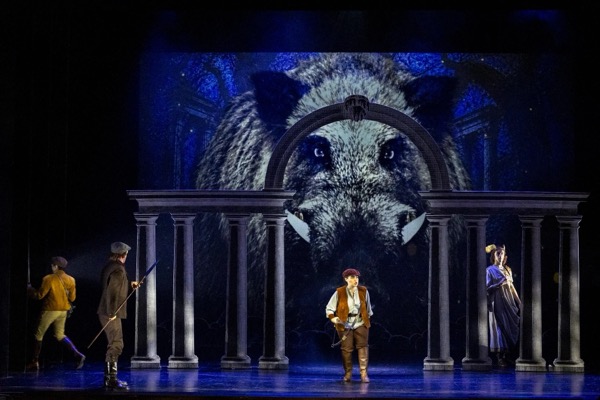
Peter Edge (Nicandro), Silvia Porcellini (Atalanta), Pierre Gennaï (Mercurio) © Birgit Gufler
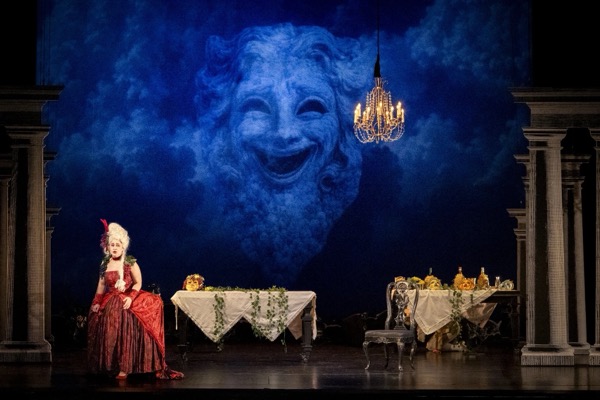
Silvia Porcellini (Atalanta) © Birgit Gufler
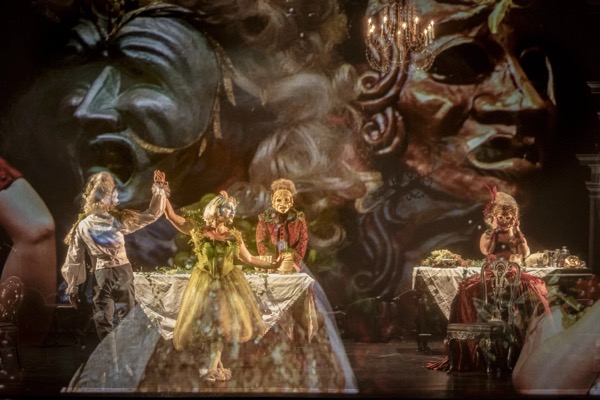
At the ball of Atalanta © Birgit Gufler
Costumes and character details further deepen the opera’s core themes of hidden desires and shifted roles. The two main couples alternate between sumptuous gowns, work clothes hinting at local Tyrolean flair, and plain white nightgowns. This playful wardrobe shifting charmingly reinforces the opera’s motifs of disguised identity and hidden truths.
In the title role, soprano Silvia Porcellini displayed a bright, clear tone tailor-made for Atalanta. Though her vocal production showed minor instability as she initially entered the character, she quickly settled into a radiant delivery. Rich in Baroque dramatic tension, her performance captured Atalanta’s emotional arc with delightful naturalness. Moving from the playful cat-and-mouse games of the early chase to the ecstatic burst of joy in the final reconciliation, Porcellini transformed a distant mythological figure into a passionate, authentic young girl.
Soprano Sarah Hayashi, a late addition to the cast as Meleagro, seized her opportunity with complete conviction in a role packed with Handel’s most brilliant arias in this opera. She brings vibrant vitality to her singing and shows a brave, highly expressive approach to musical phrasing. Her stage acting was equally magnetic; in sheer physical commitment and stamina, she anchored the performance. In her first duet with Porcellini, their voices interwove to mimic the bickering of young lovers with incredible charm. During their final reconciliation, captured at a thrillingly fast tempo as the two ran joyfully across the stage, the atmosphere rose to pure ecstasy, striking directly at the audience’s heart.
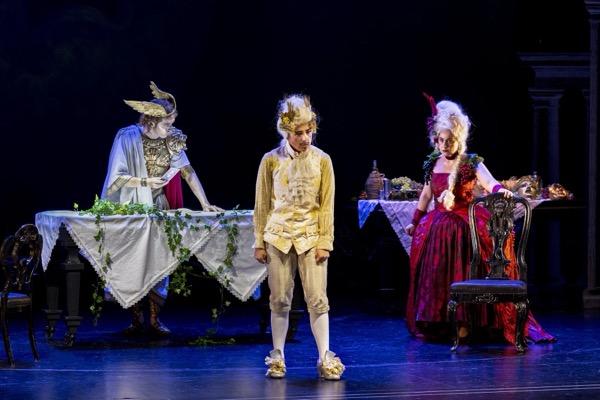
Pierre Gennaï (Mercurio), Sarah Hayashi (Meleagro), Silvia Porcellini (Atalanta) © Birgit Gufler
The secondary couple, Salvador Simão (Aminta) and Justina Vaitkute (Irene), offered a vivid exploration of Arcadian sincerity. Simão’s portrayal of Aminta was somewhat understated, leaving his stage persona less sharply defined. However, his vocal delivery packed plenty of explosive power, providing a robust acoustic contrast to Vaitkute’s wiser, more grounded Irene. Functioning as the intellectual engine of the subplot, Vaitkute guided Irene’s psychological tests with maturity. During the scene where the ribbon and arrow are exchanged, dramatic sparks genuinely flew, resolving into a pure harmony that celebrates the trials of the human heart.
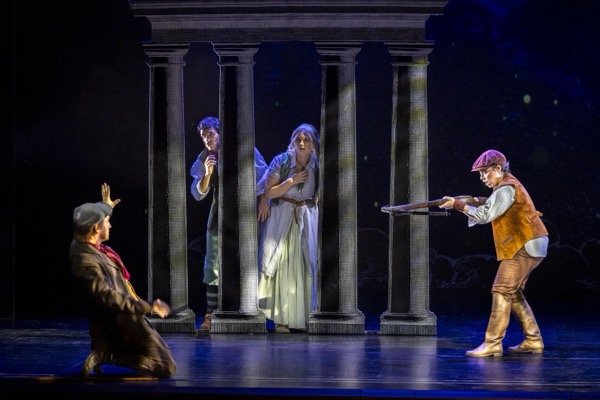
Peter Edge (Nicandro), Salvador Simão (Aminta), Justina Vaitkute (Irene), Silvia Porcellini (Atalanta) © Birgit Gufler
Rounding out the cast, Peter Edge (Nicandro) and Pierre Gennaï (Mercurio) anchor the dramatic framework with strong stage presence. Both singers commanded the hall with precise resonance, allowing their full, powerful voices to project through the theatre. Gennaï’s Mercurio, dressed in striking Roman attire, used his rich, solid bass-baritone to act almost as a formal orator. His commanding presence, combined with backdrop lettering reminiscent of ancient Roman inscriptions, lent the evening a crisp classical dignity.
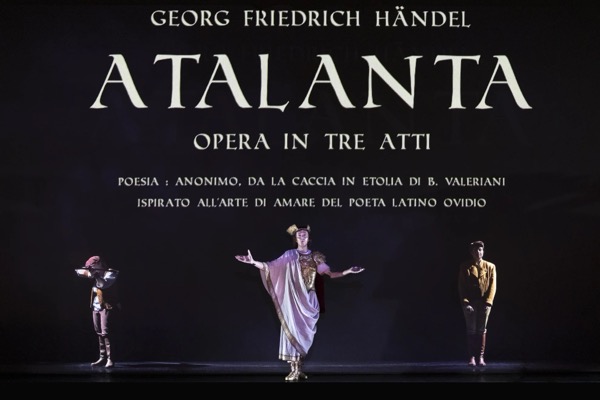
Silvia Porcellini (Atalanta), Pierre Gennaï (Mercurio), Sarah Hayashi (Meleagro) © Birgit Gufler
Under the direction of Andrea Buccarella, the Orchester der Schola Cantorum Basiliensis delivers a performance full of freshness, drive, and youthful spirit. Buccarella brought out the sweet, enchanting qualities of Handel’s pastoral score, supported by exceptional, lively continuo playing from two harpsichords. As the projection behind the final wedding scene revealed an elegant country villa, the audience shared a heartfelt hope that these talented young musicians will enjoy careers just as luminous as this unforgettable afternoon.
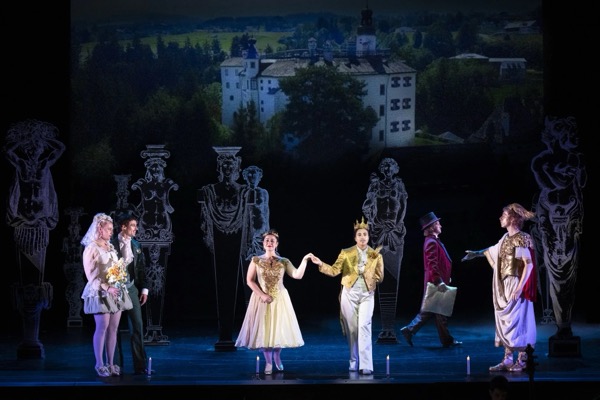
Full cast of Atalanta © Birgit Gufler
For more of the best in classical music, sign up for our E-Newsletter