George Enescu (1881-1955) and Yehudi Menuhin (1916-1999) shared one of the most profound teacher-student relationships in twentieth- century classical music. In fact, Enescu’s mentorship continued for decades, guiding Menuhin’s entire approach to music and to life.
As Menuhin said about his teacher, “He will remain for me the absoluteness through which I judge others… Enescu gave me the light that has guided my entire existence.” (Muzeul National “George Enescu”)
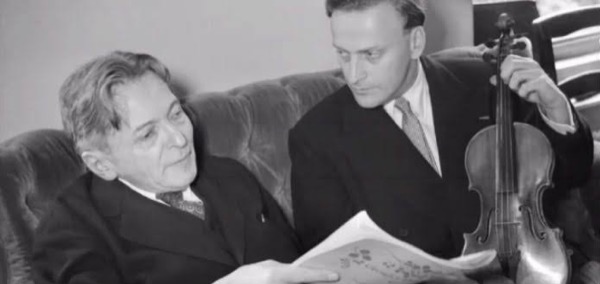
George Enescu and Yehudi Menuhin
To celebrate Enescu’s birthday on 19 August, let’s take a closer look at this extraordinary relationship through the eyes of one of the greatest violinists of the century.
Menuhin & Enescu play Bach: Double Concerto in D minor (excerpt)
Finding a Mentor
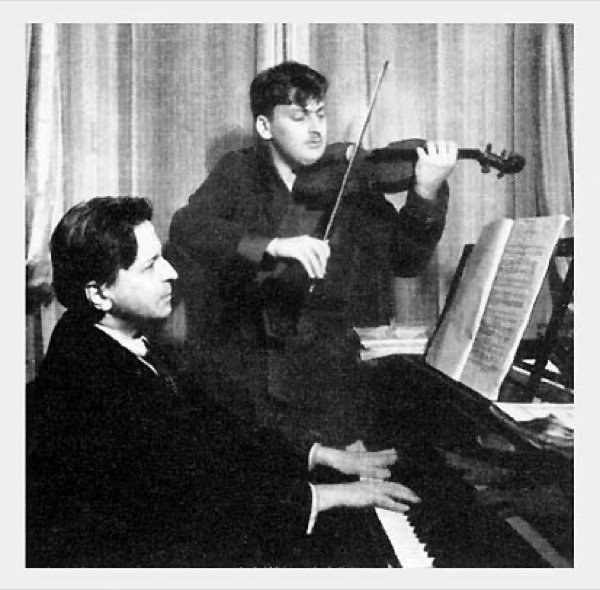
George Enescu and Yehudi Menuhin
Yehudi Menuhin, as he relates in his autobiography, Unfinished Journey, first encountered George Enescu in San Francisco when he was a young boy, around age 8. Enescu was conducting one of his own symphonies and performing the Brahms Violin Concerto. As Menuhin recalls, “everything about him proclaimed the free man, and the spontaneity of creative genius and fire.”
The most influential and flamboyant violin virtuoso at the time was the great Eugène Ysaÿe, and it was generally assumed that Menuhin would study with him. But after listening to Enescu, the ten-year-old child insisted that he wanted Enescu to be his teacher.
In the event, it meant travelling to Europe and learning French, which Menuhin mastered with ease in a very short period of time. By the time he auditioned for Ysaÿe, whom Menuhin described as “an imposing bulk, but old, ailing, decaying, and chained to his chair by a diabetically gangrenous foot,” his mind was already made up.
George Enescu plays Mendelssohn: Violin Concerto in D minor, “Andante”
A Reluctant Master
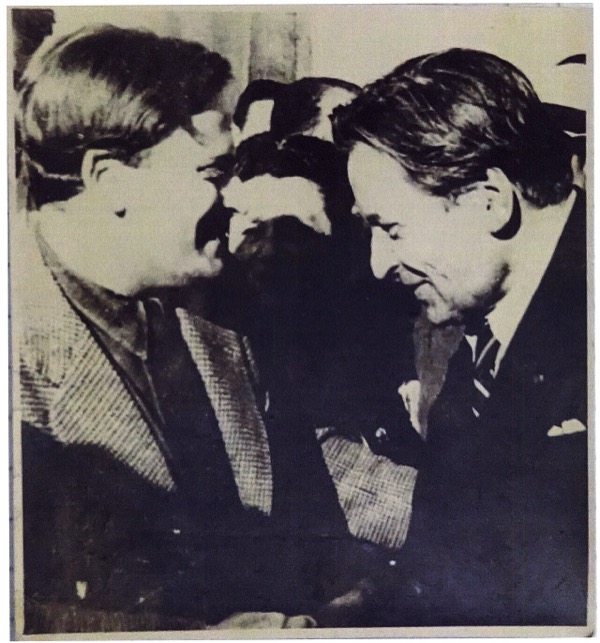
George Enescu and Yehudi Menuhin
Back in Paris, Menuhin approached Enescu but was met with an unexpected refusal. While Enescu admired Menuhin’s extraordinary gifts, he also believed that, at that stage of his development, he needed a rigorous technical teacher rather than an artist-philosopher.
Yet, the disappointed boy refused to give up and persuaded Enescu to hear him play before making a final decision. Enescu listened carefully and immediately recognised a remarkable talent and an exceptional musical sincerity. Enescu reversed his decision on the spot and declined to take any payment for the lessons.
Menuhin reports, “Enescu gave me lessons whenever his concert schedule allowed, perhaps five in five successive days, then none for a fortnight, but each one lasting an entire afternoon. A lesson was an inspiration, not a stage reached in a course of instruction.”
George Enescu plays Kreisler: “Tempo di Minuetto”
Lessons Beyond Technique
“It was the making of music, much as if I were his orchestra, playing under his direction, or his apprentice-soloist, and he both conductor and orchestra, for while he accompanied at the piano, he also sang the different voices of the score.”
“There were few interruptions. Sometimes he took up his own violin to illustrate a point, say, about vibrato or glissando; very, very rarely would he give me a dissertation on violin theory. When I came to study with him, I too played more or less as a bird sings, instinctively, uncalculatingly, unthinkingly, and thus neither he nor I gave much thought to theory.”
“What I received from him by compelling example, not by word, was the note transformed into a vital message, the phrase given shape and meaning, the structure of the music made vivid… I had never known it to have such clear and vital form before.”
George Enescu plays Wagner: “Albumblatt in D-flat Major”
The Master’s Voice
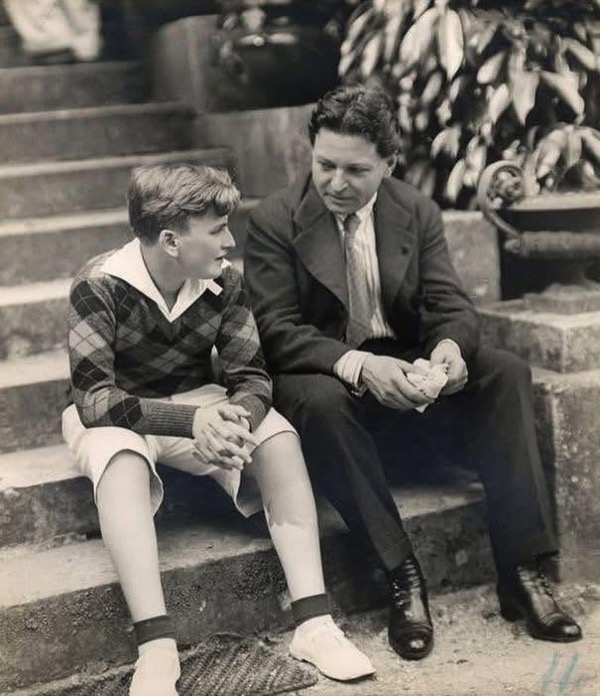
Yehudi Menuhin and George Enescu
“When, occasionally, he did use words to make a point, they were not cut-and-dried injunctions, nor ready-made solutions, but suggestions, images, which bypassed reason to infuse the imagination with a more complete understanding. He did not impose his views.”
“Above all, Enescu carried me on the wave of his conception of the music. For years and years afterwards, I could hear his voice, sometimes in words, mostly in music, telling me about what I was playing, and as my experience grew, these remembered counsels gained validity.”
“Nothing he said was wrong, nothing he pointed to was misleading. Even insignificant indications took on ever greater weight and value, underscoring, over and over again, the profundity, sensitivity, and richness of his musicianship, reminding me repeatedly how right I had been to trust him and how fortunate I was to win his guardianship. I know that everything I do still carries his imprint today.”
George Enescu conducts Enescu: Romanian Rhapsody No. 1, Op. 11
A Lifelong Bond
Menuhin soon became one of the world’s most celebrated violinists, yet their lessons continued whenever Enescu’s concert schedule permitted. Their relationship evolved into a lifelong mentorship and friendship founded on mutual admiration and deep affection.
They appeared together on numerous occasions in recitals, with Enescu accompanying his former student at the piano. And let’s not forget that they collaborated in chamber music performances across Europe as well.
George Enescu died in 1955, and Menuhin mourned the loss of a man he regarded as a second father. He tirelessly championed Enescu’s music, conducting his works and programming them in concert. His teacher’s voice resonated long after the lessons themselves had ended, and few students have offered more eloquent tributes to their teacher.
For more of the best in classical music, sign up for our E-Newsletter