Aldo Forte created Impressionist Prints: Six Masters in Two Galleries, using artworks by 6 of the greatest impressionists. Each painting captures a particular idea within Impressionism.

Aldo Rafael Forte
He opens with Monet’s work in London. Monet’s 1872 painting Impression, Sunrise, was the work that gave Impressionism its name, and so Forte makes reference to that in the name of his movement. The work he’s focusing on, however, comes from some 30 years later. Monet was in London in the autumn of 1899, and the early months of 1900 and 1901. Over those visits, he painted nearly 100 paintings of the Thames River from the viewpoint of his window in the Savoy Hotel or from the terrace at St Thomas’ Hospital. Those included about 19 paintings in which the Houses of Parliament were the subject, showing Parliament at sunset, in the fog, under a stormy sky, with the sun breaking through the fog, etc. Sunrise was never a time when he painted Parliament.
We’ll take one of the many views as indicative of Forte’s inspiration, in this case, the House of Parliament, painted in 1900 and 1901, where the sun is starting to set, and the buildings are outlined against the sky and reflected in the water.
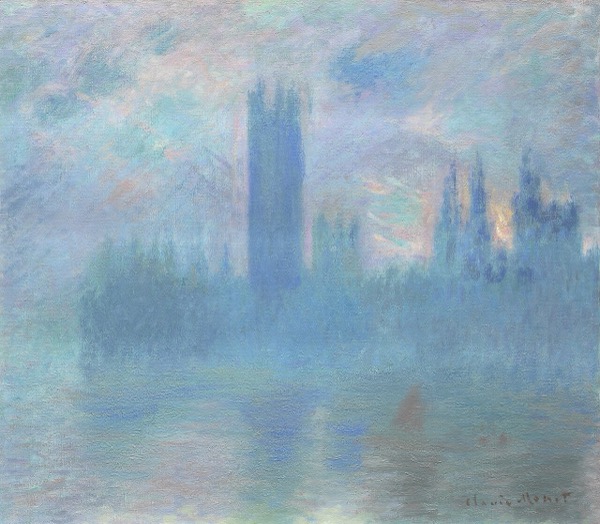
Monet: Houses of Parliament, London, 1900–1903 (The Art Institute of Chicago)
Forte divided his Impressionist Prints into two Galleries. The first has paintings by Monet, Degas, and Van Gogh, and the second by Renoir, Seurat, and Toulouse-Lautrec. Forte’s music emphasises the loneliness of the building on the river through the use of an upward running motif in the English horn. At the same time, there’s a solidity and presence of the building in the music.
Aldo Forte: Impressionist Prints: Gallery I: Monet: Impression Sunrise – Imposing Houses of Parliament In Fog (United States Air Force Heritage of America Band; Larry H. Lang, cond.)
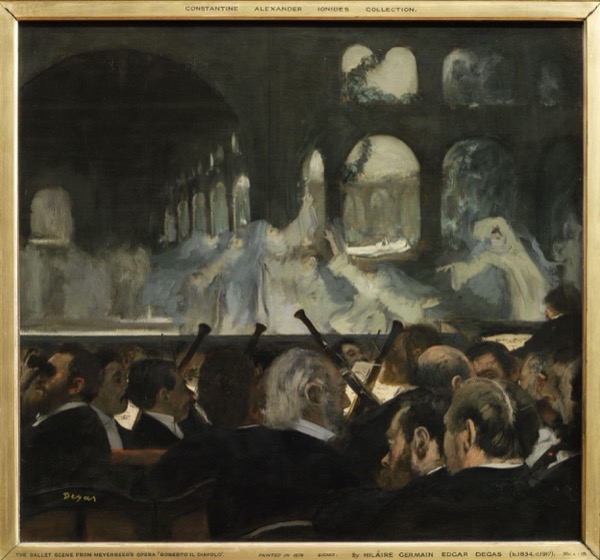
Next, we’re in Degas’ world of the stage and dance. Instead of focusing on the backstage world of the corps de ballet, we’re in the audience, in a box, looking down onto the triumphal acknowledgement of the prima ballerina at centre stage. The backstage world intrudes in the back, with the other dancers waiting to make their appearance, and a stage manager on the left, watching to make sure all is going as it should.
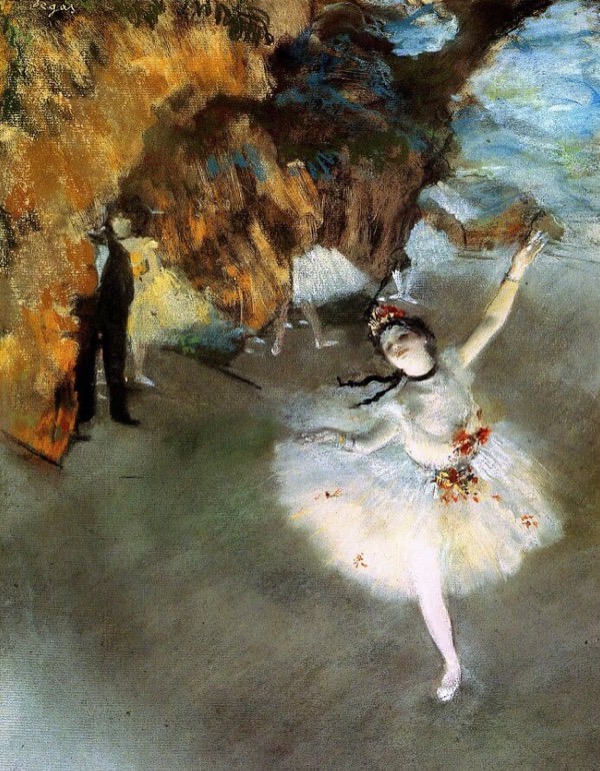
Degas: Ballet / The Star / Dancer on the Stage, 1876–1877 (Musée d’Orsay)
Forte takes the upward-running motif from his first movement and animates it by making it faster and longer. We can hear the dancer’s whirls and twirls in the music, the actions of the corps de ballet as it acts as her backdrop against her virtuosic actions, building to her solo climax.
Aldo Forte: Impressionist Prints: Gallery I: Degas: Ballerinas, “The Star” (United States Air Force Heritage of America Band; Larry H. Lang, cond.)
Now we’re in the other world of impressionists: the outdoors. In one of his final works, Van Gogh captured an intense yellow wheatfield, cut through by dark lanes, with the sky filled with flying crows. The sky is a bright blue with clouds just appearing on the horizon.
The lack of figures in the expansive landscape and the uncertain direction of the crows’ flight give a tremendous sense of isolation in the image. For Van Gogh, crows were considered the most observant of birds and symbolised both death and rebirth. The end of the road is invisible, but by leading it to the cloud, it seems to have a more optimistic spirit.
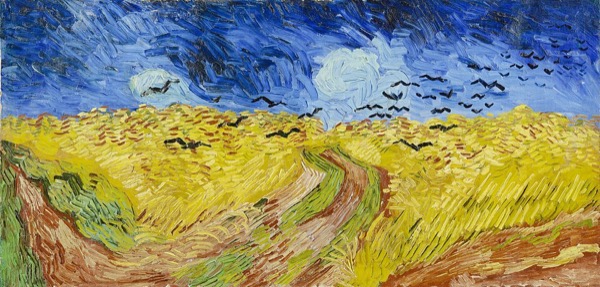
Van Gogh: Wheatfield With Crows, 1890 (Amsterdam: Van Gogh Museum)
Forte sees the building clouds as foretelling storms, or is the storm within the artist? A robust bass melody is highlighted by the woodwinds above while the percussion keeps up a driving pressure. The winds whirl and perhaps there’s even some thunder and lightning, all in keeping with the movement in the painting.
Aldo Forte: Impressionist Prints: Gallery I: Van Gogh: His Storms, “Wheatfield With Crows” (United States Air Force Heritage of America Band; Larry H. Lang, cond.)
Thus closes Gallery I, and we go on to Gallery II, opening with high fashion.
Pierre-Auguste Renoir’s La Parisienne made its first public appearance at the First Impressionist Exhibition in 1874. The elegant woman in blue turns to the viewer as she pulls on her gloves. Originally, she stood before a doorway on the left and a curtain on the right, but Renoir removed these to leave her floating in an indeterminate background. One early critic bemoaned what he couldn’t see, declaring that ‘Her dress does not reveal enough of her body. There is nothing more annoying than locked doors’. Twenty years later, it was described as ‘simple, fresh, and beautiful’.
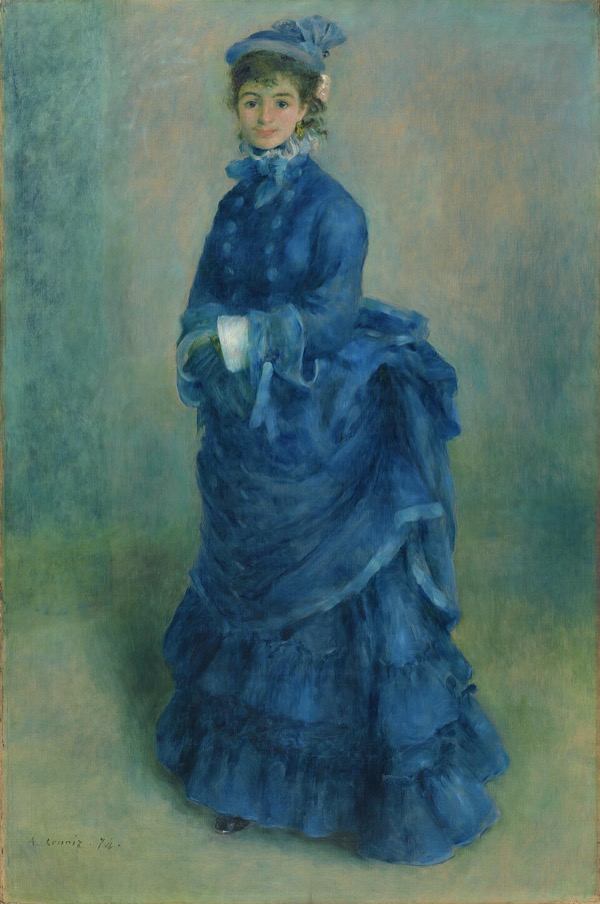
Renoir: La Parisienne, 1874 (Cardiff, Wales: National Museum / Amgueddfa Cymru)
Forte picks up the many shades of blue in his setting, to which he has added the title ‘Elegance and Beauty’. After the frenetic action of the wheatfield and crows, the woman’s stillness rings through.
Aldo Forte: Impressionist Prints: Gallery II: Renoir: Elegance And Beauty, “La Parisienne” (United States Air Force Heritage of America Band; Larry H. Lang, cond.)
The strongest proponent of pointillism, Georges Seurat, sought to demonstrate what could be achieved with the style. In Circus Sideshow, Seurat gives us the strongest contrast he could by depicting a nighttime outdoor scene lit by the artificial light of the Circus Corvi. The nature of pointillism still gives us sharply defined pictures, but the juxtaposition of colours enables the artist to depict many kinds of shadows, as befits a nighttime scene. Behind the man on the right is the head of the line for the box office, while the players draw attention for the scenes behind the canvas.
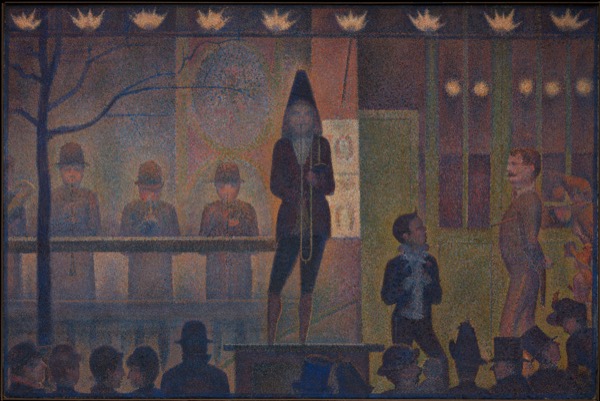
Seurat: Circus Sideshow (Parade de cirque), 1887–1888 (Metropolitan Museum of Art)
Forte makes the dotting of pointillism the basis of his setting, with a swooping imagining of what the central trombonist is doing. The other wind instruments twitter behind him and try to set up a dramatic anticipation for the rest of the unseen sideshow.
Aldo Forte: Impressionist Prints: Gallery II: Seurat: Pointillism, “The Side Show” (United States Air Force Heritage of America Band; Larry H. Lang, cond.)
The cabaret Moulin Rouge was founded in 1889 and is known as the home of the cancan. Bringing wealthy Parisians to Montmartre, where they could meet people from all walks of life, proved profitable. The original café-concert was soon outstripped in fame by its cabaret, and the posters for the house, made by Jules Chéret, Alfred Choubrac, and, most famously, Henri Toulouse-Lautrec, brought fame to the dancers of the house, including La Goulue, Jane Avril, la Môme Fromage, Grille d’Egout, Yvette Guilbert, and others. In this image, La Goulue, with her back to the viewer, arranges her hair. Seated at the table are dancers La Macarona and Jane Avril (noted for her red hair), as well as photographer Paul Sescau, poet Édouard Dujardin, and vintner Maurice Guibert. The face lit in shocking green is the singer May Milton – a deliberate move on the artist’s part to emphasise the Moulin Rouge’s innovative use of electric light. The two men at the centre back are the diminutive artist and his cousin, the physician Gabriel Tapié de Céleyran. Toulouse-Lautrec places the viewer in the middle of the action, and with the singer May Milton at your table, you must be famous!
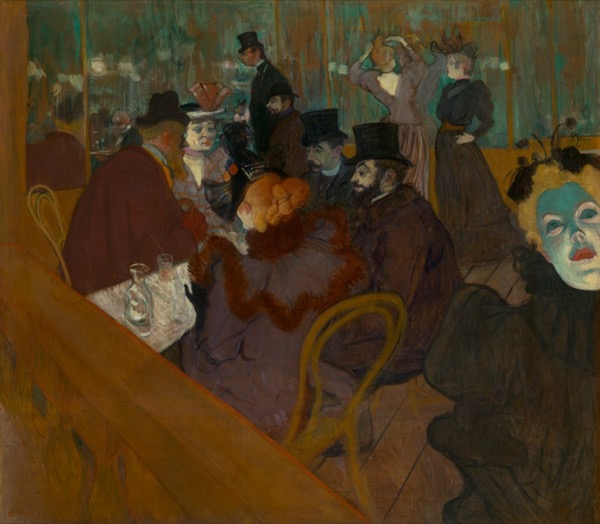
Toulouse-Lautrec: At The Moulin Rouge, 1892–1895 (Art Institute of Chicago)
Forte takes us directly to the dance floor, the orchestra plays, the trombones swoop, and suddenly, we’re in the middle of a can-can. Our attention is constantly shifted from here to there as famous people enter, the dancers take to the stage, and the clever use of the Can-Can melody in the low brass, with the upper winds flittering away, gives us the perfect image of the dancers’ skirts in motion.
Aldo Forte: Impressionist Prints: Gallery II: Toulouse-Lautrec: At The Moulin Rouge (United States Air Force Heritage of America Band; Larry H. Lang, cond.)
Forte paints the many worlds of impressionism in music with great success. There are references to the images in the painting, but he also leaves space for your own imagination. Considered as a set of mini tone poems, they’re great fun!
For more of the best in classical music, sign up for our E-Newsletter