Erik Satie, born on 17 May 1866 in Honfleur, France, is famous for his humorous piano pieces peppered with whimsical instructions. Eccentric titles like “Three really flabby preludes for a Dog,” to be played “like a nightingale with a toothache,” firmly established him as a member of the Parisian avant-garde.
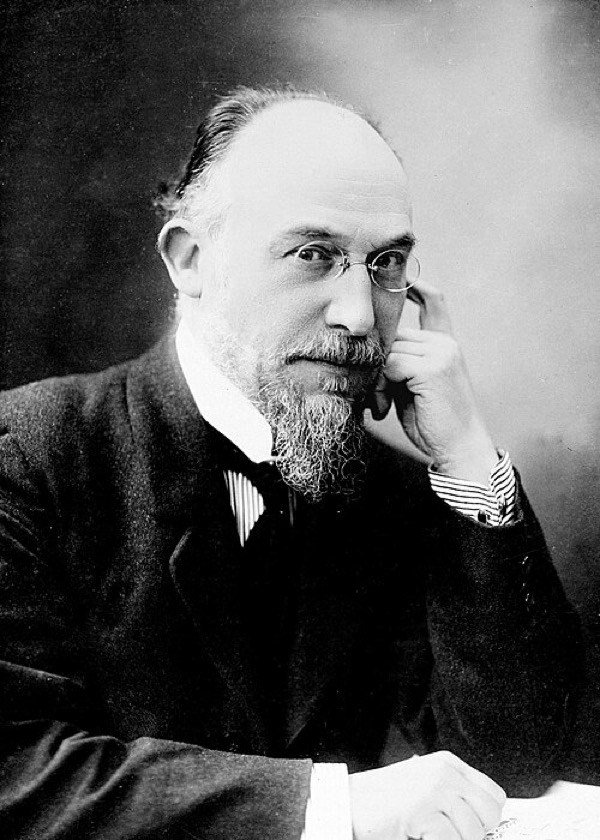
Erik Satie
Audiences never knew what to expect, as his musical universe is a peculiar blend of sentimental circus, lyrical modernism, and absent-mindedness. Some called it sublime, pure and humorous, while others saw it as vulgar, complex, and rather sad.
Satie was a loner and an original, and everything he touched was cutting-edge. We all know his famous piano pieces, but did you know that Satie also composed a number of songs? To celebrate his birthday, why don’t we explore some of his mélodies?
Erik Satie: Trois Mélodies, “No. 1. Les anges” (Meriel Dickinson, mezzo-soprano; Peter Dickinson, piano)
Angels Without Bar Lines
Satie’s first set of “Trois Mélodies” dates from 1886, and it sets poems by his friend J.P. Contamine de Latour. He was a Spanish poet living in Paris, and in his ruminations, he was greatly influenced by Baudelaire and the sentiments of other symbolists.
Robed in white, in the blue sky,
Their long veils extended,
The angels glide through the ether,
Lilies afloat amongst the stars.
Lutes tremble under their fingers,
Lutes of godly harmony.
Like incense, their voices rise,
Calm, beneath the infinite vault.
Below, the bitter seas roar;
The night extends its veils too.
The angels glide through the ether,
Lilies afloat amongst the stars.
The first poem, as you can tell, describes angels floating in the sky like water lilies among the stars. Immediately, Satie creates a strong contrast with continuous slow chords formed from clusters of seconds and sevenths, all without bar lines.
Erik Satie: Trois Mélodies, “No. 2. Les fleurs” (Meriel Dickinson, mezzo-soprano; Peter Dickinson, piano)
Symbolist Irony and Decadence
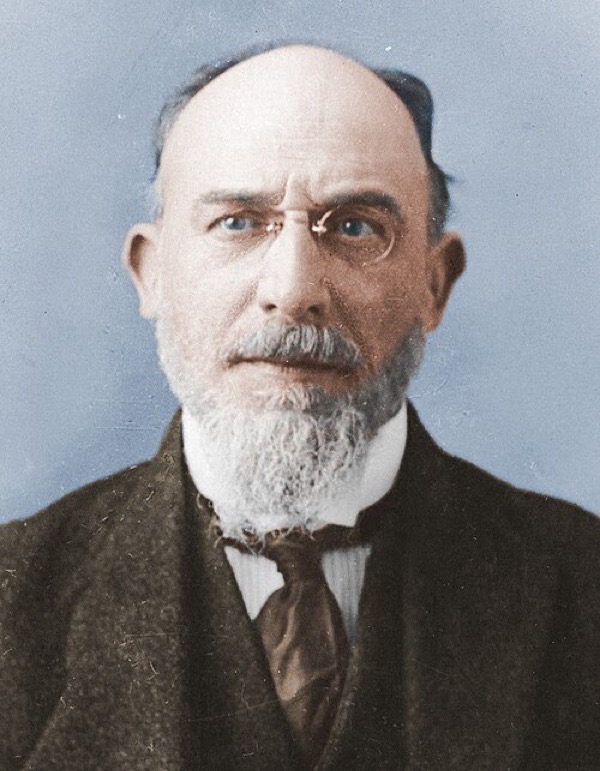
Erik Satie
“Les fleurs” explores a flower opening at dawn, creating images of tenderness, but it only lasts a short time. The concluding “Sylvie” tells of a girl who is so beautiful that the angels are jealous. Her eyes are stars, her lips rubies, her soul is a cloudless sky, and her heart is paradise.
Satie’s setting completely avoids the tensions of the minor/major system and leaves us with a stagnant tonality. The focus is on the colour of each chord, and the music mirrors the decadence of the words in the manner of a parody.
In a sense, it is a paradoxical setting as Satie provides an irreverent and contradictory response to Latour’s texts. These melodies were originally published by the composer’s father, and while they are among his earliest compositions, they already carry the label Op. 20.
Erik Satie: Trois Mélodies, “No. 3. Sylvie” (Meriel Dickinson, mezzo-soprano; Peter Dickinson, piano)
The Composer as Poet
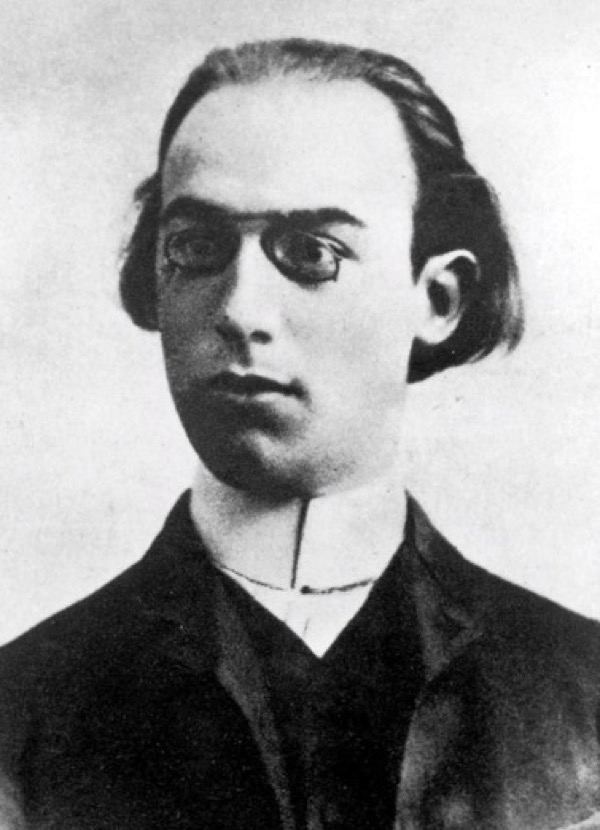
Erik Satie, 1884
Almost 30 years later, Satie composed his song cycle Trois Poèmes d’amour in 1914. It is the only set of melodies to feature his own poetry. In the original preface to these songs, not taken over in the published version, Satie describes the ideas behind the poems.
“These poems do not discuss the love of Glory, the love of Lucre, the love of Commerce or of Geography. No. These poems are poems of love…. Of Love; they are simply and devout pages wherein are reflected all the tenderness of a virtuous man, very proper in his ways. You can listen to them without fear.” (Potter, Erik Satie: Music, Art and Literature, “Satie as Poet, Playwright and Composer”)
Erik Satie: 3 Poèmes d’amour, “No. 1” (arr. Caby) (Barbara Baier; European Music Project Ensemble)
Mock-Troubadour
“Love Poem No. 1; the title of the second is a little less glorious. Love Poem No. 3; as to the third poem, its title is more modest still. Love Poem No. 2. I am going to sing them to you myself, with a single vocal cord, in the same way as was customary in ancient times, at the court of our good ol’ kings of the 12th, of the 12th arrondissement.”
Satie eventually decided against the 1, 3, 2 numbering, but in his reference to the 12th century, he presents a modern reimagining of medieval French troubadour songs. Both text and music are deliberately written in an archaic style with a number of contemporary twists.
Erik Satie: 3 Poèmes d’amour, “No. 2” (arr. Caby) (Barbara Baier; European Music Project Ensemble)
Infinite Harmony
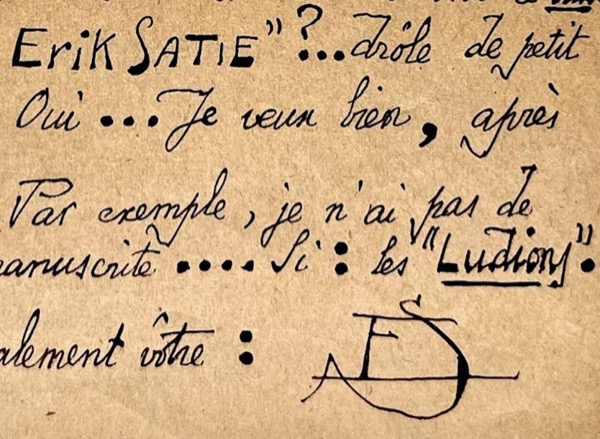
Letter by Erik Satie
The poetic form of each poem is identical, and all the rhymes are identical as well. In the first song, the narrator presents himself as a humble petitioner akin to a grain of sand who seeks to please his lover.
I am but a grain of sand
Always fresh and kind to you.
Who drinks, who laughs, who sings
To please his lover
Gently, my dear, lovely one
Love your fragile lover;
He is but a grain of sand
Always fresh and kind to you.
As to the musical settings, Satie writes, “a melody does not imply its harmony, any more than a landscape implies its colour. The harmonic character of a melody is infinite for a melody is an expression within the overall Expression.” We find this half-concealed interrelationship between the vocal and piano part in just about every measure of these three love songs. (Potter, Erik Satie: Music, Art and Literature, “Satie as Poet, Playwright and Composer”)
Erik Satie: 3 Poèmes d’amour, “No. 3” (arr. Caby) (Barbara Baier; European Music Project Ensemble)
Bronze Frog and Broken Elegance
Probably the best known of Satie’s generally neglected art songs are the Trois Mélodies of 1916. Dedicated to Jane Bathori, a star of the Parisian opera world, the set first sounded during a benefit for artists affected by the war.
The so-called “Festival Erik Satie-Maurice Ravel” was a high-society event, and newspapers mentioned long lines of limousines in front of the Salle Huyghens. Apparently, Satie’s music was introduced in a lecture before the concert.
The poem “La Statue de bronze” is notoriously difficult to translate, and it was written by the absurdist poet Léon-Paul Fargue. The poem describes the boredom of a great metallic frog, with passerby tossing coins and other objects into its open mouth.
Erik Satie: 3 Mélodies, “No. 1. La statue de bronze” (Marc Mauillon, baritone; Alain Planès, piano)
Blowing Bubbles of Music
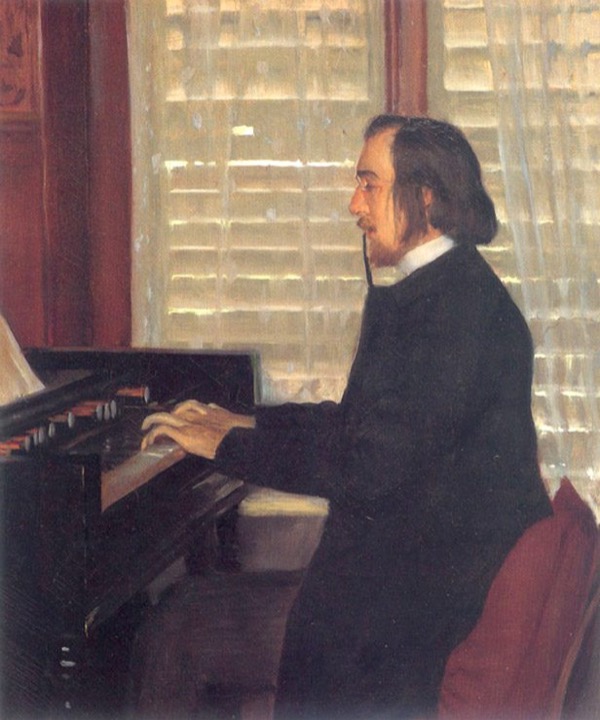
Santiago Rusiñol, Portrait of Erik Satie at the harmonium
Satie immediately invokes the music hall by providing a cake-walk introduction, with the piano subsequently falling into an oom-pah ostinato rhythm. The vocal line fades into quiet pensiveness, as the artificial frog complains that at night, his mouth is full of insects it cannot eat.
Clearly, he would rather be a real frog, “blowing bubbles of music out of the moonlight’s soap.” It has been said that this set contains the essence of Satie, the ironist, the wit, and the skilful parodist.
The second song is titled “Daphénéo,” and the poem was written by M. God, the pseudonym for Marie Anne Godebska. She was the niece of Misia Sert, Satie’s foremost patron of the period.
Erik Satie: 3 Mélodies, “No. 2. Daphénéo” (Marc Mauillon, baritone; Alain Planès, piano)
Bird-Trees and The Mad Hatter
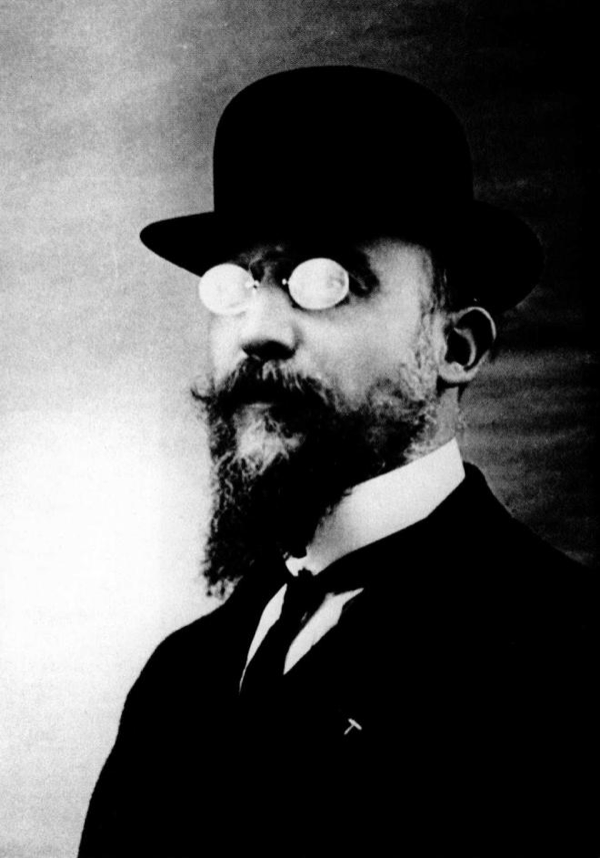
Erik Satie in 1909
The poem for “Daphénéo” is a whimsical dialogue between two made-up mythical characters, Daphénéo and Chrysaline. Chrysaline tells her that nut-trees produce nuts, and bird-trees bear birds and weep. An enlightened Daphénéo replies “Ah!”
Satie writes gently swaying and solemn music to provide the text with a bit of ironic dignity. The effect of this juxtaposition is just funny, as Satie turns a bit of nonsense into music of sobriety and restraint.
Erik Satie was seriously fond of Lewis Carroll’s Alice’s Adventures in Wonderland. In fact, he was contemplating writing a ballet on the subject. The poet René Chalupt adapted parts of the story into poetry for the concluding song in this set.
Erik Satie: 3 Mélodies, “No. 3. Le chapelier” (Marc Mauillon, baritone; Alain Planès, piano)
Operatic Quotation
“Le Chapelier,” the Hatter, comes from Alice’s “A Mad Tea-Party” when the mad hatter frets over his pocket watch, which is running three days late even though he lubricates it with the best butter and dunks it into his tea.
Satie’s accompaniment actually parodies the love duet from Gounod‘s opera Mireille. And what is more, Satie provides the playing instruction “genre Gounod.” This seems to have been a discreet way of poking fun at Gounod, the composer of bourgeois sentimentality.
Satie was rather pleased with his “Le Chapelier,” as he dedicated it to his friend Igor Stravinsky. He was one of the few contemporary composers he admired without reservation.
Erik Satie: Ludions, “No. 1. Air du rat” (arr. Habermann) (Trio Satie)
Floating Songs
In his last song cycle for voice and piano or organ, written shortly before his death, Erik Satie fused the music-hall genre with the melodies of the French art song. With Ludions, Satie once again set the poetry of Léon-Paul Fargue, perhaps his nearest counterpart in literature.
A “ludion,” better known in English as a “Cartesian diver,” makes reference to one of the most popular toys at the time. It is a tiny figurine that, when placed in a sealed water-filled container, is made to rise, sink, and spin when external pressure is applied to the liquid.
Erik Satie: Ludions, “No. 2. Spleen” (arr. Habermann) (Trio Satie)
One-Minute Elegies
These songs premiered at Count de Beaumont’s fancy dress ball, one of the most celebrated events in Paris. Each of the songs hardly lasts one minute, and the text is almost impossible to translate.
The “Air du Rat,” the rat’s song, is based on a poem that Fargue wrote at the age of 10 to lament the death of his pet white rat. There is a fragile tone of lament in the vocal line, all hinting at the sad loss of the juvenile’s little friend.
Erik Satie: Ludions, “No. 3. La grenouille américaine” (arr. Habermann) (Trio Satie)
Melancholy and Parody
“Spleen” features a jaded blonde prostitute, sitting like “an ocean of ill-will” on a bench in a public square. And the nostalgic poet longs for her in the cabaret of nothingness, which is probably life. We find a chorale-like piano intro, and the music gradually reaches an emphatic climax.
“La grenouille américaine”, or the American frog, is a childhood vignette of Fargue being ogled by his pet frog. The poem is generally untranslatable, but the poet calls the episode “A love scene.”
Erik Satie: Ludions, “No. 4. Air du poète” (arr. Habermann) (Trio Satie)
Exoticism and Irony
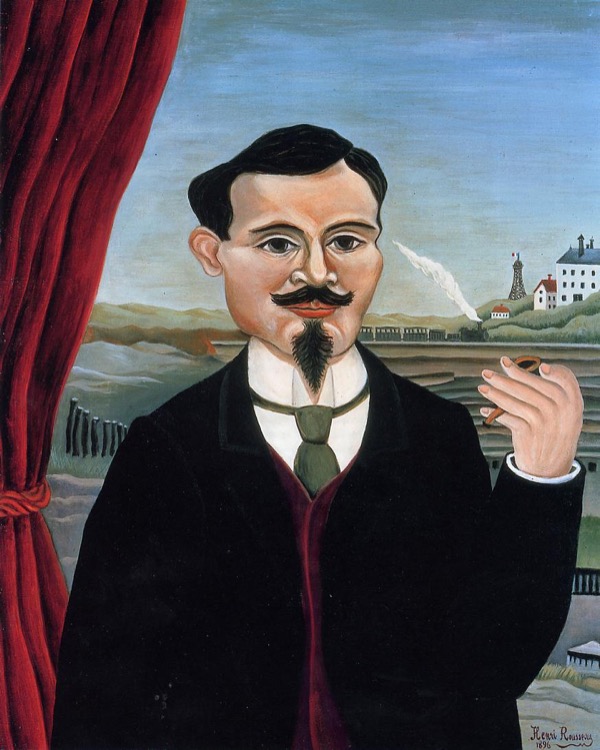
Léon-Paul Fargue, by Henri Rousseau (1896)
In the “Air du poète,” the poet makes love to a Papuan and then wishes the person wasn’t Papuan. Satie provides a pentatonic melody that suggests the exotic setting, and it also lends a bit of irony to the gravitas of the text and the stammering poet.
Fargue wrote the poem “Chanson du chat”, the Cat’s song, in honour of his obese cat Potasson. The name was a hit, and all his friends jokingly nicknamed themselves after the animal. In response, Satie writes a cabaret-style parody using music from a traditional French children’s song.
Beyond the Eccentric Label
Satie exerted an important influence on Debussy, Ravel, and the composers of Les Six during his life. He was predictably vilified after his death, but by the 1960s, he had been restored to cult status by figures like John Cage.
During the mid-20th century, scholars began to reassess his output, a trend that was consolidated in the later decades of the 20th century. Scholars like Robert Orledge and Caroline Potter applied musicological tools to provide detailed analytical and contextual insights into his music.
As we found in his melodies, Satie emerged not merely as an amusing eccentric on the fringes of French music. Rather, his deceptively simple works conceal a musical imagination that remains provocative and elusive.
For more of the best in classical music, sign up for our E-Newsletter
Erik Satie: Ludions, “No. 5. Chanson du chat” (arr. Habermann) (Trio Satie)