If you are looking for perhaps the most famous river journey ever sounded in music, look no further than Bedřich Smetana’s Vltava (The Moldau). The idea of turning the Vltava River into a tone poem occurred to Smetana in August 1867 while travelling with a friend to the western edge of Bohemia.
That friend later remembered that Smetana looked around at the enchantingly lovely countryside, at the confluence of the streams. He followed the Otava, accompanying it in spirit to the spot where it joins the Vltava, and in him sounded the first chord of the two motives which intertwine and increase and later grow and swell into a mighty melodic stream.
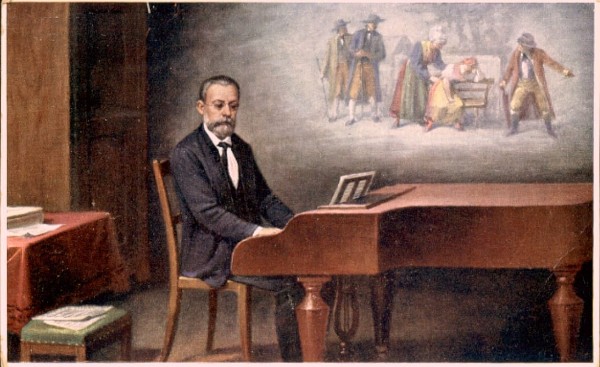
Bedřich Smetana
By the time Vltava premiered in 1875, Smetana had lost his hearing completely. And this wondrous river is not a stand-alone work but part of a cycle titled Má vlast (My Country). To celebrate Smetana’s birthday on 2 March 1824, let’s have a listen to the other, maybe not so well-known parts of that cycle.
Bedřich Smetana: Má vlast, “Šárka”
Šárka
Let’s get started with the shortest of the cycle’s six parts, called Šárka. This poem does not depict a landscape but the legend of the maiden Šárka. She was a Bohemian Amazon who led a rebellion against the rule of men.
She made use of her extraordinary beauty as a weapon in her fight for outright female supremacy. To be sure, her motivation was not of the noblest kind, either.
Luckily, we have Smetana actually describing this tone poem to a friend. In the beginning is the musical depiction of the maiden Šárka, enraged by her lover’s infidelity and swearing vengeance on the entire male race, as her Amazon companions pledge their support.
From afar, the arrival of armed men led by Ctirad is heard, on their way to the place they intend to conquer and punish the rebel maidens. In the distance, Ctirad hears a girl’s cries for help, and on investigating, he finds Šárka, who has been tied to a tree by her accomplices as a ruse to entrap him.
Šárka’s beauty so inflames Ctirad that he falls in love with her as he sets her free. She then offers him and his men a refreshing drink, but it is a potion which first intoxicates them and then quickly puts them to sleep. Šárka then sounds her hunting horn, and her Amazon warriors rush from their hiding places amid the rocks to commit their bloody deed.
The horror of the pitiless slaughter and the passionate fury of Šárka in satisfying her thirst for vengeance constitutes the finale of this composition.
Did you notice that some passages almost anticipate the sound world of Richard Strauss? And then there is the warriors’ drunkenness depicted in a distorted polka, and their snoring is heard in the contrabassoon. And just listen to the ominous tremolandos and dark colours of the woodwinds to musically evoke the foreboding of destruction.
Bedřich Smetana: Má vlast, “Tábor”
Tábor
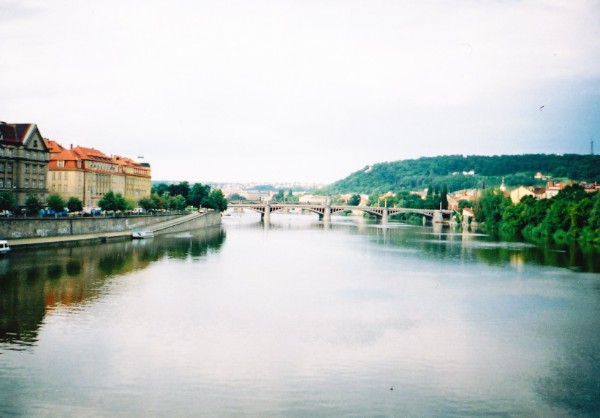
Vltava in 2001
Smetana originally conceived Má vlast as a series of four symphonic poems. Overjoyed by the reception of the original tetralogy, however, Smetana decided to add two additional movements.
One of these additional movements depicts the town of Tábor, an important location in Czech history and folklore. The history starts in 1415 when the Bohemian patriot and religious reformer Jan Hus was burned at the stake for heresy. His followers then made Tábor their stronghold.
They called themselves Hussites or Táborites, and the hymn “Ye who are warriors of God” became a rallying cry for Czech freedom. Smetana had used this chorale earlier, as did Dvořák and later Karel Husa.
Smetana wrote of Tábor, “The whole composition is based on this majestic chorale. It was undoubtedly in the town of Tábor, the seat of the Hussites, that this stirring hymn resounded most powerfully and most frequently. The piece depicts the strong will to win battles and the dogged perseverance of the Táborites, and it is on this level that the poem ends. It cannot be analysed in detail, because it expresses the glory and renown of the Hussite warriors.”
Bedřich Smetana: Má vlast, “Blaník”
Blaník
The final tone poem in this cycle is called “Blaník,” and it is named after a mountain. According to Smetana, Blaník begins, where the preceding Tábor ends. Following their eventual defeat, the Hussite heroes took refuge in the Blaník Mountain where, in heavy slumber, they wait for the moment when they will be called to the aid of their country.
This follows the 15th-century legend that Good King Wenceslas and his knights did not die, but fell asleep inside Mount Blaník, a range located in southern Bohemia. For Smetana, it was not Wenceslas but Jan Hus who sleeps within the sacred mountains, waiting to be summoned to do great deeds.
No surprise then, that the Táborite chorale is used as the basic foundation of this piece. Smetana tells us that it is on the basis of this melody that the resurrection of the Czech nation, its future happiness and glory, will develop. With this victorious hymn, written in the form of a march, the composition ends, and with it the whole cycle of Má vlast.
As a brief intermezzo we hear a short idyll, a description of the Blaník region where a little shepherd boy plays a pipe while the echo gently floats back to him. If you counted correctly, there are at least five march episodes and three intermezzos in this tone poem.
Bedřich Smetana: Má vlast, “Vyšehrad”
Vyšehrad
I hope you will forgive me for jumping around in the cycle, but each of the tone poems paints such a marvellous picture that can stand on its own. And by the way, the first four segments of the cycle were premiered individually.
So now, we are moving to the first poem titled “Vyšehrad” or “The High Castle.” It describes the castle in Prague, which was the seat of the earliest Czech kings. The castle towers over Prague, as it stands on a rock rising steeply from the Vltava River.
Smetana wrote of Vyšehrad, “the harps of the bards begin; a bard sings of the events that have taken place on Vyšehrad, of the glory, the splendour, the tournaments and battles, and finally of its downfall and ruin.”
The composition ends on an elegiac note. The musical theme is actually taken from the second act of Smetana’s opera Libuše. Apparently, Smetana liked to point out that the opening notes of “Vyšehrad” are the initials of his own name.
Bedřich Smetana: Má vlast, “From Bohemian Fields and Groves”
From Bohemian Fields and Groves
Originally, this tone poem was written to be the final of Má vlast, but as we heard earlier, Smetana added two further musical pictures. Contrary to all the other tone poems, this selection tells no real story.
It basically is a depiction of the beauty of the Czech countryside and its people, and Smetana suggested that it portrays the first strong impression of arriving in the country, the sight of a simple country girl walking through the fields, noon on a summer’s day, with the shade of the woods, the singing of birds, and a final harvest and festival in peasant celebration.
Musically, it is a further exploration of the Bohemian countryside in a broadly structured account of nature with reminiscences of local folk music.
It is a symphonic poem of thoughts and feelings, as intimate songs evoke the sweeping surroundings. All of the groves and blossoming fields sing their melodies, sometimes cheerfully and then with great melancholy.
The deep dark forests speak in the solo passages of the horn, and we can hear the sunny and fertile low-lying plains along the Elbe River. It is a wonderful journey of the heart, and Smetana lets your imagination fill in the details.
Vltava
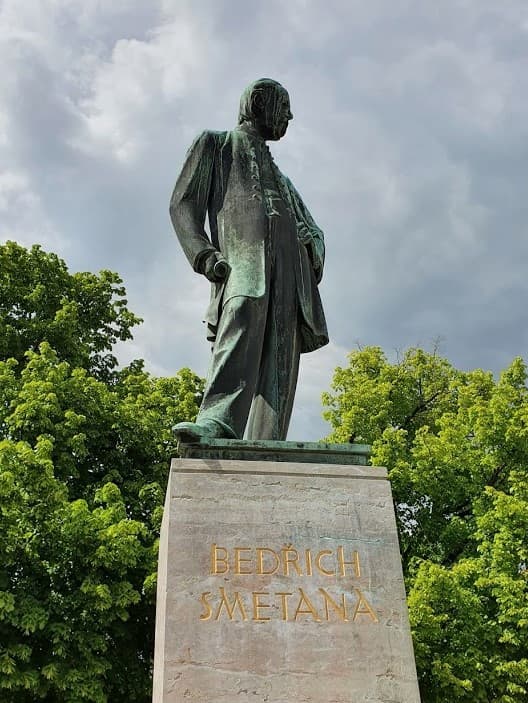
Statue of Smetana in Litomyšl
You all know the famous river journey by heart, so I won’t give you a blow-by-blow description. But I will tell you that the premiere was conducted by Adolf Čech. On 4 April 1875, he took to the podium with the Orchestra of the Prague Provisional Theatre in the musical depiction of Bohemia’s longest river.
The work was rapturously received by audiences and critics alike, and like Beethoven, Smetana had actually composed most of this popular work after losing his hearing completely. In 1874, he noticed a substantial hearing loss and wrote to the management of the Provisional Theatre.
“It was in July… that I noticed that in one of my ears the notes in the higher octaves were pitched differently than in the other and that at times I had a tingling feeling in my ears and heard a noise as though I was standing by a mighty waterfall. My condition changed continuously up to the end of July when it became a permanent state of affairs, and it was accompanied by spells of giddiness so that I staggered to and fro and could walk straight only with the greatest concentration.”
Most of the “My Country” cycle was thus composed in deafening silence. But Smetana was aware of the role some of his works had begun to fill. He writes in 1882, “I must seek to keep that honourable and glorious position which my compositions have gained for me in my nation and in my country. According to my merits and according to my efforts, I am a Czech composer and the creator of the exclusively Czech style in the branches of dramatic and symphonic music.”
In Má vlast, Smetana provides a glittering panorama of crumbling castles, warriors who sleep inside mountains, and two tiny springs that become a river of legend, pastoral beauty, and national pride.
It’s a specific love letter that Smetana wrote to the Bohemian landscape, its people and its legends. And it’s a love letter written from a place remembered and reimagined.
For more of the best in classical music, sign up for our E-Newsletter