At the ripe old age of twenty-one, Edward Elgar (1857-1934) was still selling musical wares at his father’s shop in the High Street of Worcester. And in his spare time, he was engaged in all manners of local amateur music-making.
This included playing the organ at St. George’s Roman Catholic Church, and he also had an appointment as conductor of the attendant’s band at the Worcester and County Lunatic Asylum from 1879.
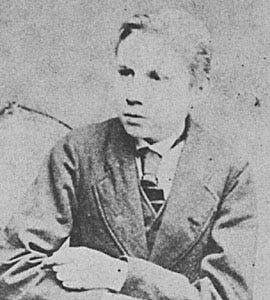
The young Edward Elgar
At the time, he was honing his compositional craft and trying his hand at a variety of musical works. Most of these pieces were written for his own use and the participation of close friends.
As we commemorate Edward Elgar’s passing on 23 February, I thought it might be fun to return to the years 1878/79 and look at the compositions Elgar cooked up during that particular period.
Edward Elgar: 6 Promenades
Six Promenades
Elgar composed the Six Promenades in 1878 for the unusual combination of two flutes, oboe, clarinet, and bassoon. These charming musical miniatures were written around the time when the composer would spend a long day journeying to London and back for a rehearsal and afternoon concert at Crystal Palace.
Elgar certainly had a fondness for whimsical subtitles, and while the opening Promenade leisurely unwinds in an atmosphere of relaxed country life, the Promenade Nr. 2 is subtitled “Madame Taussaud’s.” It’s not too far-fetched to consider this delightful morsel a souvenir of a London visit.
Promenade Nr. 3 unfolds with youthful exuberance, while Promenade Nr. 5 contains some subtle experimentation in harmony and meter. The subtitles for “Somniferous” and “Hell and Tommy” for the concluding Promenade remain enigmatic, but the entire set provides glimpses of Elgar’s growing prowess as a composer.
Edward Elgar: Harmony Music No. 1 (Athena Ensemble, Ensemble)
Harmony Music
In 1878/79, Elgar got four friends together to perform music among themselves. The two flute players, Hubert Leicester and Frank Exton, were highly capable musicians. As was Elgar’s younger brother Frank on the oboe.
Hubert Leicester’s brother William, however, needed simple clarinet parts. Elgar himself was a proficient violinist, but he taught himself to play the bassoon to round out the quintet.
Elgar wrote a number of larger works for this particular group and called them “Harmony Music.” These quintets were also sometimes referred to as “Shed” music from the place where the players rehearsed.
Jerrold Northrop Moore, the Elgar specialist and biographer, cites a memoir by the composer in which he recalls that the players met on Sunday afternoons, that they had a new piece, composed or arranged, to play every week, and that many of these were prepared in the organ loft at St George’s Roman Catholic church during the sermon, which used to take at least half an hour.
Edward Elgar: Harmony Music No. 5 (Athena Ensemble, Ensemble)
Cryptic Titles
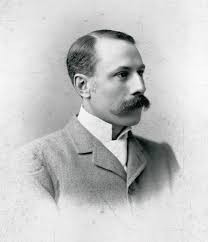
Edward Elgar
The Harmony Music No. 1 is a single-movement work completed on 4 April 1878. It is dedicated to the second flute player, Professor Exton. It’s all good-natured fun with Elgar taking the bassoon lead in the second subject area. It all finishes with a rather long coda that includes some contrapuntal niceties.
The Harmony Music No. 5, however, is the most extended of these works. Completed on 4 May 1879, it unfolds in four movements, the first carrying Elgar’s cryptic title “The Mission.”
A Menuetto and Trio is followed by an Andante to which Elgar gave the title “Noah’s Ark,” but only in his own bassoon part. A spirited rondo brings this piece to its rousing conclusion, all ending in a quiet coda.
Edward Elgar: 5 Intermezzos (Athena Ensemble, Ensemble)
Passing Musical Thoughts
While Elgar was working on the Harmony Music, he also drafted five short pieces that he titled Intermezzos. They are rather brief and fragmentary, almost like musical thoughts caught in passing. The longest of these Intermezzos barely lasts for 90 seconds.
Elgar might have written down ideas for which he could find no place in the longer works, and the harmonies are certainly more experimental.
Elgar again attached enigmatic subtitles to two of these miniatures. No. 2 bears the inscription “Mrs and Miss Howell,” while No. 3 is marked “Nancy,” as revealed in a recently discovered autograph manuscript. Whether these names refer to specific individuals, private jokes, or emotional associations remains unclear.
Edward Elgar: Adagio cantabile, “Mrs Winslow’s Soothing Syrup” (Athena Ensemble, Ensemble)
Four Dances
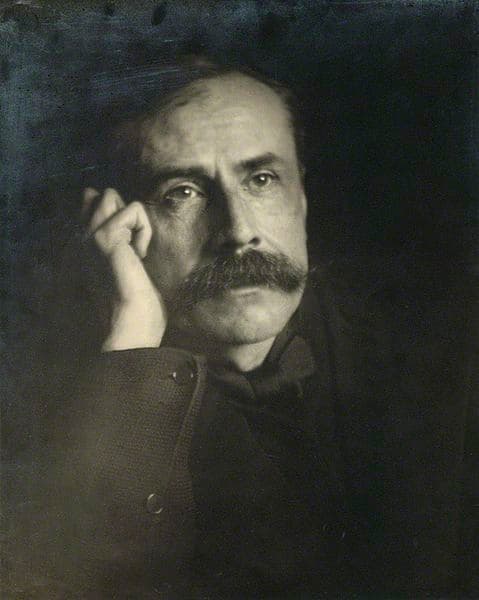
Charles Frederick Grindrod: Edward Elgar, ca. 1903
This must have been a time of great joy for Elgar, as he was able to immediately hear the results of his studies. His Four Dances, each an exercise in an eighteenth-century form, were composed in April 1879.
The Gavotte, “Alphonsa” was named after the clarinettist’s sister, and Elgar returned to this early Saraband fifty years later, while sketching ideas for his unfinished opera The Spanish Lady.
The Andante con variazioni “Evesham Andante” is dedicated to Hubert Leicester and takes the name of a nearby town where Elgar sometimes played as a violinist. And then there is “Mrs Winslow’s Soothing Syrup,” a miniature inspired by a patented medicine.
Edward Elgar: Dances for Worcester City and County Pauper Lunatic Asylum, Powick: Die junge Kokette (Innovation Chamber Ensemble, Ensemble; Barry Collett, cond.)
Powick Appointment
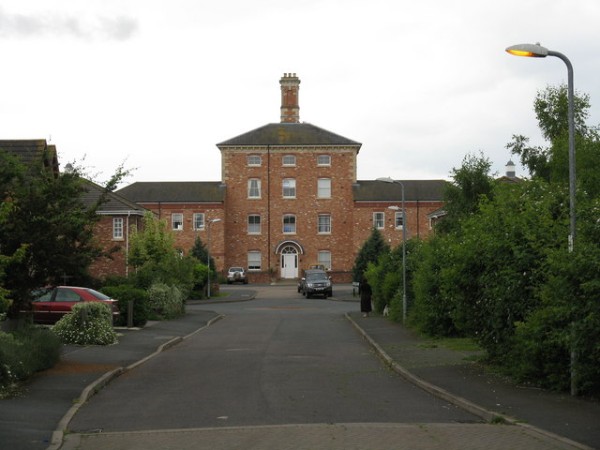
The Powick Hospital (previously Worcester County Pauper and Lunatic Asylum)
In January 1879, Edward Elgar received an official appointment. He became Bandmaster at the Worcester County and City Pauper Lunatic Asylum in the nearby village of Powick.
The Asylum had opened in August of 1852, and from early on, music played a part in the rehabilitation of the patients. Elgar was responsible for a brass band, established only four years after the Asylum opened.
The therapeutic effects of the Band’s activities were described in a 1857 report. “The weekly amusements have been continued as heretofore, and with the same beneficial results.
No other means of recreation have been observed capable of realising a similar curative influence, and their value is enhanced by the large proportion of the Patients who can participate in them.” (Lyle, 2014)
Edward Elgar: Dances for Worcester City and County Pauper Lunatic Asylum, Powick: L’Assom[m]oir (Innovation Chamber Ensemble, Ensemble; Barry Collett, cond.)
Elgar at the Asylum
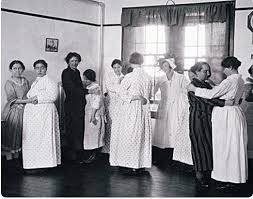
Dance Therapy, c. 1850
Elgar succeeded his former violin teacher, Frederick Spray, as Bandmaster, and actually held the position until late 1884. His responsibilities involved teaching and rehearsing the resident musicians, preparing music for performance, and composing dance pieces for the weekly Friday evenings.
The Band consisted of members of the Asylum staff and some of Elgar’s local
Worcester contacts. In the wind section, Elgar counted on piccolo, flute, clarinet, two cornets, euphonium, and a bass tuba.
In the strings, the band numbered up to eight violins, divided into two groups, and occasional parts for viola, cello, and double bass. The band, at full strength, comprised as many as nineteen players, with the piano anchoring the ensemble.
Edward Elgar: Dances for Worcester City and County Pauper Lunatic Asylum, Powick: La Brunette (Innovation Chamber Ensemble, Ensemble; Barry Collett, cond.)
Dances at Powick
To get the job at Powick, Elgar apparently had to submit an audition piece, a re-scoring of a dance which he had already composed for flute and string quartet. Once appointed, Elgar was certainly dealing with an eccentric orchestra, and the music he wrote for them seems to have been often very demanding of his players.
During his tenure, Elgar composed four sets of Quadrilles and a set of Lancers, each consisting of five dances. And we also need to add five Polkas to that list.
There is speculation that a good many other dances might have been lost, and that he used well-known nursery rhymes and other tunes as well. To be sure, the surviving dances have evocative titles. We find “The Young Flirt,” dedicated to Miss Jessie Holloway, daughter of the Asylum Engineer, and the pianist for the entertainments.
We also find L’Assomoir, with the misspelt title originating in a novel by Émile Zola, and the last set of quadrilles from 1879 is titled “La Brunette,” and dedicated to the Clerk of the Asylum, George Jenkins.
Edward Elgar: Romance, Op. 1 (Marat Bisengaliev, violin; Benjamin Frith, piano)
Violin and Romance
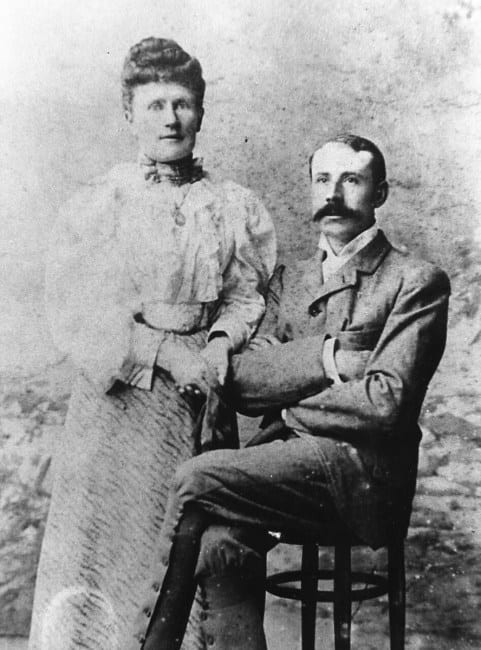
Caroline Alice Roberts and Edward Elgar
While Elgar was busily writing dance music for the Asylum, let’s not forget that his violin was never far away. He tried his hand at a violin sonata in 1877 and started another ten years later, yet both of these works remained unfinished.
We have already met Frederick Spray, Elgar’s first proper violin teacher. Edward made great progress and soon found himself playing in the second violins for the Worcester Glee Club.
In 1876, Elgar began teaching the violin, and by August 1877, he travelled to London for his first lessons with Adolphe Pollitzer. And he began composing solo studies, and the five Etudes caractéristiques date from 1878.
Elgar would make his living from playing and teaching, but he was also looking to make his breakthrough as a published composer. Pollitzer approached the London office of the German publisher B. Schotts Söhne with a “Romance in E minor.” Elgar had composed the piece in 1878, and he now handed it over for “One Shilling & 20 Gratis copies.”
The Romance appeared as Elgar’s Op. 1, and it was dedicated to Oswin Grainger, who played alongside Elgar in the Worcester orchestras. And wouldn’t you know it, in September 1888, Elgar wrote the work that became the biggest popular success of his life.
“Liebesgruss,” a love greeting, was written to celebrate his engagement to Caroline Alice Roberts. The publisher Schott actually preferred the title in French, and it became a resounding success as “Salut d’amour,” just a couple of years later.
For more of the best in classical music, sign up for our E-Newsletter