As Mozart approached his final years, his work finally started to achieve the promise of his early years. His operas gained an international audience, he was being commissioned to write for private clients, and his works were becoming of a complexity and seriousness required by his audience. This doesn’t mean, however, that he was financially flush. His last decade was spent free of the demands of patrons, but it meant that he was begging friends for money all the time.
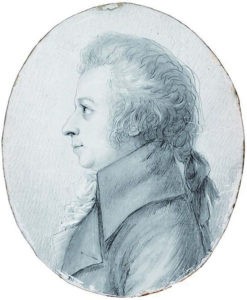
Dora: Mozart, 1789 (Salzburg: Mozarteum)
In the summer of 1788, Mozart wrote three symphonies, Nos. 39, 40, and 41, that we have come to see as his ultimate statement on the form. Unfortunately, Viennese taste had turned toward the galant style, which was very much not to his liking. Each of his last symphonies had a different character. If No. 39 was quite like chamber music, and No. 40 had closer links to opera, No. 41, with its synthesis of sonata form and fugue, and its ties to the older Baroque forms (overture, concerto, and fugue), still ended up as a symphony that only Mozart could have imagined.
The final symphony, No. 41 in C major, K. 551, is dated 10 August 1788; it is nicknamed Jupiter, probably by the impresario Johann Peter Salomon. It’s not known if Mozart ever heard a performance of the work, which, for Mozart, was unusual. It may have been written in preparation for a series of public concerts that Mozart wanted to set up, but which never happened. These ‘Concerts in the Casino’ were supposed to be held at a new casino in the Spiegelgasse, but the project does not seem to have been held. It was supposed to be held in June but was then delayed from month to month through the summer, into the fall, and then vanished.
The final movement of Symphony No. 41 is held to be one of Mozart’s finest works and the 4-note opening phrase was such a favourite of Mozart’s that he had used it already in 2 masses and Symphony No. 39. The Jupiter is often (mis-)named as the Symphony with the Fugal Finale but, despite its seemingly fugal opening, this is quickly abandoned for a more characteristic working out of the themes. He pulls together the themes from early movements of the symphony to create a beautifully syncretic finale that concludes in a magnificent climax.
As Mozart’s final symphony, the work has assumed special status, which is, of course, only applied retrospectively. Until his final illness, Mozart assumed he had many more years ahead of him! This is the longest symphony he wrote and reflects much of the musical world he was familiar with, including references to the music of both Michael and Joseph Haydn and some of Handel’s Alexander’s Feast, which Mozart was reorchestrating at the time, as a ‘contrapuntal tour-de-force’, the finale shows Mozart at his most playful. Starting with a simple 4-note theme, and developing four other themes, he plays them, flips them, plays them backwards, and takes them through many keys. At the end, Mozart takes the five themes he started with and combines them, culminating in all five themes being heard simultaneously. It’s a grand statement of ‘compositional virtuosity’ that only Mozart could pull off.
Wolfgang Amadeus Mozart: Symphony No. 41 in C Major, K. 551 “Jupiter” – IV. Molto allegro
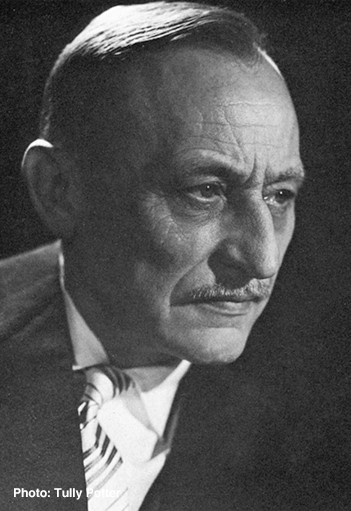
Jonel Perlea
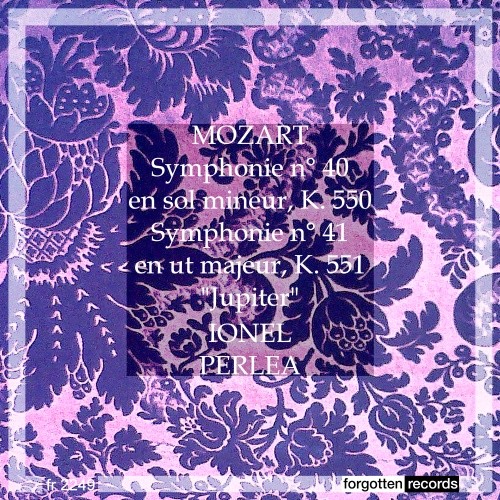
This recording was made in 1955 by the Bamberg Symphony Orchestra under the direction of Jonel Perlea. Romanian conductor Perlea (1900–1970) moved to Germany as a child and studied in Munich and Leipzig. He made his conducting debut in 1919 in Bucharest and then worked at the opera houses in Leipzig (1922–23) and Rostock (1923–25). His debut as an opera conductor occurred in 1927, when he directed Aida in Cluj, Romania. He conducted at the Budapest Opera in 1928 and was made their music director in 1934, serving until 1944. After WWII, his career was mostly in Italy, including La Scala (1947–1952) and he was a champion of Nino Rota’s new opera I due timidi. Up until that point, Rota had been known as a film composer, and this 1950 opera was first given only on the radio. A full staged version didn’t happen until 1952 in London. Perlea also conducted in Genoa, Florence, and for the 1949–1950 season, was guest conductor at the Metropolitan Opera in New York.
Performed by
Jonel Perlea
Bamberg Symphony Orchestra
Recorded in
1955
Official Website
For more of the best in classical music, sign up for our E-Newsletter