Pianist Adelina de Lara’s name has largely been forgotten today. However, there’s no reason it should be.
She spent over seven decades on the concert platform, made dozens of wonderful recordings, hobnobbed with many of the greatest musicians of multiple generations, and wrote some of the most vivid descriptions of Clara Schumann that historians have today.
Today, we’re looking at the life and times of Adelina de Lara.
Adelina de Lara’s Family
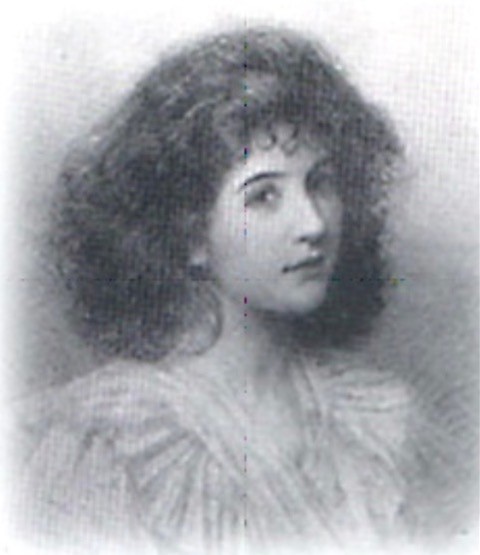
Adelina de Lara
Adelina de Lara was born Lottie Adelina Preston on 23 January 1872 in the town of Carlisle, Cumberland, eight miles south of Scotland, in North West England.
Both of her parents had been married before, and Adelina was their only child. However, her mother had two daughters from her first marriage, and her father had a son from his, so she grew up with older half-siblings.
Her mother, Anna, was a talented singer who had given up a promising career at sixteen to marry her first husband, who turned out to be an abusive alcoholic.
Her father was also musical; he played multiple instruments and had a fine voice, but worked as an engraver by day. One of her first memories was sitting on his knees while he played the harmonium.
When she was young, her father decided that Adelina was going to become a professional pianist. Accordingly, she was never sent to school and was made to play piano for hours every day. She had no toys.
Her mother protested the plan, but her father got his way.
Adelina de Lara plays Robert Schumann’s Arabeske, Op. 18
Adelina de Lara’s Early Training
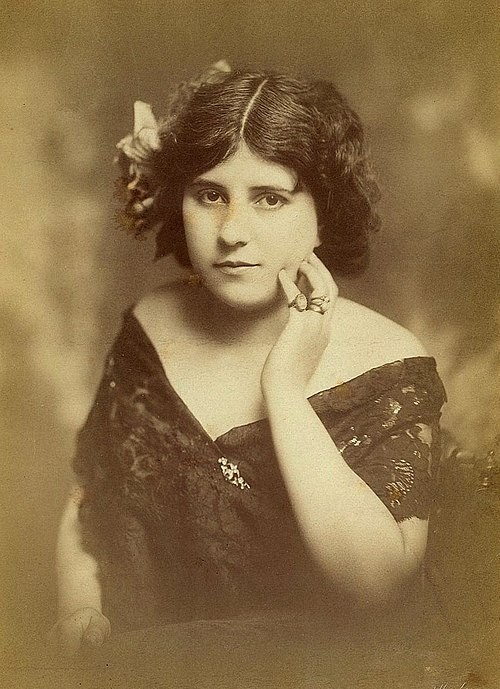
Adelina de Lara
During one visit to a local music shop, the owner suggested her family change her stage name to something less English, because he felt that musicians with English names had a harder time establishing a career.
They settled on using her mother’s maiden name, de Lara.
Soon afterwards, while still a little girl, she began a regular job playing at a waxworks museum in Liverpool.
Her performances there became increasingly popular. People were especially impressed by her extraordinary memory. Soon she began earning five pounds a week.
Over the next few years, she began touring across England to supplement her income, ultimately becoming the family breadwinner.
Childhood Tragedy
Unthinkable disaster struck the family in 1883, when her father died of pneumonia.
Adelina wasn’t able to take the week off, so she went to her father’s funeral and then was sent to play, as usual, at the waxworks gallery.
Her mother was so shocked by her husband’s death that she collapsed onto the sitting-room sofa and died of heart failure a week later.
Then, two weeks after their father’s death, Adelina’s eldest half-sister, Nellie, who was already mentally ill and emotionally unable to face the responsibility of caring for her siblings alone, drowned herself.
Adelina had to turn to her half-sister Pen, who stepped in to become her little sister’s manager and companion during her musical education.
The two surviving girls were eventually looked after by their aunts and a series of benefactors.
Adelina de Lara plays Robert Schumann’s Davidsbündlertänze
Meeting Fanny Davies
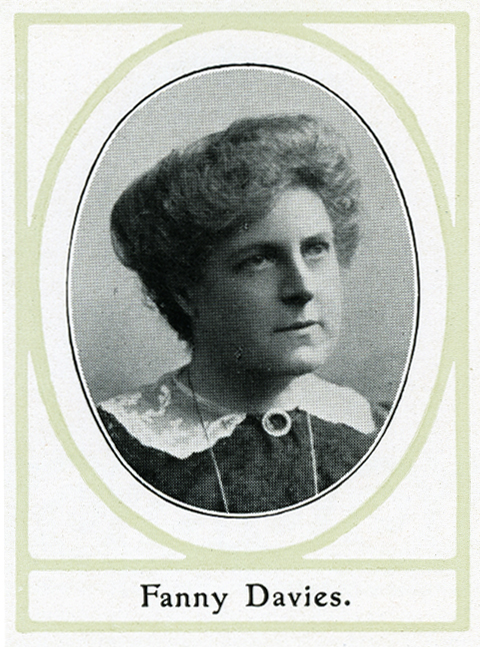
Fanny Davies, ca 1909
As a child, Adelina played for royalty, all of whom adored her.
She also played for Fanny Davies, a British pianist eleven years her senior, who had recently finished studying with the great Clara Schumann.
As soon as Adelina finished playing for her, Davies cried, “You must go to Madame Schumann!”
Davies began prepping Adelina for her audition with Clara Schumann, scheduled for the next time she stopped in England.
The audition, although nerve-racking for the teenager, was successful, and Schumann agreed to accept Adelina into her exclusive class at the Hoch Conservatory.
Studying with Clara Schumann in Frankfurt
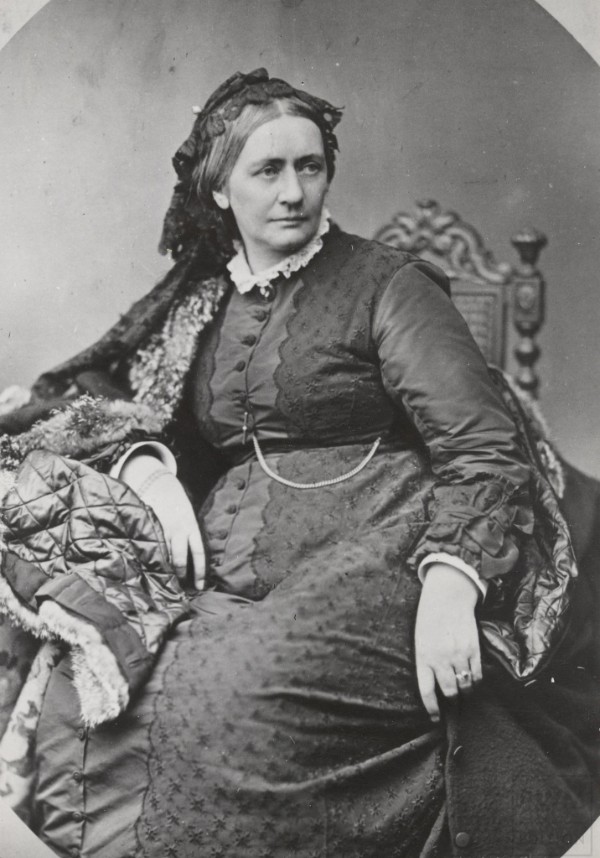
Clara Schumann
In 1886, at the age of fourteen, she moved to Frankfurt, Germany, to study at the Hoch Conservatory.
Adelina had an extraordinarily productive and happy time working in Schumann’s piano studio. She even had the opportunity to collaborate with Brahms when he dropped in on her lessons.
Today, her descriptions of working with Clara Schumann are some of the most colourful that we have.
She was originally only going to study in Frankfurt for one year, but one year turned into five.
Upon Clara Schumann’s recommendation, she made her debut as a finished artist in 1891 at St. James’s Hall in London, at the age of nineteen. Violinist Joseph Joachim was present and walked her to the piano, an act of kindness that vanquished her nerves.
Adelina de Lara reminisces about her time studying with Clara Schumann
Falling In Love (Multiple Times)
At sixteen, she became engaged to a British cellist named Bert Priestley, whom she met while studying in Frankfurt.
However, a couple of years later, she fell in love with Priestley’s cello teacher, the married Edward Howell, who was more than twice her age, and she broke off the engagement with Priestley.
She became a ward of the Howell family, moving in with them and giving them the earnings from her burgeoning career.
However, the Howells managed money badly. Edward turned to alcohol, and was devastated when Adelina drifted away emotionally…and became engaged to his son instead!
Ultimately, Adelina left the entire Howell family, choosing instead to marry an actor named Thomas Shipwright in 1896. She wasn’t particularly in love with him, but he was kind. Plus, he was about to embark on a tour of America, and she wanted to see the world.
She writes in her autobiography that many musical figures were disappointed in her for sacrificing her career to get married.
Adelina de Lara plays Beethoven’s 32 Variations in C-minor
Becoming a Mother, and Resuming Her Career
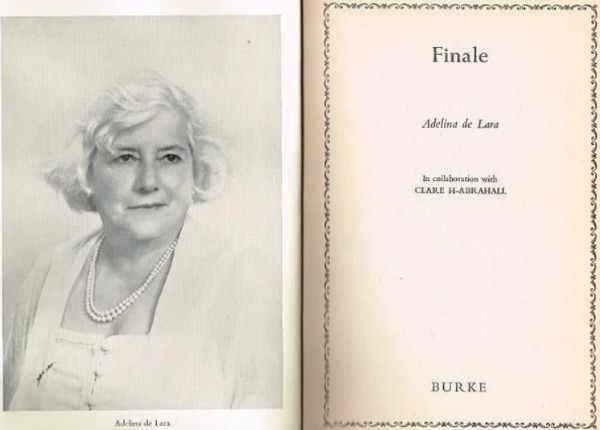
Adelina de Lara’s memoir title page
The couple’s travels were cut short when she found out she was pregnant during the American tour.
They left to return to Britain in January 1897, and she gave birth that spring to her first son, Thomas Alan Kingston. Her second child, Denis, was born in May 1898.
After the children were born, she decided that she wanted to continue her career. Throughout their boyhoods, she would spend long stretches of time away from them.
An Accidental Australian Tour
Soon after Denis’s birth, her husband dropped a bombshell: he was going to tour Australia…and he didn’t want Adelina to come with him.
She was devastated. Immediately after he left, she developed appendicitis and nearly died. However, she clawed her way back to health and, as soon as she could, boarded a ship to Australia, leaving her children behind so that she could reunite with Thomas.
Unfortunately, on the voyage, she fell passionately in love with a ship’s officer (although, in classic Adelina fashion, she forgot him soon enough after docking in Australia).
She reunited with Thomas and gave well-received performances across the continent, although he was frequently jealous of the rapturous reception she received.
The couple toured throughout Australia and Africa before returning to England.
Adelina de Lara plays Robert Schumann’s Piano Sonata No. 1
A Fateful Memory Slip, and Starting to Compose
She endured a traumatic professional setback in 1908, when she had a memory lapse in Birmingham during the third movement of the Schumann concerto.
She was so shaken by it that she did not perform another concerto by memory for twenty-seven years!
Soon after, she came down with double pneumonia and nearly died. She moved to France to recover.
A couple of years earlier, she had met with Enrico Caruso, who sang her song cycle, “The Rose of the World.” As a result, in France, she began pursuing her interest in composition more seriously.
Thomas’s Death, and A New Love
Tragically, Thomas returned from a five-year tour of Australia with a bad case of nervous exhaustion from overwork.
He came down with pneumonia and died in 1911, leaving Adelina a thirty-nine-year-old widow.
She made a living by composing and teaching. By her side was her husband’s friend, a man named Toby, who had been born, to use the terminology of her memoir, “a hermaphrodite.” He had been raised as a girl, but had surgery and lived life as a man.
Adelina fell in love with him before learning about his gender nonconformity. Her memoir is vague as to how their feelings eventually evolved, but Adelina and Toby remained intermittent partners for years to come, often living together as a couple.
World War I
During World War I, Adelina organised concerts to benefit wartime charities.
One of her special causes was the Blue Cross, a British charity focusing on animal welfare. The Blue Cross ultimately treated over 50,000 injured horses in France.
Both of her sons signed up to fight. At first, Alan became a member of the Kent Bicyclists’ Battalion. Denis became a pilot for the Royal Flying Corps. Fortunately, both survived.
Adelina de Lara playing Schumann’s The Elf, Op. 124, No.17
Between the Wars
Between the wars, Adelina became renowned for her frequent broadcasts on the BBC.
Composer Dame Ethel Smyth became a huge admirer and friend, advocating loudly for her and referring pupils to her so that she could support herself.
One of those pupils was Eileen Joyce, who became one of the most popular (and glamorous) pianists in Britain in the 1940s.
A Fateful Fall, and Returning to Composition
In the 1930s, Adelina suffered yet another health crisis: she slipped on the ice and fell, breaking her ankle and bruising her body. It took months to recover.
But just as she had before, she used her recovery time to focus on composing. She wrote in her memoir:
Out of my enforced idleness came one good thing. I taught myself, on Dame Ethel’s advice, how to score for string orchestra, but I would not touch woodwinds. For a long time, I had had ideas for a piano concerto; then one night, as I lay in bed unable to sleep, three complete movements were blazing in my head. It kept me awake all night, and early the next morning I started scoring. It was laborious work; I wrote it over and over again.
She performed her concerto in London, and it received positive reviews.
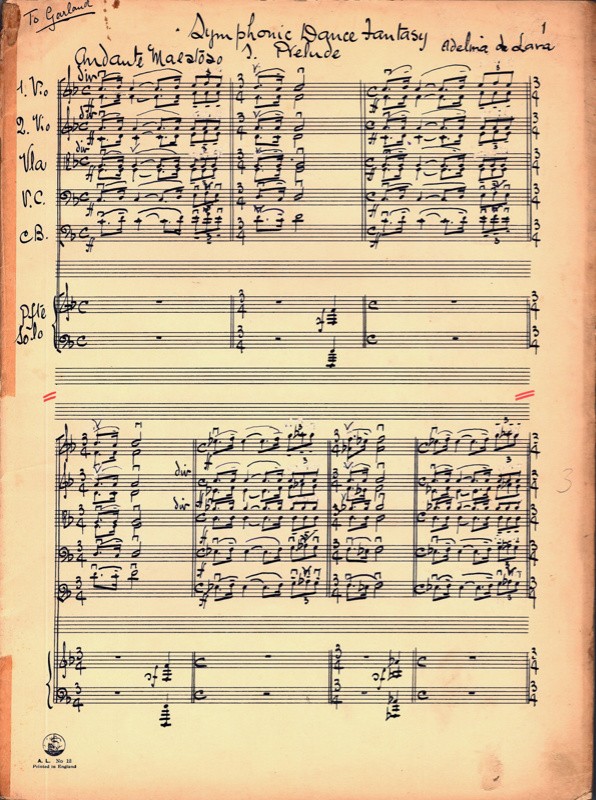
Over the course of her career, she wrote a variety of works, including two piano concertos, an orchestral suite called In the Forest, and even a symphony.
World War II
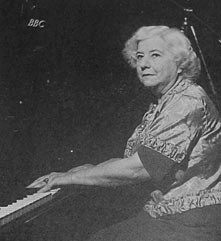
Adelina de Lara
When World War II began in 1939 (a development she termed a “nightmare”), she returned to her old wartime activity of organising benefit concerts, performing as often as she could.
During the destruction of the Blitz, she teamed up with fellow pianist Dame Myra Hess to perform a lunchtime concert at the National Gallery.
Nighttime performances were impossible during the war, as venues had to be blacked out to avoid detection by Nazi bombers.
Hess’s daytime concert series and Adelina’s appearances at the National Gallery were a culturally important constant for the British public during wartime and immediately after it, as London rebuilt.
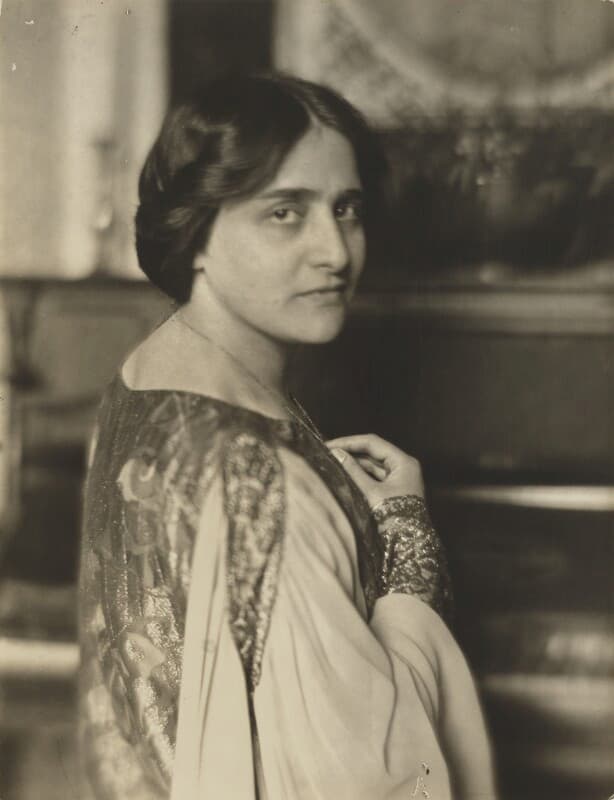
Myra Hess
For this January 1946 performance, she chose to play the original version of Schumann’s Variations for two pianos, which Clara Schumann had asked Adelina to play in London. Fifty years after it was made, she fulfilled her beloved teacher’s request.
Adelina de Lara and Albert Ferber play Robert Schumann’s Andante and Variations Op. 46
Later Career, and the De Lara Legacy
Adelina’s performing career continued well into her seventies and eighties. If anything, she became more energetic with age.
She decided that before she died, she wanted to record as many of Robert Schumann’s piano works as possible, which she did.
For her 82nd birthday in 1954, she performed a televised recital on the BBC. She made her final public appearance that summer at Wigmore Hall. For her final BBC broadcast, she chose to perform Schumann’s Kreisleriana.
Adelina de Lara plays Schumann “Kreisleriana” Op. 16
She also wrote an extraordinary autobiography titled Finale, which was published in 1955. It’s available to read for free on the Internet Archive.
She died in November 1961. She was almost ninety years old.
Adelina de Lara has slipped from the pages of music history, but with the renewed modern interest in Clara Schumann, hopefully, the life of one of her most colourful students will be remembered more frequently in the future!
For more of the best in classical music, sign up for our E-Newsletter