Last year, I had the pleasure of speaking with Lithuanian pianist Rasa Vitkauskaite, when she shared the personal story behind her album A Concert Piano Christmas at Boston Symphony Hall, a recording that blended artistry with memories of family and homeland. That conversation revealed her deep sensitivity to the ways music preserves identity and carries stories across time and distance. With the release of her latest project, Contrasts, Vitkauskaite extends that vision into chamber music, where themes of belonging, cultural dialogue, and artistic discovery come vividly alive.
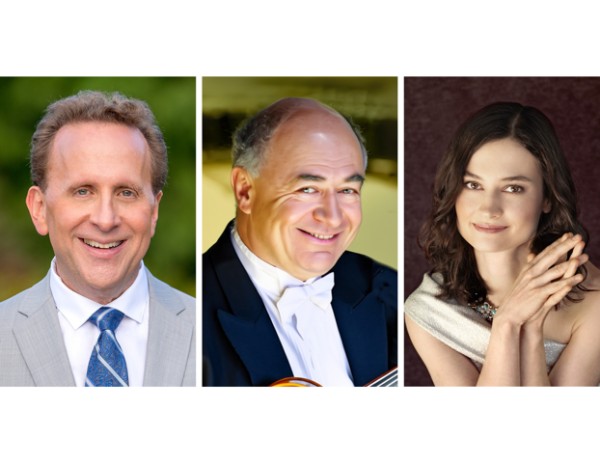
Jonathan Cohler, Ilya Kaler and Rasa Vitkauskaite
The album, recorded with longtime collaborators violinist Ilya Kaler and clarinetist Jonathan Cohler, brings together five works that define the clarinet–violin–piano trio repertoire. Charles Ives’s Largo, Khachaturian’s Trio, Bartók’s Contrasts, Stravinsky’s Suite from L’Histoire du Soldat, and Paul Schoenfield’s Klezmer Trio form what Cohler calls “the five pillars” of the genre. For Vitkauskaite, the choice of repertoire was both natural and deliberate. “We wanted to share what we see as the core of this ensemble’s literature. Some of these works, like the Schoenfield and the Ives, are not often recorded, and it felt important to bring our interpretations forward.”
Paul Schoenfield: Trio (“Klezmer”) for Clarinet, Violin and Piano: I. Freylakh
Although the pieces seem to emerge from very different worlds, Vitkauskaite is fascinated by their underlying connections. “At first glance, Schoenfield’s klezmer dances, Khachaturian’s Armenian roots, Bartók’s Hungarian folk melodies, and Stravinsky’s jagged modernism might appear unrelated. But once you listen closely, the threads between them are striking. The klezmer rhythms of Schoenfield resonate with Khachaturian’s folk idioms, and Bartók’s vitality echoes some of the patterns Stravinsky uses. These unexpected links create a cohesion that makes the program feel like a journey rather than a collection.”
Vitkauskaite describes the ensemble itself as perfectly suited to embody these dialogues between tradition and modernity. “The clarinet and violin are central to many folk traditions, but they are also refined classical instruments. Pair them with the piano, and you get an ensemble that can move fluidly between vernacular and concert hall, between dance and meditation. That flexibility is what allows these pieces to feel so alive.”
The collaboration with Kaler and Cohler grew out of years of shared performances and recordings, from Latin Journey to their recent Mendelssohn album. Vitkauskaite treasures the trust that underpins their work. “Ilya and Jonathan bring such depth and brilliance, and the leadership between us shifts constantly depending on the piece. What excites me most is the sense of discovery that continues even after years of playing together. In the studio, we would suddenly uncover a new phrase or connection, and those moments are unforgettable.”
Aram Khachaturian: Trio for Clarinet, Violin and Piano – Moderato
That sense of discovery was supported by Grammy-winning engineer Brad Michel, who captured the ensemble’s dynamic range at the Shalin Liu Performance Center in Rockport, Massachusetts. “Brad makes it effortless for us,” Vitkauskaite says. “We could focus entirely on being present in the music, knowing that every nuance was being preserved.”
For Vitkauskaite personally, Contrasts represents one of the most challenging and transformative projects of her career. “These are some of the most demanding works I’ve ever played,” she admits. “Schoenfield’s Klezmer Trio requires immense technical preparation—the piano writing is stunning but relentless. Stravinsky’s rhythmic complexity demands absolute ensemble precision, while Bartók’s combination of spontaneity and rigor tests you in every way. To play them with real freedom, you need to live inside the music until it becomes part of you. That process changes you as an artist.”
She points to Schoenfield’s Niggun as a particularly meaningful moment. “The Niggun begins as a meditation, then transforms into ecstatic dance. It’s the spiritual center of the piece, and it speaks to something larger—the transmission of culture, the transformation of memory into art. For me, that’s what this album is about. It’s not only about performance; it’s about how music carries identity forward.”
Igor Stravinsky: Suite from “L’Histoire du Soldat” – Tango – Valse – Rag
The release of Contrasts does not conclude Vitkauskaite’s journey but opens into new ones. With Kaler, she is recording the complete Beethoven Violin Sonatas, a monumental project set to culminate in a Carnegie Hall performance in 2026. With Cohler, she is preparing a new album of Brahms and Schumann works, and together they are launching a project of transcriptions that includes Cohler’s arrangement of Rachmaninoff’s Cello Sonata for clarinet and piano. “Each of these projects offers a new perspective,” she says. “They challenge me to grow, to see music in fresh ways.”
Looking at her recent work, from the personal reflection of A Concert Piano Christmas to the cultural dialogues of Contrasts, Vitkauskaite reveals a through-line in her artistry: a belief that music is both a mirror of the past and a living conversation with the present. “For me, this album is about more than just notes on a page,” she reflects. “It’s about who we are, where we come from, and how music carries those stories forward.”
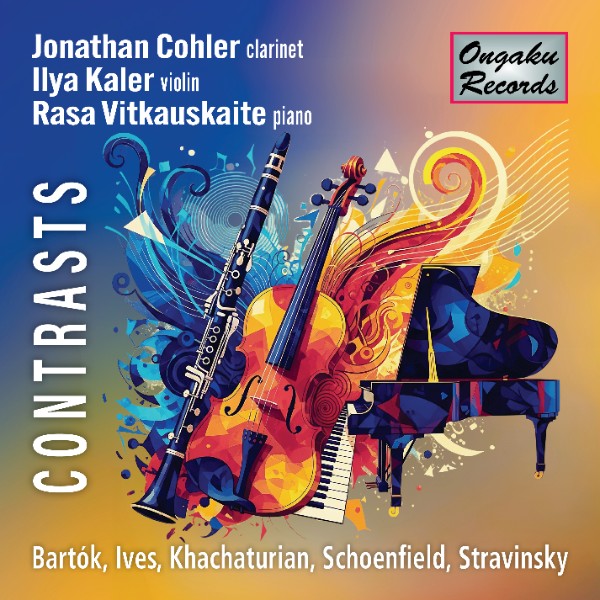
In Contrasts, she has helped shape an album that is both rooted and timeless, one that bridges folk traditions, modernist rigor, and deeply personal reflection. It stands as a testament not only to her artistry but to the enduring power of chamber music to carry stories forward, linking identity and memory across cultures and generations.
Release Date: August 20th
Recorded at the Shalin Liu Performance Center, Rockport, MA
Streaming & Download links: https://ongaku-records.com/Contrasts.html
album.link/Contrasts
For more of the best in classical music, sign up for our E-Newsletter