Dmitri Shostakovich is famous for his devastating music and decades-long struggle to assert his artistic autonomy in the face of a totalitarian government.
The important roles that his wife and two children played in his life and career are less known.
Today, we’re looking at the marriage of Dmitri Shostakovich and Nina Varzar, as well as the lives of their two children, Galina Shostakovich and Maxim Shostakovich.
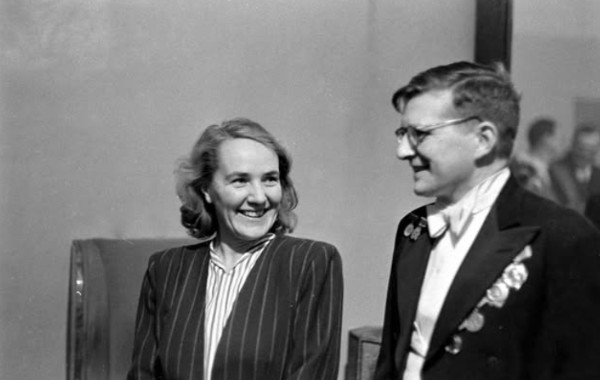
Shostakovich and his wife Nina
Dmitri Shostakovich and Nina Varzar Get Married
Dmitri Shostakovich and Nina Varzar met while on vacation in the summer of 1927.
She was eighteen years old and studying at the Physics and Mathematics Department at Leningrad University. He was a twenty-year-old composer whose first symphony had recently been a triumph.
Shostakovich’s first symphony
Neither of their families was keen on the idea of their getting married. Nina’s family thought she was too young and should graduate from college first, and Shostakovich’s doting mother didn’t want to share him with a wife.
Their relationship was open, or at least on-and-off again, but they always found their way back to each other. They finally married in May 1932.
That December, he finished an opera he called Lady Macbeth of the Mtsensk District. He dedicated it to Nina. Lady Macbeth opened to good reviews and enthusiastic audiences.
Dmitri Shostakovich: Lady Macbeth of Mzensk
An Affair, A Divorce, and a Pregnancy
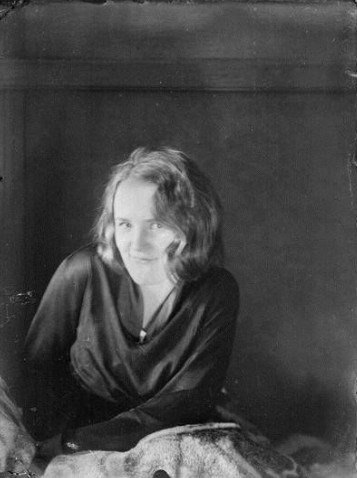
Dmitri Shostakovich’s wife Nina
In May 1934, Shostakovich fell in love with a translator named Elena Konstantinovskaya and began an affair with her. That August, Nina asked for a separation.
Shostakovich, who hated conflict and confrontation, dragged his feet while simultaneously appearing in public with Konstantinovskaya throughout 1935.
However, he did finally relent to Nina’s request, and a divorce certificate was issued, which he showed to a friend.
He decided he would end the messy situation, move from Leningrad to Moscow, and make a fresh start.
However, while picking up his belongings and saying goodbye to Nina, she surprised him with some life-changing news: she was pregnant.
He wrote a telegram to a friend, “Remaining in Leningrad. Nina pregnant. Remarried.”
Lady Macbeth and Shostakovich’s Denunciation
On 26 January 1936, Joseph Stalin came to see a production of Shostakovich’s Lady Macbeth of the Mtsensk District, the opera he’d dedicated to Nina.
Before the opera finished, Stalin and his entourage left the theater: a sign that the dictator was displeased with what he’d seen and heard.
When Shostakovich came onstage to take his bows, audiences noted that he was “white as a ghost.”
On 28 January, Pravda – the official newspaper of the Communist Party in the Soviet Union – came out with a devastating review that would haunt Shostakovich for the rest of his life.
It was called Muddle Instead of Music, and protested the opera’s “formalism” and vulgarity. It didn’t matter that other Soviet outlets had praised it: Stalin’s personal opinion outweighed everyone else’s.
It was a devastating blow to Shostakovich’s career. It came at an especially sensitive time, given that Nina was five months pregnant.
Their first child, Galina Shostakovich, was born in May 1936.
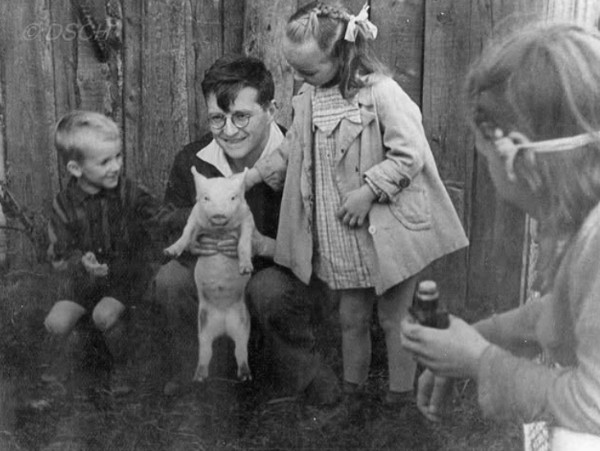
Dmitri Shostakovich and his children
Especially in the aftermath of the denouncement, Shostakovich appreciated having a stable home life.
In 1936, he wrote to his friend Ivan Sollertinsky, “There can be no question of a divorce from Nina. I have only now realised and fathomed what a remarkable woman she is, and how precious to me.”
In addition to being a physicist and mother, Nina also served as her husband’s secretary. She routinely told people who would telephone him and demand his attention that he was “gone for two months.”
Shostakovich and the Great Purge
During this time, Shostakovich continued composing. He watched with trepidation as friends and colleagues disappeared and were killed, seemingly at random.
In June 1937, Mikhail Tukhachevsky, a Soviet general sympathetic to Shostakovich, was executed. That November, his colleague, dramatist Adrian Piotrovsky, was executed. In January 1938, musicologist Nikolai Zhilyayev was executed. A month later, Boris Kornilov, a Soviet poet, met the same fate.
Amidst the Great Purge, in the late summer of 1937, Nina got pregnant again. At the same time, Shostakovich was putting the finishing touches on his fifth symphony, the work that would make or break his political reputation.
Fortunately, the Fifth was a great success and helped to restore Shostakovich’s fortunes. It premiered in November 1937.
His second child, Maxim Shostakovich, was born not long after, in May 1938.
Shostakovich’s Symphony No. 5 (1937)
The Shostakovich Family and World War II
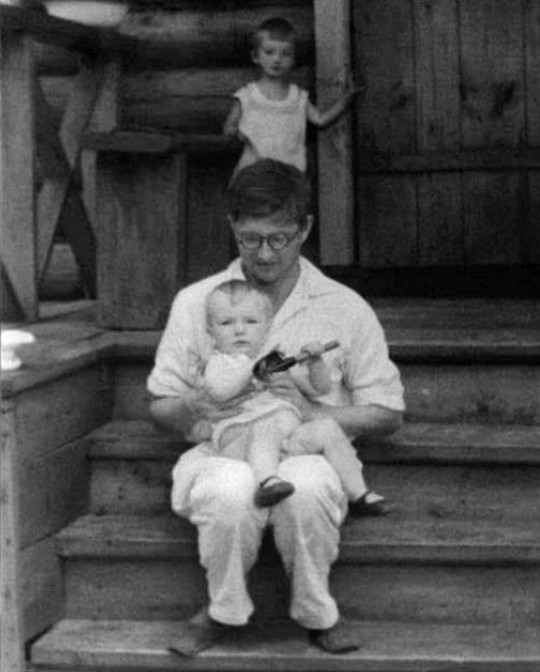
Dmitri Shostakovich and his children
At the dawn of World War II, Shostakovich, Nina, and their two small children lived in Leningrad.
He contributed to the war effort by writing his seventh symphony, which came to be known as the Leningrad Symphony. The powerful work would be used as a morale booster for the Allies.
Shostakovich’s Symphony No. 7 (1942)
Nina, Galina, and Maxim were in the audience for its spring 1942 premiere. Maxim would later remember the candy that his mother gave him so he’d stay still.
Due to his importance as a Soviet cultural figure, Shostakovich and his family were ultimately evacuated from Leningrad, saving them from the horrific Nazi siege of the city that lasted from 1941 to 1944.
Nina’s Death
In 1954, Nina went to the hospital. It was discovered that she had a tumour in her colon. She emerged from a surgery in a coma and never woke up. She was buried on 10 December 1954. Galina was eighteen and Maxim was sixteen.
Shostakovich had lost not only his wife but also a co-parent, a secretary, and his stabilising influence.
He asked his children what they thought about his proposing to the great composer Galina Ustvolskaya, who was thirty-five years old at the time and a former student. However, Ustvolskaya rejected his offer.
Ustvolskaya’s sixth piano sonata
What Happened to Galina Shostakovich?
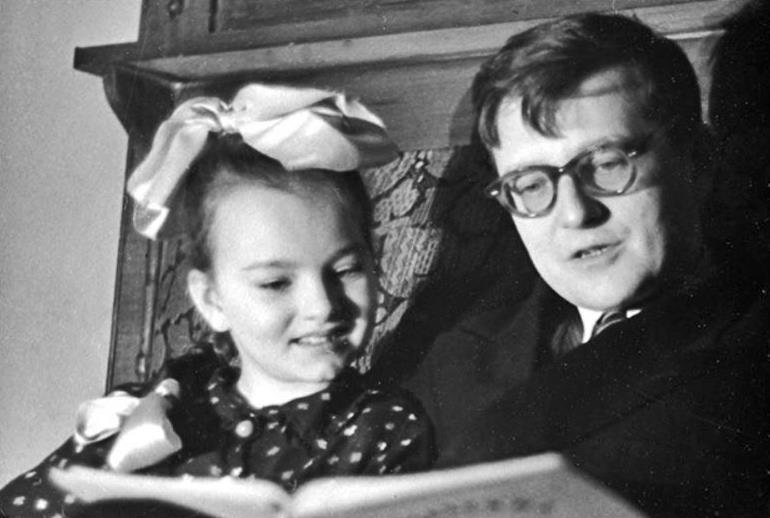
Dmitri Shostakovich with daughter Galina, 1940s © Ogonyok/Kommersant
Galina began learning the piano as a child.
Shostakovich supported her studies by composing his piano suite A Children’s Notebook, op. 69, which he wrote between 1944 and 1945 as the final months of the war raged on.
He would write a movement, give it to Galina to learn, and then, once she’d mastered it, move on to composing the next part.
Dmitri Shostakovich: Children’s Notebook Op.69
Galina attempted to give the premiere in Moscow in 1945 when she was nine, but she had a memory slip and couldn’t finish. Shostakovich came onstage and finished the performance himself.
Galina studied biology at the Moscow University. She graduated in 1959 and got married to cinematographer Yevgeniy Borisovich Chukovsky that same year.
What Happened to Maxim Shostakovich?
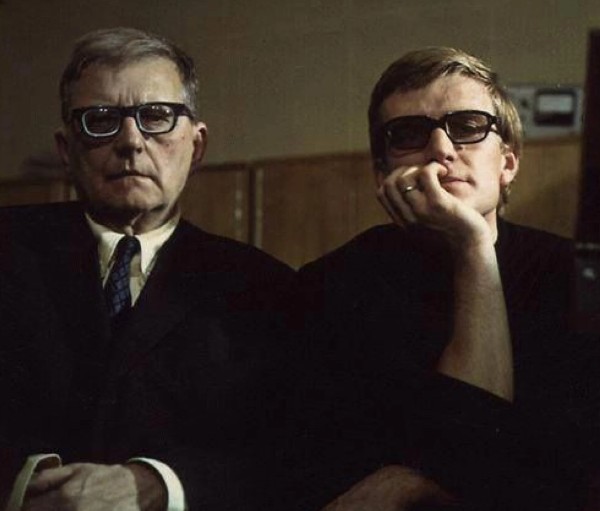
Dmitri Shostakovich and his son Maxim
Maxim was born in May 1938.
He shared a love of music with his father and decided at an early age that he wanted to be a professional musician.
However, he was less interested in composition and more intrigued by conducting. His father encouraged him, but suggested he needed to study piano first.
In November 1954, when he was sixteen, Maxim played his father’s Concertino for Two Pianos at the Moscow Conservatory. Three years later, he gave the premiere of Shostakovich’s second piano concerto at his Moscow Conservatory graduation concert.
He studied at the Moscow Conservatory and Leningrad Conservatory and pursued a successful international career as a conductor.
Maxim Shostakovich conducting his father’s fifth symphony
He defected to West Germany in 1981, but has since returned to St. Petersburg, saying he wants his family to be Russian.
He has spent his career advocating for the works of his father, providing a valuable personal connection to Dmitri’s music.
He told Robert Duffie in Chicago in 1992:
Biologically, I can recognise all kinds of fathers’ character, which I know very well, because I spent all my life with him. His kind of humour, his kind of anger, his kind of talking; for me, he will never die because when I conduct his music, I feel like he stays close to me and talks! I recognise his voice through his music.
Here’s a performance of the second movement of Dmitri Shostakovich’s second piano concerto, with Maxim Shostakovich conducting, and Maxim’s son Dmitri Jr. on piano.
For more of the best in classical music, sign up for our E-Newsletter
Shostakovich: Piano Concerto No. 2 – II. Andante
Read more about Shostakovich’s personal life and his three wives.