Charles Ives (1874–1954) used his chamber music as experimental studies, trying out his ideas with a small ensemble. In his Piano Trio, written between 1904 and 1911 and revised in 1914, he brought out musical ideas that dated from his time as a student at Yale.
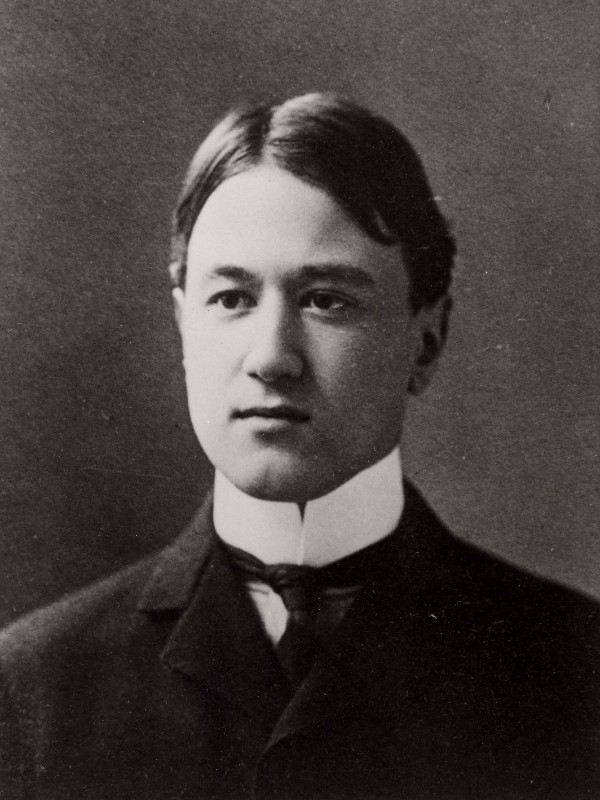
Ives’s graduation portrait from Yale University, c. June 1898
The first movement functions as a duet between the piano and the cello at its opening. Next follows a section for violin and piano, where one of the characteristics of the violin line is the requirement for double stops, i.e., playing two notes at the same time. And then, because he’s working with three instruments, he combines the music from the two duets – the characteristic dotted rhythms and triplets of the violin line continue and are supported by the simpler cello line, all ending on an A minor chord.
Charles Ives: Piano Trio – I. Moderato (Bekova Sisters, Ensemble)
In the second movement scherzo, Ives labels it with an acronym: TSIAJ, meaning This Scherzo is a Joke. It was also variously subtitled in drafts as ‘Holding Your Own’ and ‘Medley on the Campus Fence’. Ives was thinking back to his days at Yale and included some 25 melodies (not all of which have been identified) into the movement.
The work opens with a substantial quotation of the song from the Delta Kappa Epsilon fraternity, ‘A Band of Brothers in DKE’. Other songs include ‘My Old Kentucky Home’, ‘Sailor’s Hornpipe’, ‘The Campbells Are Coming’, ‘Long, Long Ago’, ‘Hold the Fort’, and the hymn ‘There Is a Fountain Filled with Blood’. One melody, ‘Reeves’s 2nd Reg. Quickstep’, was played at Yale Games. ‘Marching Through Georgia’, ‘In the Sweet By and By’, ‘Reuben and Rachel’, and songs from Yale’s secret societies all make an appearance. These songs may not be as you remember because Ives has altered them in every direction: rhythm, pitch, and harmony.
Charles Ives: Piano Trio – II. TSIAJ: Presto (Bekova Sisters, Ensemble)
Even as early as 1904, Ives was creating his polytonal world in his music that reflected the music he heard around him. Fraternity men gathered around the old fence aren’t going to be singing anything correctly except, perhaps, the words. Melodies wander or are misremembered, rhythms go awry, and harmony will be skewed by all the different singers. Ives didn’t try to straighten it out but gave us the world he heard.
The final movement seems to smooth out all the imperfections of the earlier movements. Starting with an opening of perfect fifths, the melody is taken up by the cello with a descending figure. A second theme, based on dialogues between the piano and the strings, follows. A section of canon follows for the violin and cello, culminating in a climax based on the perfect fifths that opened this movement. Now those fifths lead to his last quotation of the work, the hymn ‘Rock of Ages’, that’s the center of the Adagio cantabile close.
Charles Ives: Piano Trio – III. Moderato con moto (Bekova Sisters, Ensemble)
Ives had started work on the Piano Trio in 1904, just 6 years after he graduated from Yale, when its memories were still quite strong. He worked on the piece until 1911 and then, after setting it aside, revised it again in 1914.
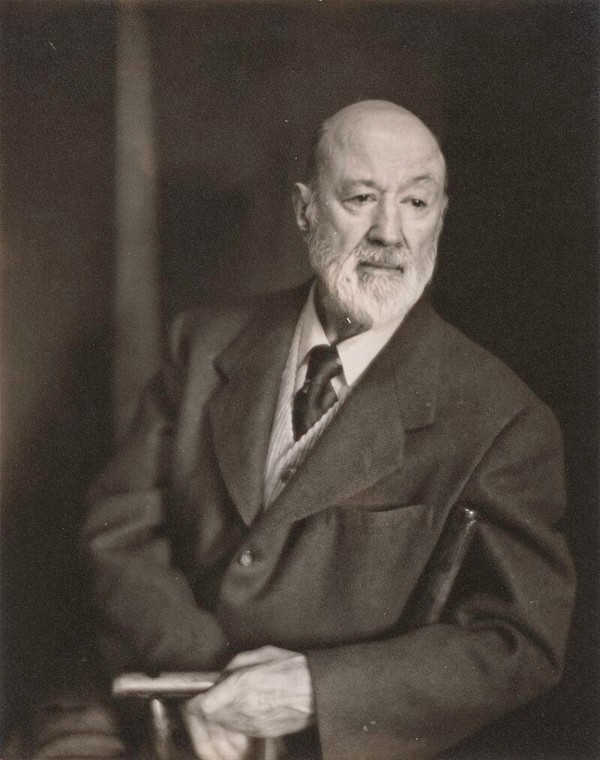
Clara Sipprell: Charles Edward Ives, ca 1947 (Washington, DC: National Portrait Gallery)
The first public performance wasn’t until 1948, and John Wolaver, the pianist of the Baldwin-Wallace College Faculty Trio that gave the premiere, wrote to Ives’ wife, Harmony, to see if there were any notes about the work. She wrote back to him that there had been a private performance around 1918 in New York, and ‘there was a copy of the program notes, but we can’t find them…the Trio was, in a general way, a kind of reflection or impression of his college days on the Campus now 50 years ago. The 1st movement recalled a rather short but serious talk, to those on the Yale fence, by an old professor of Philosophy-the 2nd, the games and antics by the Students on the Campus, on a Holiday afternoon, and some of the tunes and songs of those days were partly suggested in this movement, sometimes in a rough way. The last movement was partly a remembrance of a Sunday service on the campus, Dwight Hall, which ended near the ‘Rock of Ages’!’
The Piano Trio has become a unique part of the genre’s repertoire, being an experiment on the part of Ives that has succeeded in capturing many advocates.
For more of the best in classical music, sign up for our E-Newsletter