The great English writer Jane Austen (1775–1817) only completed six novels, but they were novels that are not just stories but telling and pointed commentary on English landed gentry at the end of the 18th century. The definition of people by their income is quite shocking today, but in a mercantile society, it was the only measure of success.
‘It is a truth universally acknowledged, that a single man in possession of a good fortune must be in want of a wife’. And so, Austen’s immortal Pride and Prejudice launches off with the statement that will work its way through to the happy ending of Elizabeth Bennet and Mr. Darcy.
Music is important in Jane Austen’s world of home dances, home music-making, and, gasp, balls! Luckily, the family music books of the Austen family are available to be consulted and in them we find a wealth of Regency era music.
What was the music situation at the time? Haydn was better known in London than Mozart, the composer/pianist Ignaz Pleyel was a favourite, as was the composer J.L. Dussek.
This minuet from Dussek’s Piano Sonata in E flat major, here played on an 1815 piano by the Viennese maker Joseph Brodmann, is the kind of work that would have played in the Austen household. They also had a piano from this era.
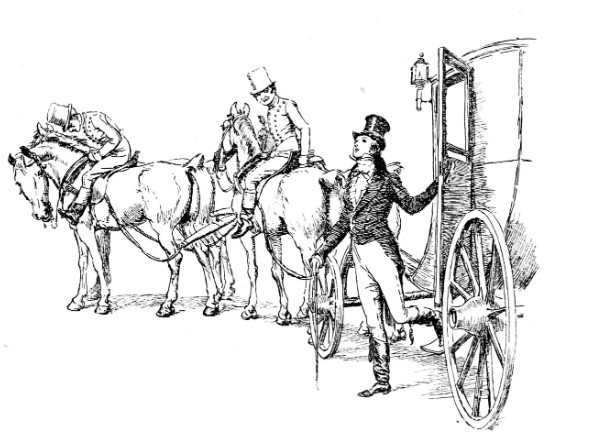
Jane Austen: Pride and Prejudice, The Arrival of Mr Bingley, illustration by George Allen, 1894, chapter 1
Jan Ladislav Dussek: Piano Sonata in E-Flat Major, Op. 44, “The Farewell” (excerpts) (performed on Joseph Brodmann piano, c. 1815) – III. Tempo di minuetto più tosto allegro (Alexei Lubimov, piano)
The Austen music books, digitized by Archive.org, is made up of 18 music books. Some have music copied by Jane herself.
In the book of keyboard music, copied between 1790 and 1810, there is music by composers from England, Italy, Scotland, Germany, and Austria; all composers who had made their name in London. Many are still known today, but others have faded from the scene. The music includes a sonata by Joseph Massinghi, a four-hand variation set on the Scottish ballad Old Robin Gray, and the overture to the opera Artaxerxes by Thomas Arne.
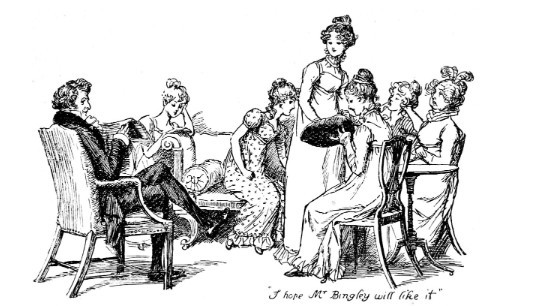
Jane Austen: Pride and Prejudice, The Bennet family, illustration by George Allen, 1894, chapter 1
Niccolò Piccinni: La buona figliuola maritata: Overture (Martin Souter, piano)
The volume of printed keyboard music includes sonatas by Steckel and Schobert, overtures by Mercadanti and Anfossi, and the Hallelujah Chorus and Coronation Anthem by Handel. One of the works is a four-hand arrangement of Haydn’s Scottish folksong Shepherds I have lost my love.
Franz Joseph Haydn: Shepherds, I have lost my love, Hob.XXXIa:93bis (Jamie MacDougall, tenor; Haydn Trio Eisenstadt, Ensemble)
The arrangement in the Austen Music books is for one harpsichord four-hands, or it may be performed on the pianoforte. The arrangements were by T. Billington.
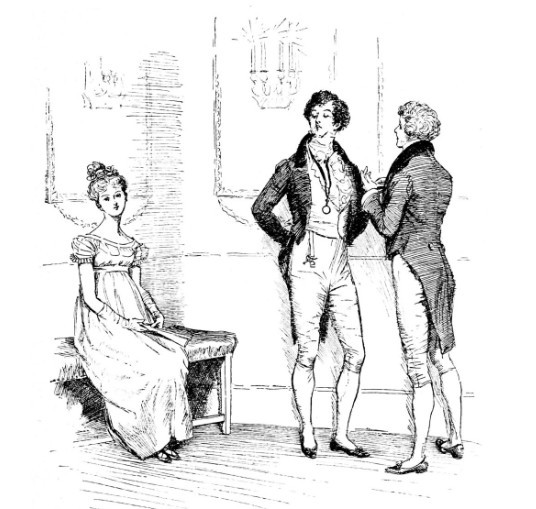
Jane Austen: Pride and Prejudice, Mr Darcy disdains Elizabeth to Mr Bingley, illustration by George Allen, 1894, chapter 3
The outstanding work in the keyboard volumes is the arrangement of Handel’s Hallelujah for four-hand piano or organ. The arrangement in the Austen book is by J. Marsh, published in London. Here’s it arranged by Carl Czerny
George Frideric Handel: Messiah, HWV 56 (arr. C. Czerny for piano 4 hands) (excerpts) – Part II: Hallelujah (Duo Pleyel, Ensemble)
The Austen family books include that most scandalous dance of the era, the waltz, but it is thought that the waltz, as performed in country dances, was considerably more sedate than the whirling Viennese variety.
Much of the music in the books is simple, designed for a truly amateur player who was performing for an uncritical audience.
Unknown Composer: The Nightingale (Le Concert Royal, Ensemble)
In Pride and Prejudice, much is made of the daughter Mary’s constant pushing to be at the keyboard, until her father has to caution her to let others perform (‘That will do extremely well, child. You have delighted us long enough. Let the other young ladies have time to exhibit’).
She’s condemned with faint praise by the author when her father asks her a question in Chapter 2: ‘Mary wished to say something very sensible but knew not how’.
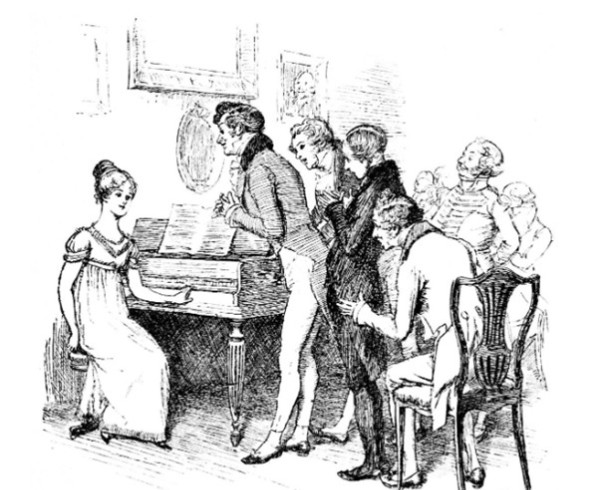
Jane Austen: Pride and Prejudice, Elizabeth at the piano, illustration by George Allen, 1894, chapter 6
In the party in Chapter 6, Elizabeth Bennet performs at the keyboard and Jane takes care to differentiate their performances: Elizabeth’s was ‘pleasing’ but came for more praise than Mary’s, which was too show-off.
[Elizabeth’s] performance was pleasing, though by no means capital. After a song or two, and before she could reply to the entreaties of several that she would sing again, she was eagerly succeeded at the instrument by her sister Mary, who having, in consequence of being the only plain one in the family, worked hard for knowledge and accomplishments, was always impatient for display.
Mary had neither genius nor taste; and though vanity had given her application, it had given her likewise a pedantic air and conceited manner, which would have injured a higher degree of excellence than she had reached. Elizabeth, easy and unaffected, had been listened to with much more pleasure, though not playing half so well
This clearly is a commentary by one who has suffered much at amateur hands at the piano!
For more of the best in classical music, sign up for our E-Newsletter