A march, in its most simple definition, is a musical work with a strong rhythmic beat designed to keep soldiers in step. Outside of that very bald declaration, there’s a world of march music. The usual form of a march moves at 120 beats per minute (think 120 steps a minute and you’ll easily achieve your daily 10,000!), and has contrasting sections, with the third section referred to as the trio. Melodies and counter-melodies all have their place and do much to enliven the necessary repetition of the work.
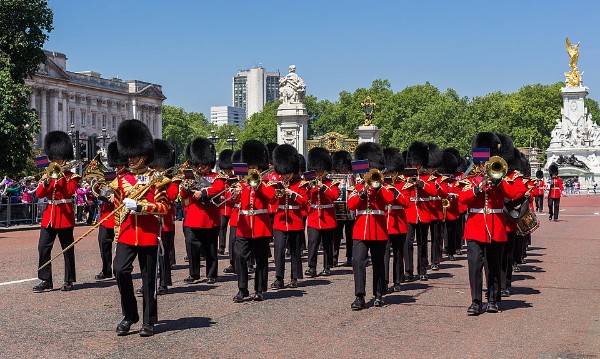
The Band of the Welsh Guards of the British Army (photo by Diliff)
For Americans, when you ask about march music, the first name that will come to mind is that of John Philip Sousa (1854–1932), who had the moniker of The March King. With the fame of British composer Kenneth Alford (1881–1945), Sousa’s nickname was changed to that of the American March King while Alford became the British March King.
Each had military connections. Sousa was director of the United States Marine Band from 1880 to 1892 before leaving the service to form his own band. Alford was both a bandmaster in the British Army and director of music for the Royal Marines.
Sousa’s famous works, still heard today, include The Stars and Stripes Forever, Semper Fidelis (official march of the United States Marine Corps), The Liberty Bell (famed through its use in the opening music for Monty Python’s Flying Circus), The Thunderer, and The Washington Post. We will ignore the work of Sousa (although we know he’s the greatest march composer of his time) and will look at march composers in other countries.
Alford’s most famous work, the Colonel Bogey March, was written in 1914, gained its fame through film, appearing in Alfred Hitchcock’s The Lady Vanishes in 1938 and then, most memorably, in David Lean’s The Bridge on the River Kwai in 1957.
The main melody in the flutes and piccolos is distinctive, and then the counter melody in the lower brass makes it even more interesting.
The name Kenneth J. Alford concealed his real identity as Frederick Joseph Ricketts, who needed to take a pseudonym as commissioned officers were discouraged from engagement in commercial activities. Accordingly, he created a name from his eldest son’s name (Kenneth), his own middle name (Joseph) and his mother’s maiden name (Alford) to live on as Kenneth J. Alford.
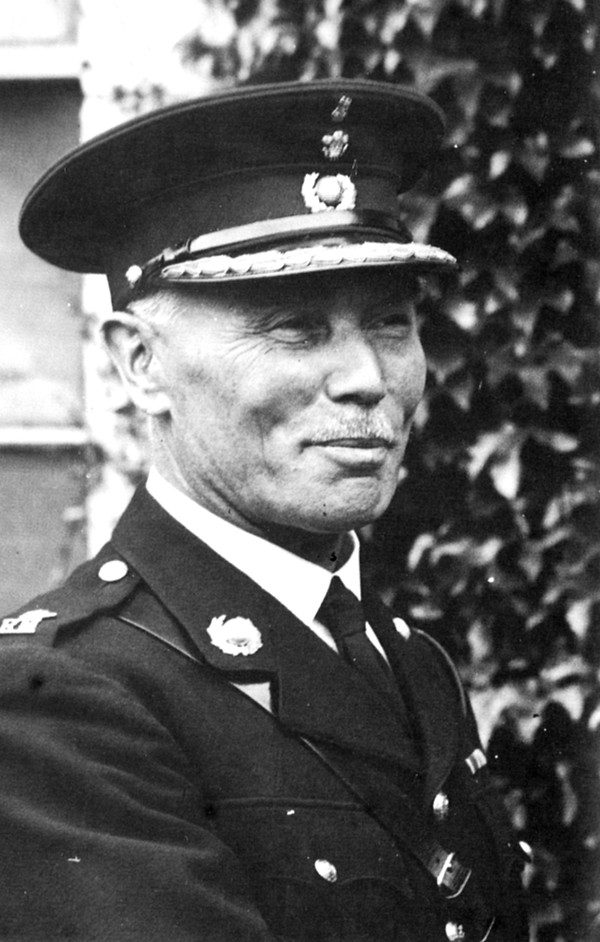
Kenneth J. Alford (Major Frederick Joseph Ricketts) as Director of Music of the Royal Marines
Kenneth J. Alford: Colonel Bogey (15th Field Artillery Band, Ensemble; Richard van Slyke, cond.)
Marches have a curious life: on one hand, they’re intended for military service. Getting the troops to move together is an important role of the military band. It also, however, has a place in civilian life.
Czech composer Julius Fučík, aka the Bohemian Sousa, wrote a military march which has become associated with circuses, i.e., Entry of the Gladiators, composed in 1897.
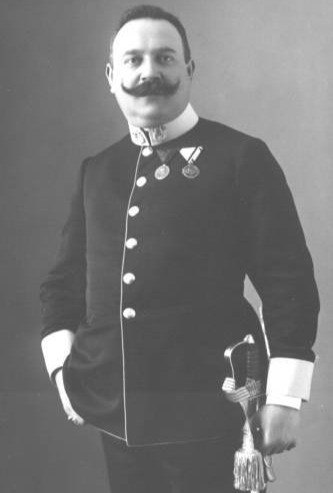
Julius Fučík
Julius Fučík: Einzug der Gladiatoren (The Entry of the Gladiators), Op. 68, “Triumph March” (Czech Philharmonic Orchestra; Václav Neumann, cond.)
In Scotland, where pipes and drums are the heart of the military bands, you will always hear the traditional tune of Scotland the Brave.
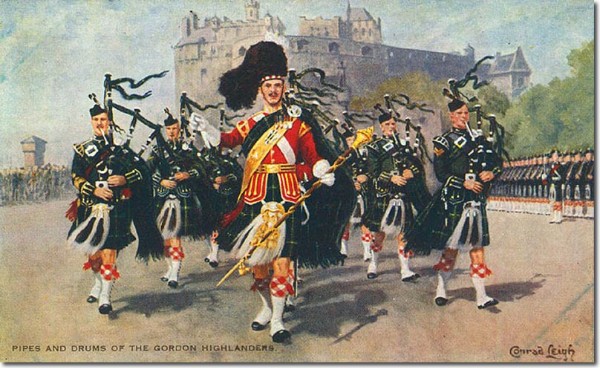
Conrad Leigh: The Pipes and Drums of the Gordon Highlanders, ca 1950
Unknown Composer: Scotland the Brave (The Gordon Highlanders, Ensemble; Douglas Ford, cond.)
The Austrian composer Josef Wagner (1856–1908) composed the march Under the Double Eagle in 1893, referring to the double-headed eagle in the Austrian coat of arms. Wagner was, of course, known as the ‘Austrian March King’. He served as bandmaster to the 29th Infantry Regiment between 1891 and 1899, and dedicated the march to Edmund von Krieghammer, the Imperial Minister of War.
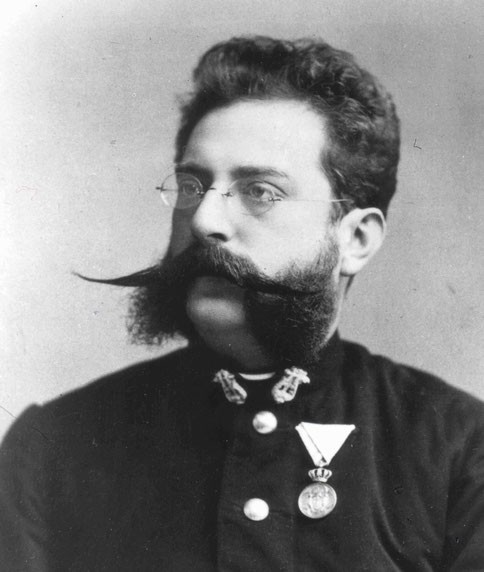
Josef Franz Wagner, before 1908
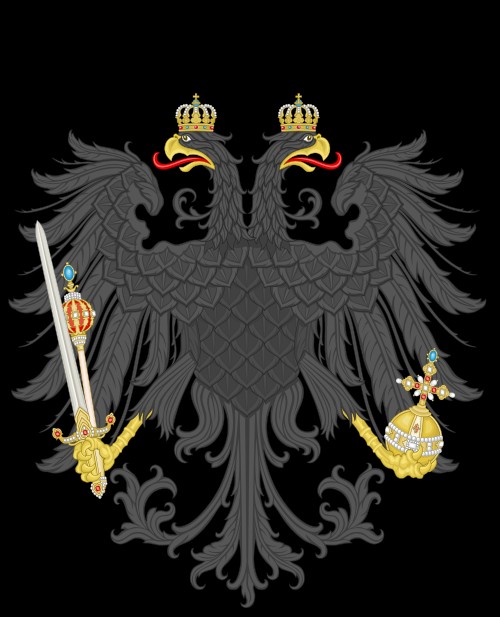
Austrian Double Eagle
Josef Franz Wagner: Unter dem Doppeladler (Under the Double Eagle), Op. 159 (Royal Swedish Airforce Band; Jerker Johansson, cond.)
Belgian composer Pierre Leemans (1897–1980) is best known for Marche des Parachutistes Belges (March of the Belgian Paratroopers, composed during WWII at the request of the Belgian parachute brigade. Leemans composed it overnight after a dinner with the brigade, using themes from earlier works. It’s written in the form of a ‘patrol’, where the music ‘marches on from the distance, plays, and passes’. The work languished after the war and was rediscovered later, rearranged by Col. John R. Bourgeois, who had been 25th director of the United States Marine Band, and it came into band popularity.
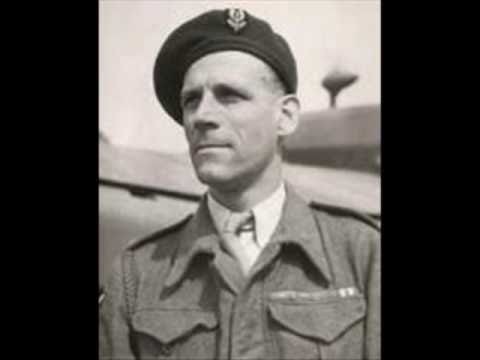
Pierre Leemans
Pierre Leemans: March of the Belgian Parachutists (The President’s Own United States Marine Band, Ensemble; John R. Bourgeois, cond.)
American composer Edwin Eugene Bagley composed the National Emblem March in 1902, and after he couldn’t get the ending right, he tossed the score away. It was rescued by his band and given a new life. He starts with the first 12 notes of the Star-Spangled Banner and then continues on with his own music. Even John Philip Sousa considered this march one of the five best in the world (he chose his own music for numbers 1-4!).
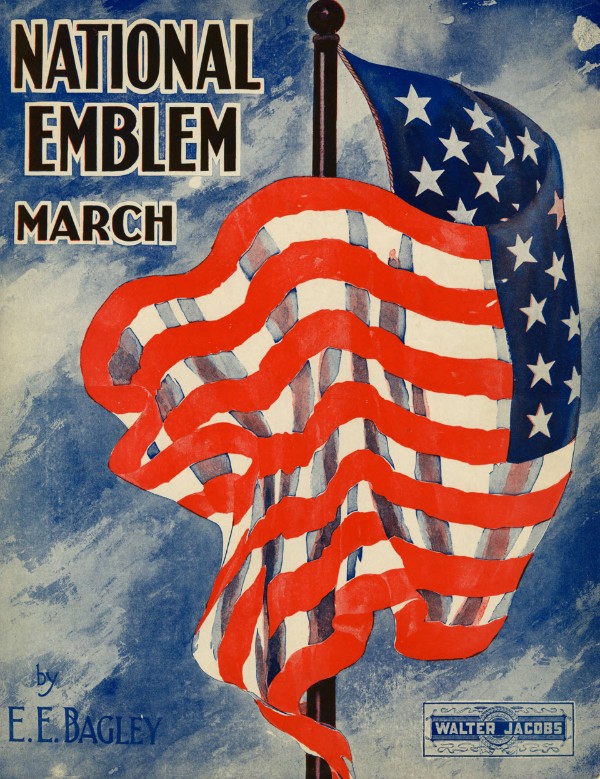
Bagley: National Emblem March sheet music, 1927 (Boston, MA: Walter Jacobs)
Edwin Eugene Bagley: National Emblem (The President’s Own United States Marine Band, Ensemble; Albert F. Schoepper, cond.)
We might be surprised to find a work by Johann Strauss I, the Waltz King, in a list of marches, but his Radetzky March, op. 228, was an important contribution to the march repertoire. He composed it in 1848 to celebrate the victory of the Austrian Empire under Field Marshal Joseph Radetzky von Radetz over the Italians at the Battle of Custoza. Now, in addition to being in the march repertoire, it’s used by the Vienna Philharmonic as a standard encore for their New Year’s Concert.
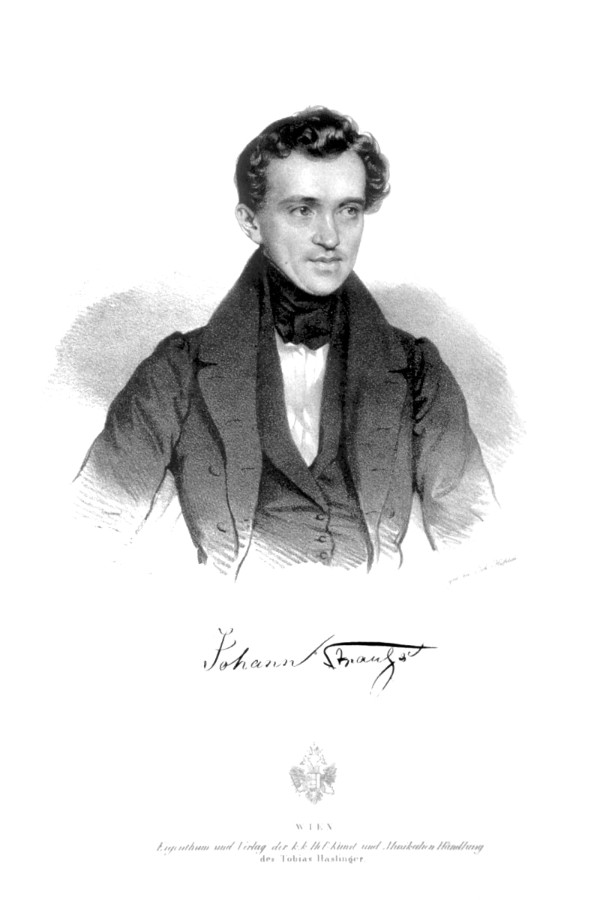
Joseph Kriehuber: Johann Strauss I, 1835
Johann Strauss I: Radetzky March, Op. 228 (Vienna Johann Strauss Orchestra; Johannes Wildner, cond.)
William Walton (1902–1983) wrote his Crown Imperial march in 1937 for the coronation of King George VI in Westminster Abbey. Unlike most marches, its original form was for orchestra. It has been used for the coronation of Queen Elizabeth II in 1953, the wedding of Prince William in 2011, and the coronation of King Charles III in 2023, and on many other state occasions.
The BBC had been looking for a composer to commission for such a work. Elgar’s Pomp and Circumstance marches had been the last coronation set they had commissioned. Elgar was dead, and his successor in English music, Ralph Vaughan Williams, didn’t write music of a style suitable for the occasion. Walton’s name was put forth, and Crown Imperial, originally commissioned for the coronation of Edward VIII, was used for George VI after Edward’s abdication.
Unlike military marches that are designed to move the marchers from Point A to Point B, this orchestral march gives the necessary dignity, grandeur, and ceremony to the occasion, while keeping everyone moving.
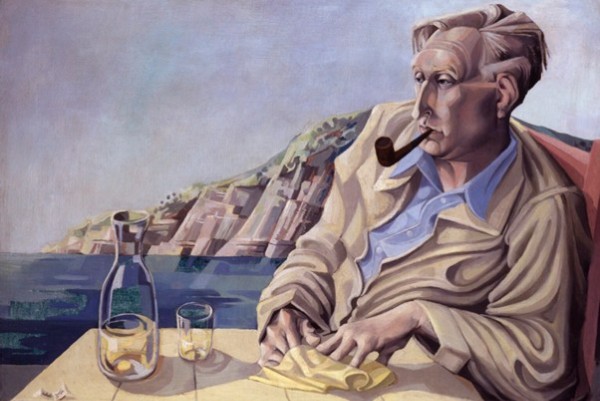
Michael Ayrton: Sir William Turner Walton, 1948 (National Portrait Gallery)
William Walton: Crown Imperial (English Northern Philharmonia; Paul Daniel, cond.)
Henry Fillmore’s Rolling Thunder march of 1916 is a march that is not intended to be marched! This is a circus march that’s intended to get the audience’s excitement back at top pitch in the middle of the show. In the march repertoire, it’s considered a ‘screamer’ and was played as 4-footed animals such as horses or zebras galloped around the ring. This screamer is a test for the trombone section, normally in the shade of the trumpet section!
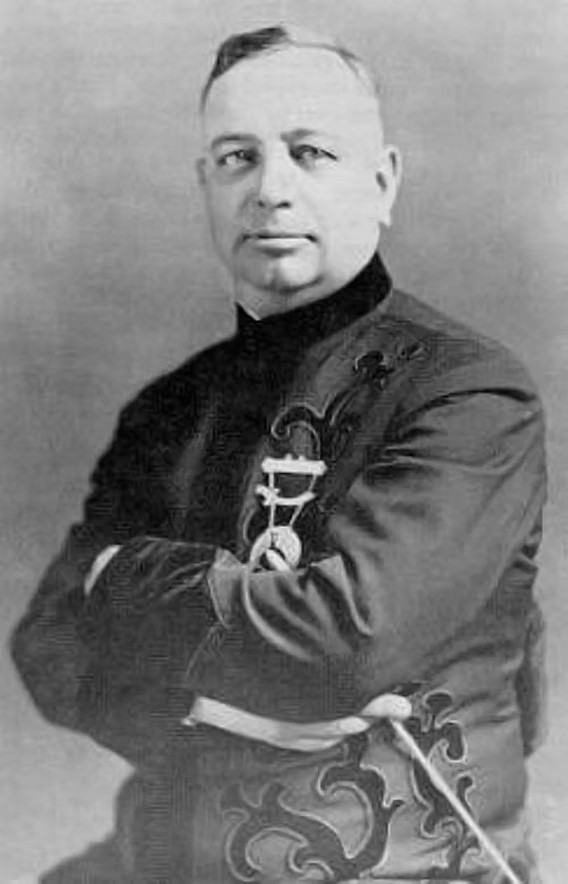
Henry Fillmore as conductor of the Syrian Temple Shrine Band, 1926 (University of Illinois: The Sousa Archives and Center for American Music)
Henry Fillmore: Rolling Thunder March (The President’s Own United States Marine Band, Ensemble; Timothy T. Foley, cond.)
Circus marches, such as the preceding screamer, are normally faster than a regular march, mostly because of the level of energy they’re intended to generate. Another in the screamer category is Karl L. King’s Barnum & Bailey’s Favorite. Written in 1913 for the Barnum and Bailey Circus, the march has become one of the best-known of the circus marches and is frequently called ‘The Granddaddy of Circus Marches’.
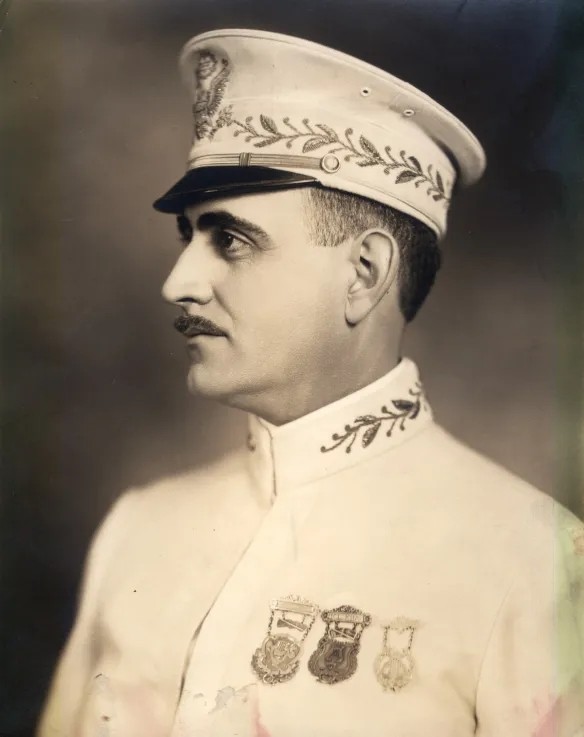
Karl L. King
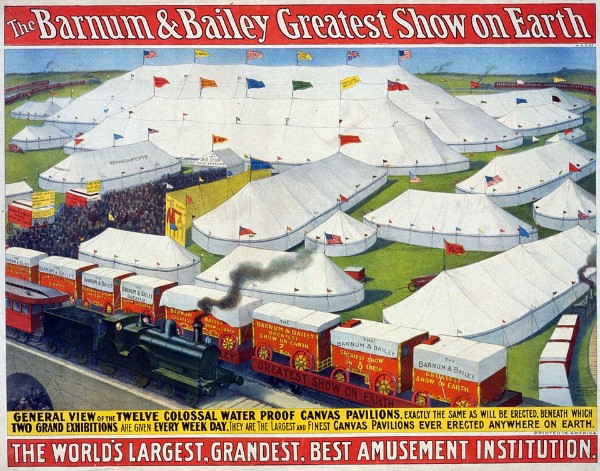
A Barnum & Bailey Greatest Show on Earth poster, 1899
Karl King: Barnum and Bailey’s Favorite (Eastman Wind Ensemble, Ensemble; Frederick Fennell, cond.)
American composer Edwin Franko Goldman (1878–1956) was the leader of the Goldman Band and was one of the most important band composers of the early 20th century. His 1923 march On the Mall remains in the repertoire a century later and was written for the Mall in Central Park, New York. One thing that Goldman did to ensure audience involvement was to include singing sections in his works – in this case, the band sings the trio section and then whistles it on the repeat, when the audience could join in.
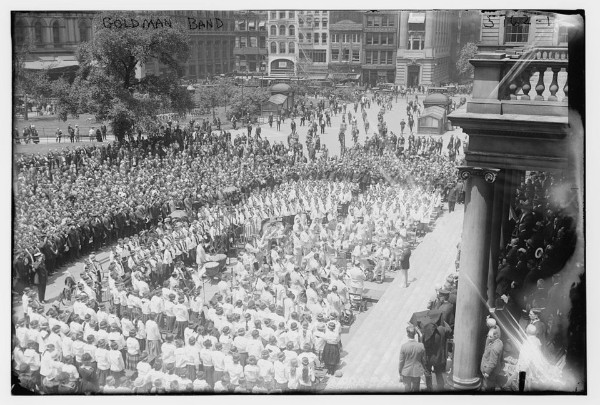
Edwin Franko Goldman leading the Goldman Band in 1922, outside New York’s City Hall (Bain News Service. Library of Congress, https://lccn.loc.gov/2014714574)
Edwin Franko Goldman: On the Mall (United States Army Field Band, Ensemble)
Viktor Widqvist’s Under blågul fana (Beneath the Blue and Yellow Banner) has become the national march of Sweden.
Viktor Widqvist: Under blagul fana (Gothenburg Musicians, Ensemble; Jerker Johansson, cond.)
In French march music, the tempo is quicker (a tempo of 120 was set by Napoleon to get his troops faster). Robert Planquette (1848–1903) composed the march Le regiment de Sambre-et-Meuse in 1873, which was a change from his normal job as composer of operettas and popular songs.
Robert Planquette: Le regiment de Sambre-et-Meuse (Royal Swedish Airforce Band; Jerker Johansson, cond.)
In Greece, the marches have a double purpose. Most of the famous ones are also set with words that are taught in schools. You can march, and you can sing!
Μακεδονία Ξακουστή (Famous Macedonia) was created from a traditional Macedonian dance, and this dual structure of a dance and a march reinforces the rhythmic structure. The work has become the national song of the Macedonian region.
“Μακεδονία Ξακουστή” (Famous Macedonia)
The Italian sharpshooter regiments, known as the bersaglieri, were created in 1836 and can be recognised by their wide-brimmed hats trimmed with draping feathers. Even when they moved from hats that protected them from sabre blows to steel helmets, they retained their distinctive feathers.
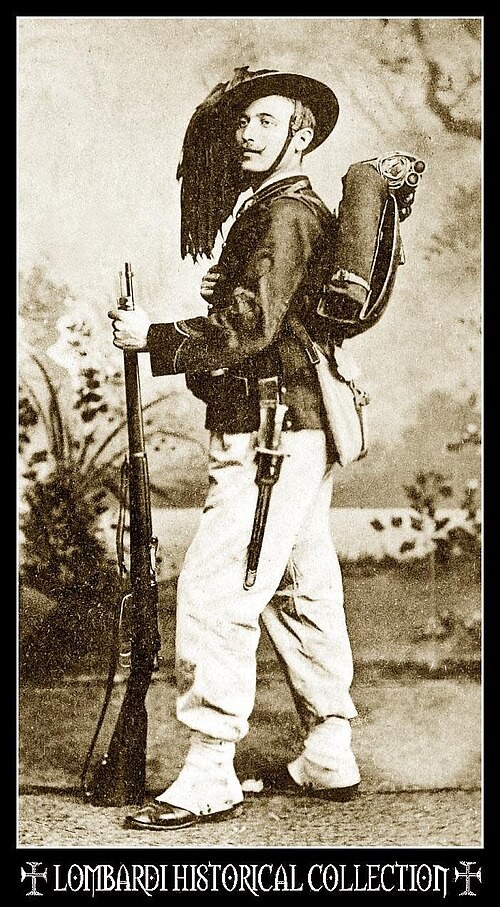
Bersaglieri, 1900
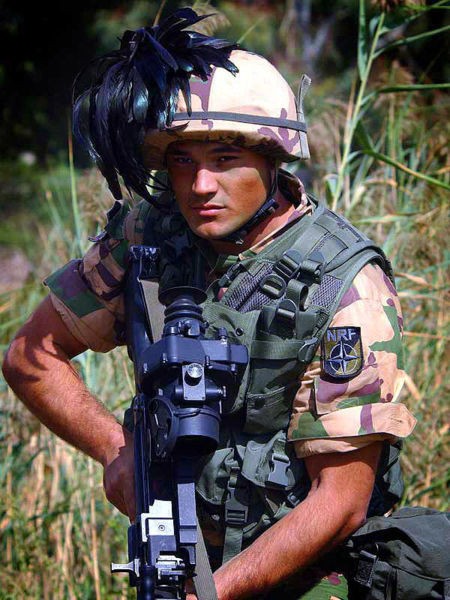
A Bersagliere of the NATO Response Force, 2008
Although the first music written for them is in a standard march tempo. Their role as shock troops makes them move in double-time, with the music to match. All marches are done at a run.
Eduardo Boccalari: Il Bersagliere (The Italian Rifleman) (National Concert Band of America, Ensemble; Edmond E. DeMattia, cond.)
Fanfara Bersaglieri – “Passo di corsa”
The last march we haven’t covered are those for the end of a life, a funeral march. These are generally in a minor key, and in a very slow tempo. Some examples are the third movement of Chopin’s Piano Sonata No. 2, and Handel’s Dead March from his oratorio Saul.
George Frideric Handel: Saul, HWV 53, Act III: Dead March (The English Concert; Trevor Pinnock, cond.)
Beethoven included the funeral march in his Symphony No. 3 and, in doing so, created the great heroic funeral march.
Ludwig van Beethoven: Symphony No. 3 in E-Flat Major, Op. 55, “Eroica” – II. Marcia funebre: Adagio assai (Vienna Philharmonic Orchestra; Claudio Abbado, cond.)
Liszt, Mahler, and Shostakovich have all written great works in the symphonic funeral march, but we will close with something lighter.
Charles-François Gounod: Marche funebre d’une marionnette (Funeral March of a Marionette) (BBC Philharmonic Orchestra; Yan Pascal Tortelier, cond.)
Marches keep you moving from here to there or from here to the great beyond.
For more of the best in classical music, sign up for our E-Newsletter