We don’t hear much about them, but there were many women pianists and composers active during the time of Beethoven and Chopin.
One of these forgotten pianists was an extraordinary child prodigy named Leopoldine Blahetka, who performed Beethoven’s second piano concerto in Vienna in 1819, when she was just ten.
She went on to charm Frédéric Chopin by offering him manuscripts of her compositions.
Today, we’re looking at the life of Leopoldine Blahetka, described by Chopin as “the first pianist of Vienna.”
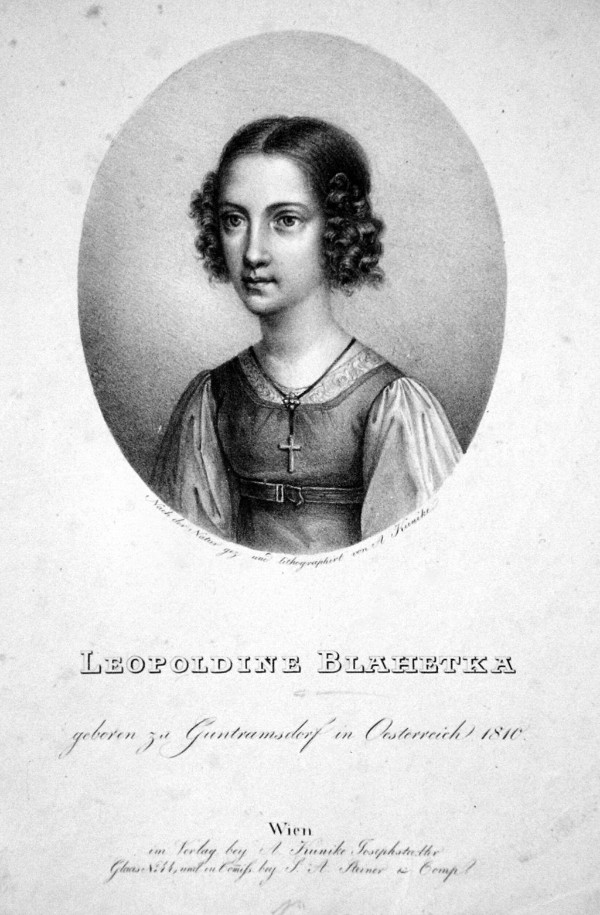
Leopoldine Blahetka
Leopoldine Blahetka’s Family
Marie Leopoldine Blahetka was baptised on 16 November 1809. She was born in the town of Guntramsdorf, twenty kilometers southwest of Vienna.
Her father, George, was a teacher and paper factory inspector, as well as an amateur musician and music journalist. He was also a friend of Ludwig van Beethoven.
Her mother, Barbara, was a piano teacher and glass harmonica player. (The glass harmonica was a musical instrument invented in the 1760s by Benjamin Franklin, and it enjoyed a surge of popularity around the turn of the century in Vienna.)
Barbara also came from a musical family. She was the daughter of composer Andreas Traeg and the niece of music publisher Johann Traeg.
When Leopoldine was young, the Blahetkas moved to Vienna so that George could take a job at Johann Traeg’s publishing house.
The Blahetkas may also have been thinking about being nearer to the teachers and musical life of Vienna.
Leopoldine Blahetka’s Star-Studded Childhood
Leopoldine began her music studies with her mother, but she quickly learned everything her mother had to teach.
She studied with a number of the greatest pianists of the day, including Friedrich Kalkbrenner, Ignaz Moscheles, and Catherina Cibbini-Kozeluch, a woman pianist who herself had studied with Italian composer Muzio Clementi.
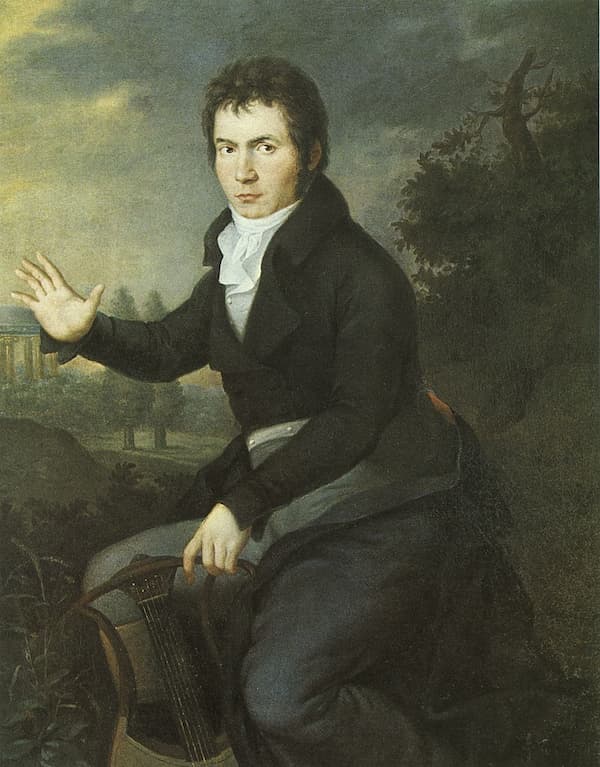
Joseph Willibrord Mähler: Ludwig van Beethoven, ca 1804–1805 (Vienna Museum)
On Beethoven’s recommendation, the family also hired Joseph Czerny (no relation to Carl Czerny). Beethoven had recently hired Joseph Czerny to teach his nephew Karl.
George would later write a biographical sketch of his daughter. In it, he claimed that Beethoven told Leopoldine to only play Mozart for an entire year. The result, he claimed, was that she played all of Mozart’s keyboard music.
According to George, Beethoven also worked with her to hone her improvisation skills.
Beethoven continued to follow Leopoldine’s career until his death. When Beethoven died in 1827, George was a torchbearer at his funeral.
Leopoldine Blahetka: Polonaise op. 19
Leopoldine Blahetka’s Viennese Debuts and Connections With Schubert
Leopoldine appeared in public for the first time in March 1818, when she was eight years old, on the same program as violinist Eduard Jaell. It also happened to be the program during which Franz Schubert’s second Overture in the Italian Style, D591, was premiered.
From that moment on, she became well-known in Schubert’s social circle.
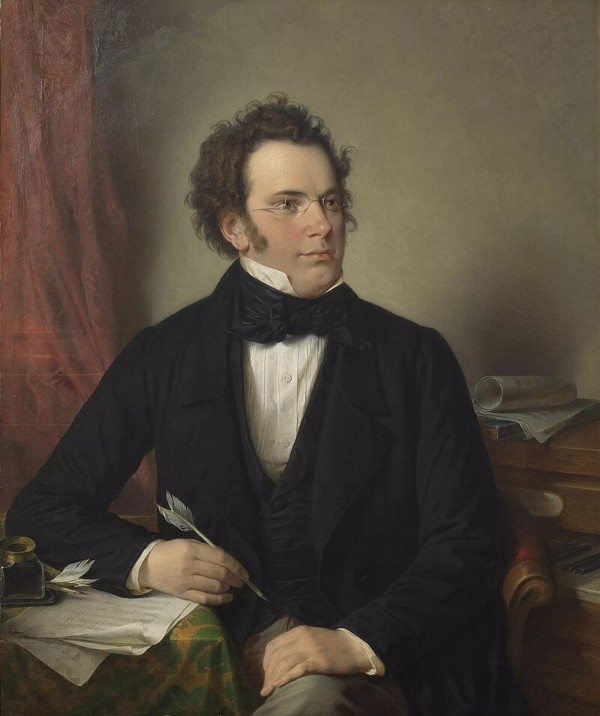
Wilhelm August Reider: Franz Schubert, 1875 after a 1825 watercolour (Vienna Museum)
An October 1818 letter addressed to Schubert and written by a mutual friend has survived.
The letter reads, in part, “Mr. von Blahetka, whom you probably know from hearing him or from his little daughter’s playing, asks you very much to compose a rondo brilliant for his daughter, or whatever it may be.”
Schubert didn’t agree to the commission – perhaps he wasn’t interested in writing for a precocious little girl pianist – but it’s interesting to note that it was assumed Schubert would remember and respect her playing.
The following spring, in March 1819, Leopoldine gave her first solo concert in Vienna.
The Vienna Allgemeine musikalische Zeitung (the “General Musical Newspaper”) praised “her skill, which was wonderful for her age, [and] the clarity with which she played the most difficult passages.”
Leopoldine Blahetka Plays a Beethoven Concerto
Ludwig van Beethoven: Piano Concerto No. 2
In April 1820, at the age of ten and a half, she made her concerto debut in Beethoven’s second piano concerto.
It was an astonishing choice, given that many audience members questioned if women were incapable of intelligently interpreting Beethoven…let alone little girls.
She played all three movements: a practice that wasn’t always followed by musicians of the day. Audiences of the era often preferred to hear excerpts from concertos, alongside shorter, lighter, more outwardly virtuosic works.
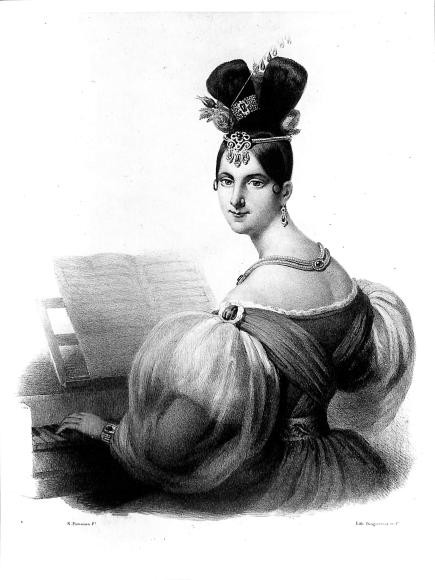
Leopoldine Blahetka
Beethoven attended the concert, but his conversation books (the books that he carried around to communicate in writing due to his deafness) suggest that he remained in the vestibule during the performance itself.
A friend reported in the conversation books that the hall was “very full.”
Joseph Czerny, her teacher, wrote to Beethoven in the book after the performance, “Your Concerto went very well, and very much pleased [the audience].”
Then, interestingly, he noted, “She is too rapturous… I have begun to fear for her sanity.”
It’s a potential glimpse into Leopoldine’s state of mind during this time.
On the other hand, Czerny was on the brink of being sacked by the Blahetka family, and he may have been badmouthing his soon-to-be former student. Czerny also complained to Beethoven that her father didn’t thank him for all he’d done.
Shortly afterwards, Blahetka came to chat with Beethoven, too. He brushed off Czerny’s annoyance: “Czerny is wild with rage. He is losing his finest and most beautiful student!” he wrote to Beethoven in the conversation book. The Blahetkas were sending their wunderkind to another teacher.
Blahetka flattered Beethoven: “How your Concerto in B-flat major has elevated my little one!” He also pointed out, “My little girl also writes without a piano.”
Leopoldine Blahetka Starts Touring
In 1821, the year she turned twelve, Leopoldine and her mother embarked on her first tour of Europe. To stand out from the crowd, Leopoldine began playing the glass harmonica, too.
Around this time, she also began performing her own compositions. She would go on to study composition with Simon Sechter, nowadays famous for being Anton Bruckner’s teacher.
She went on an even longer tour during the 1825/26 season, when she was sixteen. During this tour, she continued to make a major impression.
In Frankfurt, a critic hailed her as “an extraordinary piano player” with a solid technique and “an excellent pearly touch.”
Robert Schumann reviewed one of her performances, calling it “truly feminine, delicate, thoughtful and well-crafted.”
Even after she crossed the line from child prodigy to mature woman artist, she continued appearing on the stage. In 1828, the year she turned nineteen, she appeared at a Viennese charity concert with Niccolò Paganini.
Leopoldine Blahetka: Variations for Flute and Piano, op.39
Meeting Chopin
In the summer of 1829, her path crossed with Chopin’s.
Chopin was nineteen years old and had just traveled from Warsaw to Vienna. A figure named “Blahetka” (likely Leopoldine’s father) encouraged Chopin to give a concert in Vienna, although he hadn’t been expecting to do so.
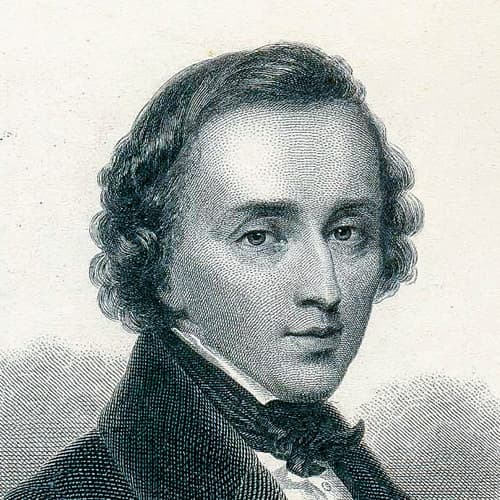
Frédéric Chopin
“Blahetka says that I shall cause a furore, that I’m a virtuoso of the first rank, that I count with Moscheles, Hertz and Kalkbrenner,” Chopin reported to his family. Chopin did indeed play two well-received concerts in Vienna.
Upon his departure, Leopoldine “gave me her compositions with an autograph inscription for a keepsake and her father told me to embrace my Papa and Mamma and congratulate them on such a son.”
He wrote more details to his best friend Tytus Woyciechowski a couple of weeks later:
[Prince Lichnowski] thought [my playing] was too weak in tone; but that is my way of playing, which, again, delights the ladies, and especially Blahetka’s daughter, who is the first pianist of Vienna. She must like me (nota bene, she is not 20 yet; living at home; a clever and even pretty girl); she gave me her own compositions with an autograph inscription, for a keepsake, when I left.
He was still thinking of her in October when he wrote to Tytus:
I am sure that you will see that I must go back to Vienna, but it is not for Panna Blahetka, of whom I think I wrote to you. She is young, pretty and a pianist; but I, perhaps unfortunately, already have my own ideal, which I have served faithfully, though silently, for half a year…
(The “ideal” in question is widely interpreted as relating to his love of – or crush on – Polish singer Konstancja Gładkowska.)
When Chopin returned to Vienna in December 1830 with Tytus, he was disappointed to hear that Leopoldine was gone:
Just imagine, Fraulein Blahetka is in Stuttgart with her parents; perhaps they will return for the winter.
Two waltzes by Leopoldine Blahetka
Leopoldine Blahetka’s Final Tours
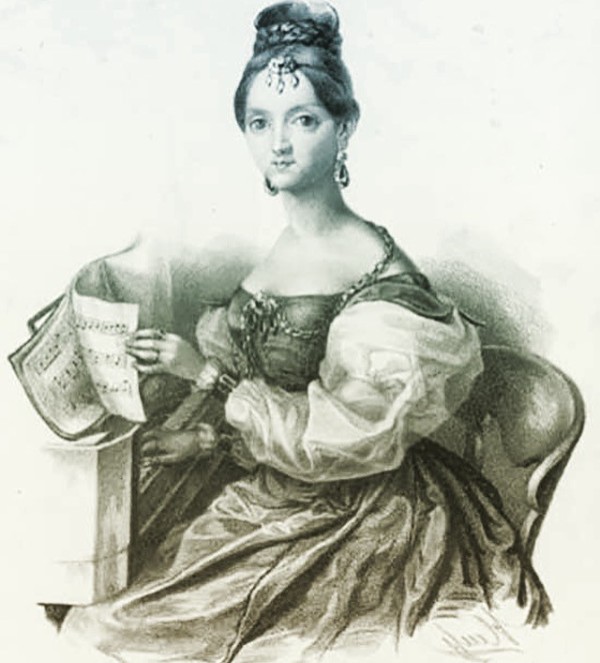
Leopoldine Blahetka
In 1830, she concertized across Austria and Italy, then traveled through Germany and Holland to London.
During her stop at The Hague, she composed a potpourri of piano themes, including two Dutch songs. The audience was thrilled.
After her appearance in London in 1832, she arrived at Boulogne-sur-mer, a charming resort town thirty-five kilometers southwest of Calais and the Strait of Dover.
Apparently, her father had some kind of health crisis there. But she and her family liked the town, and they decided to settle down there. From that point on, she devoted herself to teaching and especially composing.
That said, she still appears to have kept up with the careers of her colleagues, especially those who were women.
In 1839, she wrote a Grand Duo in F-sharp minor for piano four-hands, and dedicated it to Clara Wieck (soon to become Clara Schumann).
She also dedicated works to various noblewomen.
Leopoldine gave fewer tours during this time, but we do know that she returned to Vienna in 1845. Further research may uncover other appearances.
Her father died in 1857 and her mother in 1864. Leopoldine never married and died in 1885 in Boulogne-sur-Mer. Today, despite her brushes with many of the greatest musicians of the nineteenth century, she is almost entirely forgotten.
For more of the best in classical music, sign up for our E-Newsletter